Orbea reveals some of the secrets behind the new Oiz and how it made it faster: “We can’t replicate race conditions in a lab”
How does a bicycle capable of winning the MTB World Cup develop? Orbea has just released a video showing the work behind the new Oiz, from the first engineering tests to its victory in Leogang with Simon Andreassen. A process that includes striking decisions such as choosing a heavier frame because it offered better results.
"We cannot reproduce race conditions in a laboratory": this is how Orbea developed the new Oiz with OOLab, from the first prototypes to winning in the World Cup
The new Orbea Oiz 2027 was presented with a completely renewed frame, significantly higher stiffness than the previous generation, and small geometry adjustments. We already reviewed all its news, setups, and prices during its official presentation, but now the brand wanted to show how it reached that result.
With the video From Factory to Leogang, Orbea explains how its engineers and the riders of the Orbea FOX Factory Team worked together to develop the bicycle. Simon Andreassen is one of the protagonists of a story that ends with his victory in the Short Track of the World Cup in Leogang, just a few days after presenting the new model.
OOLab, the program with which Orbea seeks to go beyond conventional development
RECOMENDADO
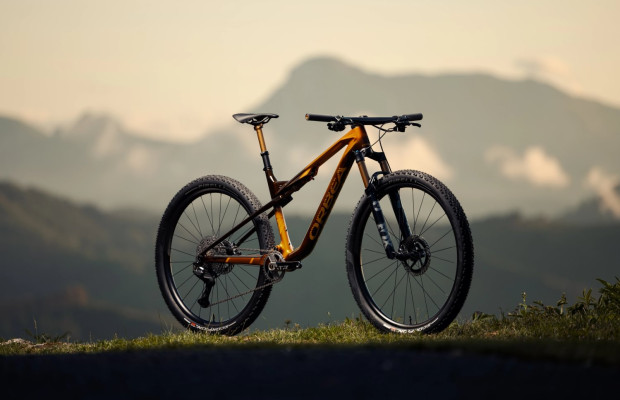
New Orbea Oiz 2027: stiffer, faster, and ready for modern XC
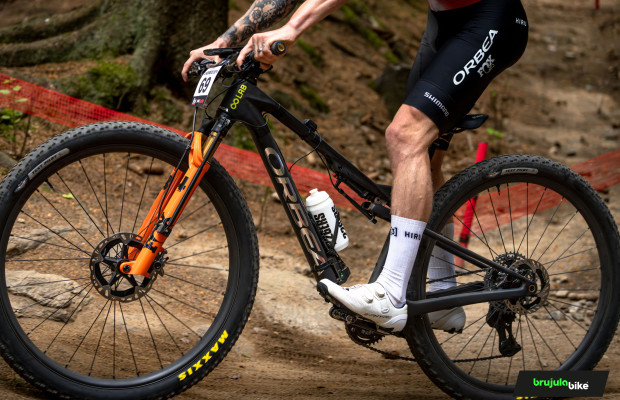
New Orbea Oiz 2027? We spotted a prototype in Nové Mesto, and it points to a radical change in the brand's XC full suspension
How much does it cost to charge an e-bike in Spain? Much less than you think
BMC finalises its XCO World Cup team, backing women’s cycling and gravel
Visma rules out a return for Primož Roglič and changes its plans to complete its 2027 roster
Alan Hatherly extends his Jayco AlUla deal until 2028 and remains determined to return to the top of MTB
OOLab stands for Orbea Optimization Lab, although it is not a physical laboratory. It is a development methodology that allows the brand to explore new solutions without the usual limitations of a commercial project. Some ideas are discarded, others help to better understand the behavior of the bicycle, and the most promising end up going into production.

The previous Oiz, presented in 2022, had already marked an important evolution by adopting 120 mm of travel across the entire range. Four years later, Orbea decided to maintain that concept and focus its efforts on improving structural behavior, efficiency, and handling precision.
One of the main objectives was to increase stiffness without adding unnecessary weight. However, an excessively stiff structure can also harm traction and increase rider fatigue. Finding the right balance became one of the keys to the project.
The riders chose a frame that weighed almost 50 grams more
During development, engineers used finite element analysis (FEA) simulations to analyze how different parts of the frame responded to pedaling forces, impacts, and lateral loads. They then manufactured several prototypes with different carbon layups.
The riders of the Orbea FOX Factory Team tested those versions without knowing exactly which configuration they were using. And the result was particularly revealing.

Repeatedly, the riders preferred a frame whose layup weighed almost 50 grams more than that of the ultralight alternative.
The lighter bicycle was not the one that provided the best sensations when pushed to the limit. That conclusion summarizes much of the philosophy of OOLab: laboratory figures must be contrasted with real-world performance.
The final result, according to Orbea, is a frame with 36% more overall stiffness and a rear triangle that is 22% stiffer than the previous OMX generation, maintaining a declared weight of 1,700 grams for the OMX frame in size M with shock.
To achieve this, engineers reviewed how the different structures interacted. The new forged aluminum miniblink is more compact and weighs approximately 30% less. The seat stay bridge has been integrated in front of the seat tube to improve torsional resistance, while the top tube incorporates structural fins that increase its stiffness.

A new Pinch-Bolt fastening system also appears at the main pivot, designed to reduce stress on the bearings and improve suspension alignment.
The carbon layup also received special attention. Orbea modified certain frame shapes to promote a more uniform compaction of the fibers and reduce resin accumulations, thus optimizing the weight-to-stiffness ratio.
Adjustable prototypes and tests in the World Cup
Geometry was another area where the riders had direct participation. Orbea manufactured adjustable aluminum prototypes that allowed for comparing different configurations on the ground. One of the clearest conclusions was that, regardless of size, the riders preferred the shortest possible chainstays.
The engineers managed to shorten them by another 2 mm, going from 432 to 430 mm. The head angle was also slightly increased, from 67° to 66.8°, seeking greater confidence in descents without sacrificing agility.

The new Oiz maintains its 120 mm of rear travel, with kinematics developed alongside FOX that combines a high initial support to improve pedaling efficiency with a more sensitive response as the travel progresses.
The final phases of development took the practically definitive prototypes to the World Cup in Nové Město na Moravě, where the riders competed with bicycles camouflaged under discreet OOLab decoration.
Shortly after came the official presentation, and just a few days later, Simon Andreassen achieved the first international victory of the new Oiz in Leogang, winning the Short Track of the World Cup.

That is precisely the journey shown in From Factory to Leogang, from the first engineering decisions to seeing the bicycle win at the highest level.

From the most technical XCO to conquering the XCM World Cup with David Valero
Although the video ends with Andreassen's victory, the subsequent results of the new Oiz allow for a better understanding of the scope of its development.
The XCO World Cup represents one of the most technical scenarios in current MTB, with circuits that demand a combination of acceleration capability, precision, and absorption. The XCC takes those demands to explosive efforts of just 20 minutes.
But the season has also shown that the new platform can perform in much longer tests.
David Valero has had an extraordinary year with the Klimatiza Orbea Team, conquering the overall title of the XCM World Cup 2026 with three victories and two other podiums.
Among his victories stands out the HERO Dolomites, where, according to Orbea, he achieved the first victory of a dual suspension in the history of the race. He also won La Tramun, securing the title of the XCM World Cup after more than four and a half hours of competition on one of the most technical routes on the calendar.
To those results is added the XCM European Championship 2026 that he won in Ramales de la Victoria, over a course of 74 kilometers and 3,000 meters of positive elevation.
Few comparisons better show the versatility of a bicycle than facing the demands of a Short Track with those of a marathon lasting more than four hours. In the former, the immediate response to accelerations is decisive. In the latter, efficiency, traction, and absorption capacity must be maintained for hours.
The new Oiz has proven to be competitive at both extremes, in addition to being designed to tackle the most demanding XCO circuits.
And that is probably the best conclusion of the work of OOLab. Orbea was not simply looking to manufacture a lighter or stiffer bicycle, but to find the balance that would make it faster in competition. The results of 2026 are the best sporting endorsement that this approach could receive.
The complete process can be seen in the video From Factory to Leogang and in the technical publication from Orbea about the development of the new Oiz.
También puede interesarte
Mountain bike
New Orbea Oiz 2027: stiffer, faster, and ready for modern XC
Mountain bike
New Orbea Oiz 2027? We spotted a prototype in Nové Mesto, and it points to a radical change in the brand's XC full suspension
eBike
How much does it cost to charge an e-bike in Spain? Much less than you think
Mountain bike
BMC finalises its XCO World Cup team, backing women’s cycling and gravel
Road
Visma rules out a return for Primož Roglič and changes its plans to complete its 2027 roster
Road
