What will happen to 29-inch MTBs when 32-inch bikes arrive?
In 2026, 32" bikes have already won races, reached the podium of the World Cup, and even conquered a World Championship. After what we've seen throughout the season and especially after the last major European fairs, the question now is what will brands do with their current 29" MTBs?
Transitioning from 29" to 32" is more complicated than it seems and has already happened
The recent fairs in Misano and Sea Otter Europe are a good thermometer to try to answer that. The Italian Bike Festival brought together more than 600 brands at the Misano circuit in early September, while Girona once again concentrated a good part of the main players in the sector a few days later.
And after touring the stands, seeing what manufacturers are showcasing, and talking to some of their representatives, the feeling is quite clear: the sector is now only thinking about 32".
But if from the outside we could imagine the bicycle sector as a flock of birds in the sky where one turns, and almost automatically, all change direction at the same time. The reality is much less coordinated.
RECOMENDADO
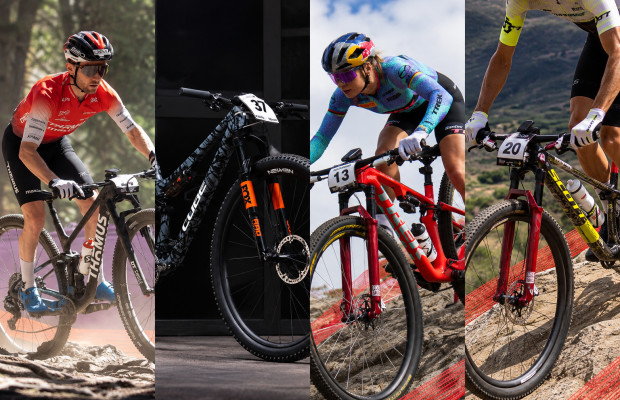
Soldier Hollow will be the ultimate test for 32-inch bikes: all the prototypes we’ll see in the World Cup
How the Mixed Relay works at the Montréal World Championships: favourites, schedule and where to watch
FSA launches its new World Cup wheels: meet the FSA KFX i30
Oakley reinvents prescription cycling glasses with this new technology

Igor Arrieta joins Lidl-Trek through 2029 after his breakthrough 2026 season

“It wasn’t the plan, but my legs were incredible”: even Van der Poel hadn’t planned his historic ride in Luxembourg
In a change like the one proposed to move from 29 to 32 inches, bicycle manufacturers, frames, wheels, tires, suspensions, and components are involved, as well as professional teams, riders, distributors, and, of course, the UCI. Each manages its own timelines, information, and interests, so these movements usually occur in a much clumsier and staggered manner.
Precisely the UCI was one of the first obstacles that 32" had to overcome, and as we already reported, the international body confirmed that it would not prohibit 32" wheels in MTB. The explanation given then by Fabrice Tiano, UCI's communication manager, is that the mountain bike commission has always considered this discipline as a laboratory for cycling and, therefore, maintains few restrictions regarding equipment.
In gravel, however, the situation is still not so clear. As of today, there is no equivalent public stance from the UCI that definitively clarifies the future of 32" in its official competitions, and there is speculation in the sector that the organization may adopt a different position than that of MTB. While that is resolved, manufacturers have been paving their own way for some time.
What advantages do 32" wheels really have?
The reasoning behind 32" is largely the same as that which drove the jump from 26 to 29 inches. By increasing the diameter, the angle at which the wheel encounters an obstacle decreases. Simply put, a rock, a root, or a step are proportionally smaller for a larger wheel. This makes it easier to overcome them and helps maintain speed over rough terrain.
A larger wheel also offers a different contact patch with the ground and can enhance traction and stability, as well as better maintain inertia once launched. In disciplines like XCO, XCM, or gravel, where maintaining speed over uneven areas can be more important than a sudden acceleration, the reasoning makes sense.
But it's not all advantages. A larger wheel complicates geometry, increases the size and potentially the weight of rims and tires, can penalize acceleration, and requires redesigning frames and forks. And there is the problem of making everything work for shorter riders as well.
There seems to be one of the keys. Among manufacturers, there is the idea that 32" could represent approximately the limit to which the diameter can be increased while maintaining a reasonable adaptation to a sufficiently wide range of sizes. It remains to be seen how each brand will address the smaller sizes.
32" no longer have to prove they can win
In 2025, the first serious prototypes began to appear, but it was during 2026 that 32 inches definitively entered competition. The Cape Epic was one of the first major showcases. There, a 32" MTB achieved a stage victory and we also saw how current technologies like the RockShox Flight Attendant began to adapt to the new diameter. Then came the World Cup.
In Lenzerheide, Alessandra Keller made history by competing with the Thömus Lightrider R32 and finishing third in the Short Track. It was the first podium for a 32-inch MTB in a World Cup, and Thömus took advantage of that debut to announce a first limited commercial series of 50 units. Here you can see all the details of this Thömus R32.
The trend continued to Soldier Hollow, where Trek appeared with its long-awaited 32" platform, developed around a RockShox SID fork specifically for this diameter, and Gwendalyn Gibson finished second in the XCO. Here we analyze the 32" Trek that arrived at Soldier Hollow.
But probably the result that has most changed the perception of this technology came at the XCM World Championship. Andreas Seewald just won the rainbow jersey with a KTM Scarp Evo 4 32 Prototype, equipped with 32" DUKE wheels, specific Schwalbe tires, and a prototype FOX fork. Thus, he became the first 32" MTB world champion.
So at this point, we are no longer talking about figuring out if a 32" can compete at the highest level. In gravel, something similar is happening.
The movement is not limited to mountain biking. Over the past few months, we have seen more and more gravel bikes and prototypes prepared for 32 inches. And here too, competition is helping to accelerate development.
The most compelling example came at Unbound Gravel XL. Robin Gemperle won the 563 kilometers of the race on the SCOTT RC Gravel 32, a prototype specifically developed around this diameter. It was the first major international victory for a 32" gravel bike.
The difference compared to MTB is that here there is still one important piece missing: knowing what position the UCI will definitively adopt for its official competitions.
Are we seeing the last 29" MTBs?
Another particularly interesting signal to understand a possible change of cycle is that in 2026 we have witnessed an extraordinary renewal of XCO bikes. Specialized, Canyon, Orbea, Giant, SCOTT, Cube, Trek, and Lapierre have renewed their 29" platforms, and this movement can be understood as brands could be closing the technological cycle of 29" before starting the next one.
The case of Trek is the most curious in this sense, as the brand developed a new 29" dual-suspension bike for its team with 115 mm of rear travel and a completely different architecture from the Supercaliber. However, when presenting it, they made it clear that this competition bike might never reach stores. Months later, we have seen Trek taking the next step with its 32" prototype.
Brands already know what happened with 29"
The first 29" MTBs appeared in 2001, but we can place their definitive implantation in 2016 when Nino Schurter won both the World Championship and the Rio Olympic Games on a SCOTT Spark 29". Approximately 15 years had passed since those first bikes.
During much of that transition, 26, 27.5, and 29 inches coexisted, which multiplied the industry's needs. It was not enough to manufacture different bikes; it was necessary to develop wheels, tires, forks, and a multitude of components for several sizes simultaneously, while stores and distributors had to maintain stock for all of them. It is hard to imagine that the sector wants to repeat a similar scenario for another decade.
Our prediction: 32" will hardly coexist with 29"
And here we deliberately enter the realm of prediction. If the main brands ultimately decide that 32 inches are the next standard for XCO and XCM, our impression after what we've seen and heard during 2026 is that they will not offer two equivalent versions for many years, one 29" and another 32", for the buyer to choose from.
We believe something simpler will happen: the new generations of some models will directly replace the 29" with the 32".
Of course, it will not happen overnight. There will be a transition period, probably of at least a couple of seasons, during which both sizes will coexist. Brands will have newly presented 29" bikes, stores will need to sell their stock, and ranges will not be renewed all at once. Additionally, there will be disciplines, categories, sizes, and types of bikes where 29" could continue to make sense for much longer.
But if the rumors about the arrival of production models during the winter of 2026-2027 come true, the change will have begun.
In the end, the customer will decide, but will only be able to choose from what is offered
The last actor in this story, and probably the most important, is the cyclist who has to buy the bike.
They can accept the 32", reject them, or consider that their current 29" already works well enough. The problem is that the consumer's ability to decide a technological standard depends on the alternatives that manufacturers maintain.
If in a few years the new generation of a bike that today uses 29 inches appears only with 32" wheels, the decision will no longer be exactly between buying that same bike with 29 or 32 inches. It will be between buying the new platform or sticking with the previous generation.

That is why we do not believe that an initial rejection from the public will necessarily be enough to stop the change if the main brands move forward together.
Something similar happened with the 29". There were years of doubts about their weight, acceleration, aesthetics, agility, and performance for shorter riders. Today they are the undisputed standard of XCO and XCM.
The difference is that this time the industry knows that story perfectly and probably does not need another 15 years to repeat it.
The 29" are not going to disappear tomorrow. In fact, current bikes likely represent the peak maturity that this size has reached. But after what we've seen in competition, in Misano, and at Sea Otter Europe, there are more and more signs that we are witnessing the beginning of a new cycle and not simply the emergence of another alternative size.
También puede interesarte
Mountain bike
Soldier Hollow will be the ultimate test for 32-inch bikes: all the prototypes we’ll see in the World Cup
Road
How the Mixed Relay works at the Montréal World Championships: favourites, schedule and where to watch
Mountain bike
FSA launches its new World Cup wheels: meet the FSA KFX i30
Bike Equipment
Oakley reinvents prescription cycling glasses with this new technology
Road
Igor Arrieta joins Lidl-Trek through 2029 after his breakthrough 2026 season
Road
