How photo-finish technology works and why bicycles look distorted
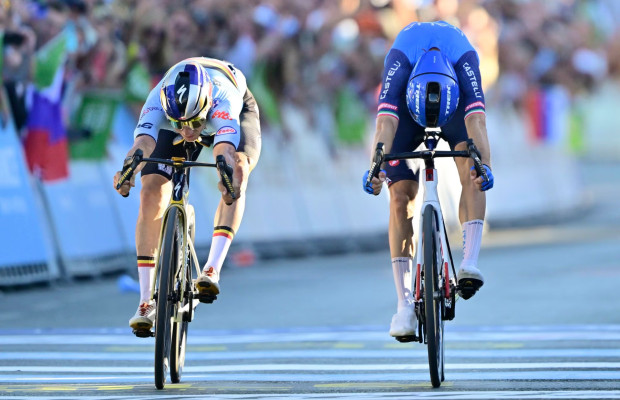
The European Cycling Championship concluded this Sunday with one of those finishes where the human eye is completely useless. Remco Evenepoel and Giulio Ciccone reached the finish line practically at the same time, and it was necessary to resort to the photo finish to determine that the Belgian had crossed first.
The photo finish does not photograph the arrival, it photographs the passage of time
The final image shows a minimal difference between the two, and as often happens with this type of photograph, it also displays some seemingly strange things. The bicycles appear deformed, the wheels are not completely round, and the proportions may seem very different from what we would see in a conventional photograph. The explanation is that a photo finish is not really a normal photograph.
A conventional camera captures an entire scene at a specific moment. A photo finish camera works differently.
The system continuously observes a very narrow vertical line located at the finish line and records what passes through it thousands of times each second. Subsequently, all those small captures are placed next to each other to form the image that we finally see.
RECOMENDADO
Crash, attack and photo-finish victory: Evenepoel wins the European Championships
How to train on the bike when life gets in the way of a fixed training plan
Which workouts do you enjoy most, and what do they reveal about you as a cyclist?
Short on time to train? Here’s how to keep improving on the bike
When to skip training and rest without feeling guilty
Free aero gains for your bike: small changes that make you faster

This completely changes the way we interpret the photograph.
The vertical axis represents the position of each rider across the width of the road, but the horizontal axis represents time, not distance.
Therefore, although it may seem that one bicycle is physically behind another when looking at a photo finish, we are actually seeing different moments of their passage through exactly the same plane. In other words, the photo finish turns time into an image.
Why do the bicycles appear deformed?
This way of recording the finish also explains why the wheels may appear oval, stretched, or with completely deformed spokes. The camera is not freezing a complete bicycle. It builds its image as each of its parts crosses the finish plane.
Moreover, a moving wheel has very different speeds at its various points relative to the ground. The point of the tire that is in contact with the asphalt moves momentarily much slower relative to the road than the top of the wheel.

When combining all of that with a system that records a single line over time, the characteristic deformations of photo finish images appear.
So if in the image of the European Championship it seems that Ciccone's bicycle is shorter or Evenepoel's is longer, it has nothing to do with their actual dimensions. It is a consequence of how the image is constructed and the speed at which each element crosses the line.
What are the cameras that take the photo finish like?
To determine the winner, it does not matter who has their head, hands, or handlebars further ahead. In cycling, the reference for establishing the order of arrival is the foremost part of the front wheel at the moment it reaches the vertical plane of the finish line.
That is precisely what the judges had to observe in the very tight finish between Evenepoel and Ciccone.

Modern photo finish systems can perform thousands of readings of the finish line each second. The ones used by Tissot in major cycling competitions can reach 10,000 readings per second, that is, one every 0.0001 seconds — a ten-thousandth of a second. At 60 km/h, a bicycle moves just 1.67 millimeters during that interval, a precision far superior to that offered by a conventional television camera.
That is why a finish that appears to be a tie on television can be resolved by a tiny difference when analyzing the specific image of the photo finish.
The paradox of the photo finish is that the image may seem completely deformed to us and, at the same time, be much more useful for determining the winner than a perfectly sharp conventional photograph.
También puede interesarte
Road
Crash, attack and photo-finish victory: Evenepoel wins the European Championships
Training
How to train on the bike when life gets in the way of a fixed training plan
Training
Which workouts do you enjoy most, and what do they reveal about you as a cyclist?
Training
Short on time to train? Here’s how to keep improving on the bike
Training
When to skip training and rest without feeling guilty
Road
