Evenepoel has something his rivals can’t replicate that makes him almost unbeatable against the clock
There are cyclists capable of producing more watts than Remco Evenepoel and specialists with a physique seemingly more suited to moving large gears over dozens of kilometers. But few, perhaps none currently, manage to transform their power into speed as effectively. Part of the explanation lies in an anatomy particularly favorable for adopting an extreme position on the time trial bike.
The small triangle that makes Evenepoel a "bullet"
The French newspaper L’Équipe analyzed with several specialists what is particular about Evenepoel's physique and why it is so difficult to compete against him in a time trial. The conclusion particularly points to the upper part of his body and his ability to minimize the space between his hands, head, and shoulders.

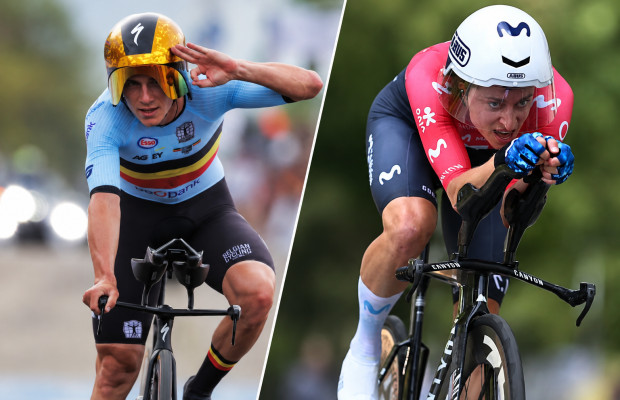
One of the most characteristic images of Evenepoel on his time trial bike is of his hands practically glued to his head, with his shoulders closed and his face hidden between his arms. This is not just a position developed over years of aerodynamic work. His own anatomy makes it easier to achieve.
RECOMENDADO
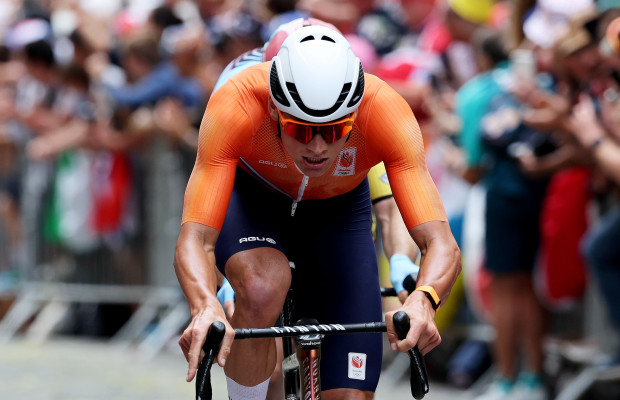
The Montréal World Championships move on to the road races: dates, schedule and TV
The 2026 Cycling World Championships begin today and Evenepoel could make history: time trial schedule, route and favourites
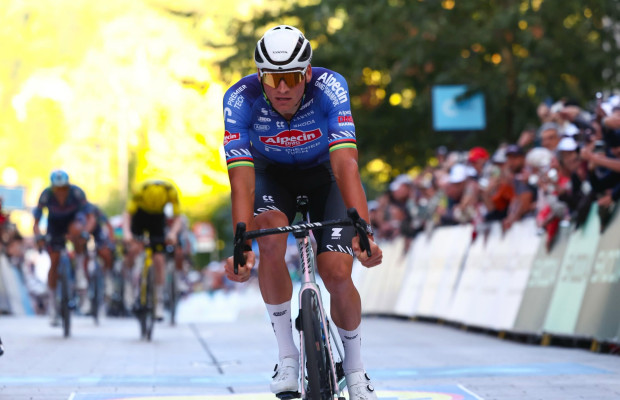
Van der Poel arrives at the World Championships two kilos lighter but warns: “It will be a little difficult for me”
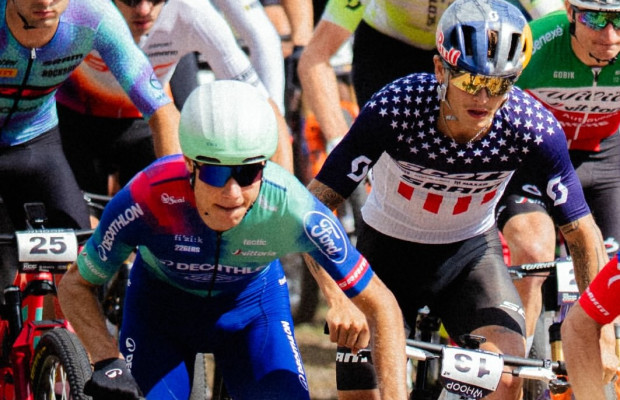
The Soldier Hollow XCO World Cup is tonight: schedule, favourites and where to watch for free
Valero battles for the 2026 XCM World Cup at “the most technical race in the world”: schedule, key points and where to watch
What do the colours of the rainbow jersey mean, and who was the first World Champion?
Thijs Hertsens, the Belgian's physiotherapist, explains in the analysis published by L’Équipe that Evenepoel has relatively short arms. This allows him to stay very compact on the extensions and form an extraordinarily small triangle between his hands, shoulders, and head.
Rémí Cavagna, a time trial specialist and former teammate of Evenepoel, focuses precisely on that area. The goal is to close the position as much as possible and bring the hands closer to the helmet to reduce aerodynamic drag. This is complemented by the Belgian's ability to tuck his shoulders and hide his head without excessively compromising his view of the road.
This is a particularly important advantage at the speeds of a time trial. As speed increases, overcoming aerodynamic resistance consumes a huge part of the available power. Therefore, it is not enough to produce many watts. They must be converted into speed while losing as little as possible against the air.
And there, Evenepoel's small size stops seeming like a disadvantage against larger specialists.
A small physique capable of competing against true rollers
The combination is extraordinary. Evenepoel combines high power with a very reduced frontal area and a position that has been optimized over the years.
His track record serves to gauge how well the formula works. He has won the last three World Time Trial Championships and is also the reigning Olympic and European champion in the specialty. In the last Tour de France, he demonstrated this again by winning the 26-kilometer time trial between Évian-les-Bains and Thonon-les-Bains. He clocked 32:19, finishing 28 seconds ahead of Tadej Pogačar and leaving Mattias Skjelmose 1:04 behind. Now he will try to conquer his fourth rainbow jersey in Montreal.
The analysis by L’Équipe helps to understand why his dominance does not solely depend on having a great engine. The particular length of his arms, the narrowness he achieves in the shoulder area, and his ability to fit his head and hands into a minimal space constitute a physical base that is difficult to replicate for a rival with a different anatomy. After that, aerodynamic work takes those characteristics practically to their limit.
But there is a question mark with the Evenepoel we will see in Montreal
However, there is one particularly interesting variable ahead of the World Championship this Sunday. What physique will Evenepoel really bring to the time trial?
The Belgian slimmed down for the Tour de France in an effort to improve his power-to-weight ratio and be more competitive in the major climbs. This process involved finding a delicate balance. Reducing mass helps when gravity becomes a factor, but excessive loss of muscle mass can ultimately affect absolute power, which is a much more important quality when it comes to rolling at very high speeds on favorable terrain.
We do not know to what extent Evenepoel has modified his body composition again since the Tour, but a few days ago, after competing in the GP of Montreal, the Belgian pointed out weight as one of the keys to the upcoming road World Championship. After checking the circuit in competition, he highlighted that the climbs could be particularly demanding for heavier riders and noted that the average weight of those who finished ahead was around 63-65 kg. So we can think that he is still maintaining a controlled weight after the Tour.
For the road race, a lightweight Evenepoel can find significant advantages when kilometers and elevation accumulate. For the time trial, however, he will have to face specialists capable of producing enormous absolute power figures during sustained efforts.
There will probably be the only big question mark surrounding a cyclist whose physique seems designed to battle against the clock.
También puede interesarte
Road
The Montréal World Championships move on to the road races: dates, schedule and TV
Road
The 2026 Cycling World Championships begin today and Evenepoel could make history: time trial schedule, route and favourites
Road
Van der Poel arrives at the World Championships two kilos lighter but warns: “It will be a little difficult for me”
Mountain bike
The Soldier Hollow XCO World Cup is tonight: schedule, favourites and where to watch for free
Mountain bike
Valero battles for the 2026 XCM World Cup at “the most technical race in the world”: schedule, key points and where to watch
Road
