A resting heart rate of 38 bpm and an HRV of 100, but Pogačar’s best asset is that he “sleeps like a log”
38 beats per minute at rest, a heart rate variability of 100 milliseconds, and an ability to maintain sleep quality even during the Tour de France. Whoop has released some physiological data of Tadej Pogačar, figures that help to understand the Slovenian's recovery capacity, although they also show that his values are not necessarily the most extraordinary in the professional peloton.
Pogačar has 38 beats at rest and an HRV of 100
The data appears in Anatomy of a G.O.A.T., the new documentary from Eurosport, TNT Sports, and HBO Max dedicated to analyzing the physical and mental characteristics of some of the greatest athletes in history. Its first installment, focused on Tadej Pogačar, premieres on November 7 and includes information provided by Whoop, one of the cyclist's sponsors.
And according to some leaked data, the resting heart rate of the Slovenian champion is 38 beats per minute, a figure considerably lower than the 59 beats that Whoop uses as a reference for a man of his age.
Kristen Holmes, head of performance science at the company, explains that the average of six other 27-year-old riders from UAE Team Emirates-XRG is 42 beats. That is, Pogačar has a resting heart rate four beats lower than his teammates.
RECOMENDADO
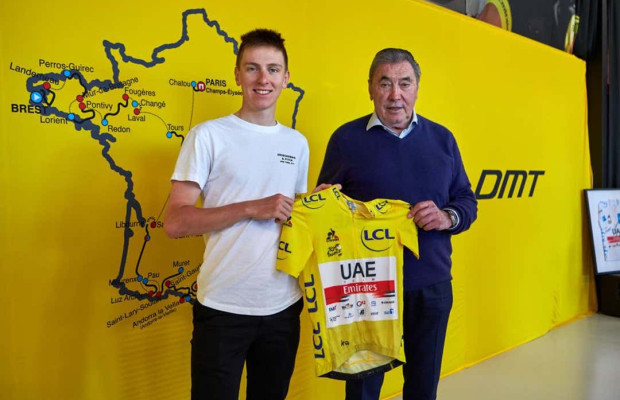
Eddy Merckx bows to Pogačar, while Contador goes even further: “He’s the greatest of all time”
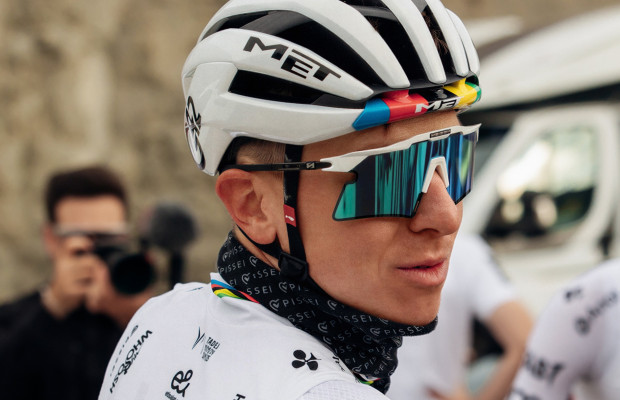
What makes Tadej Pogačar different? New documentary explores his physiology, mindset and the secrets behind his dominance
Shimano enters a new era with the EP810, a motor combining 100 Nm of torque, a weight of just 2.3 kg, 720 Wh of battery capacity and automatic shifting and assist mode
Turn your road clipless pedals into flat pedals in seconds, with no tools required, using the new Redshift Mousetrap
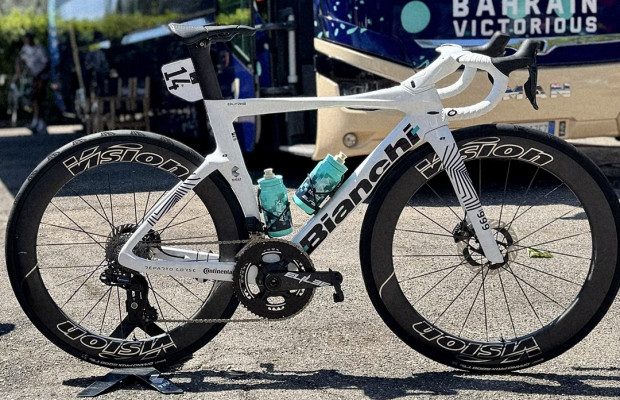
Bianchi confirms it will continue operating despite financial troubles and prepares a new strategy

Cannondale says goodbye to Factory Racing with an emotional video celebrating Avancini, Fumic, Marotte and other MTB legends
This difference is consistent with a high cardiovascular adaptation to endurance training. In elite athletes, the heart can pump a greater volume of blood with each beat, allowing for adequate cardiac output with a lower resting heart rate.
The second highlighted data is his heart rate variability (HRV), which is at 100 milliseconds, compared to the average values close to 80 milliseconds recorded among the teammates used in the comparison.
The HRV measures the temporal variations between consecutive beats and provides information about the regulation of the autonomic nervous system. In sports monitoring, it is used to observe how the body responds to training, stress, and recovery processes.
An HRV of 100 milliseconds is high and is consistent with the profile of a top-level endurance athlete. However, this variable has a significant individual component and cannot be interpreted as a direct measure of power, VO2max, or the ability to win races.
His ability to sleep during the Tour de France surprises specialists
Where the Whoop team finds particularly striking behavior is in Pogačar's sleep consistency.
During the 2026 Tour de France, the Slovenian recorded an 84% sleep consistency, a metric that evaluates the regularity of the times a person goes to bed and wakes up. It is worth noting that Pogacar, like the rest of the team, used a smart bed to control and adapt his environment each day.
According to the researchers participating in the documentary, none of the UAE Team Emirates-XRG riders analyzed reached that figure during the race. Most were between 70% and 80%. But the most surprising thing was that Pogačar increased his hours of sleep during the competition itself.
Before the Tour, he slept approximately seven hours a day, while during the three weeks of racing, he moved to around eight hours. Pogačar seems capable of maintaining a particularly stable routine even when the competitive load increases.
The cyclist himself emphasizes relatively simple aspects, such as having a proper dinner, staying relaxed, and having the next morning organized.
His former coach, Iñigo San Millán, also appears in the documentary and highlights the results obtained in different metabolic tests. According to him, some indicators related to antioxidant processes and recovery placed the Slovenian clearly ahead of the other athletes used as references.
Van der Poel had already revealed a minimum heart rate of 34 beats and an HRV above 200
Although Pogačar's figures are exceptional compared to the general population, putting them in perspective with other professional cyclists significantly changes their interpretation.
The most evident example is Mathieu van der Poel, who also maintains a collaboration with Whoop and who shared some of his data during a conversation with Will Ahmed, the founder and CEO of the company, in early 2026.
In that interview, the Dutchman confirmed that his average resting heart rate was also 38 beats per minute, exactly the same as the one now attributed to Pogačar.
However, Van der Poel claimed to have recorded a minimum of 34 beats per minute and an average HRV above 200 milliseconds, more than double the figure reported for the Slovenian.
The Dutchman acknowledged that his high heart rate variability could be partly related to genetics, although he also pointed out the importance of physical condition.
In fact, Van der Poel explained that resting heart rate and HRV are two of the indicators he pays the most attention to in order to monitor his physical state and complement his own feelings.
The comparison shows that Pogačar's values, while very good, are not necessarily extraordinary within the elite of world cycling. Although it should be noted that Van der Poel's 34 beats correspond to his recorded minimum, not his usual average, which is 38. Furthermore, an HRV of 200 does not mean he has double the recovery capacity of a cyclist with an HRV of 100.
Why having fewer beats or a higher HRV does not mean being a better cyclist
The data from both riders also serves to remind us of the limitations of these metrics when used to compare athletes.
A very low resting heart rate is often related to good adaptation to aerobic training, but genetic, individual, and physiological factors of each person also play a role.
The same goes for HRV. While it is generally positive to maintain high values relative to one's usual reference, its interpretation depends on age, genetics, recovery status, and measurement conditions.
Therefore, an HRV of 200 milliseconds does not automatically make Van der Poel a better-prepared cyclist than Pogačar, just as the 38 beats at rest of the Slovenian do not alone explain his superiority in grand tours.
In reality, these metrics are especially useful when analyzed longitudinally, comparing the data of the same athlete over different periods to identify changes in their recovery or response to training loads.
Performance in competition depends on many other capacities, including sustainable power, maximum oxygen consumption, metabolic efficiency, resistance to accumulated fatigue, and the ability to repeat high-intensity efforts.
The new data from Whoop confirms that Pogačar exhibits physiological adaptations typical of an exceptional endurance athlete, but also shows that none of these figures, taken separately, can explain his dominance.
Perhaps the most interesting aspect of the leaked information is not his 38 beats or his 100 milliseconds of HRV, but his ability to maintain and even improve rest during such a demanding competition as the Tour de France.
También puede interesarte
Road
Eddy Merckx bows to Pogačar, while Contador goes even further: “He’s the greatest of all time”
Road
What makes Tadej Pogačar different? New documentary explores his physiology, mindset and the secrets behind his dominance
Mountain bike
Shimano enters a new era with the EP810, a motor combining 100 Nm of torque, a weight of just 2.3 kg, 720 Wh of battery capacity and automatic shifting and assist mode
Road
Turn your road clipless pedals into flat pedals in seconds, with no tools required, using the new Redshift Mousetrap
Road
Bianchi confirms it will continue operating despite financial troubles and prepares a new strategy
Mountain bike
