Weight and a tendency to overtrain: Evenepoel’s coach identifies two areas he needs to improve for 2027
The weight of Remco Evenepoel is once again at the center of the debate regarding his performance. After a season in which he significantly improved his performance in the grand tours, his coach, Tim Heemskerk, acknowledges that reducing the necessary kilos to reach the Tour de France was one of the biggest challenges of his preparation. But he has also identified another aspect they need to continue working on: the Belgian's tendency to exceed the planned intensities during training.
Weight remains one of Evenepoel's major challenges to compete with Pogačar
In an interview granted to the Belgian newspaper Het Laatste Nieuws (HLN), published on October 17, Tim Heemskerk analyzed some of the aspects that marked Evenepoel's preparation during 2026 and the adjustments he considers necessary for the upcoming season.

The Dutch coach, who previously worked with Jonas Vingegaard at Visma Lease a Bike, joined Evenepoel's team in May and had as one of the main challenges for the rider to find the right weight to compete in the Tour without compromising his power.
RECOMENDADO
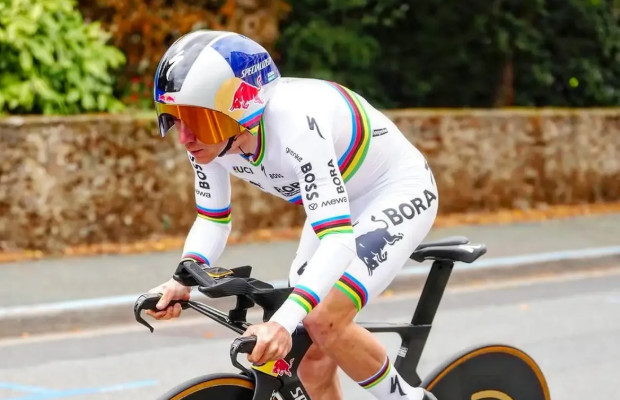
Evenepoel smashes the clock in Les Herbiers to win the 2026 Chrono des Nations by more than two minutes
Crash, attack and photo-finish victory: Evenepoel wins the European Championships
Pogačar reveals what caused his crash at La Vuelta and outlines his three major goals for 2027
When a trail disappears, someone has to rebuild it: how Olentzero was restored in Navarre
Jarno Widar leaves Pidcock with no answer to claim the 2026 Tour of Guangxi
Evenepoel, Küng and Vine go head-to-head in the year’s final major time trial today: start times and where to watch
Heemskerk acknowledges that getting Evenepoel to lose weight after the spring classics required considerable effort. "After the classics, losing weight was a huge task, but he managed it and clearly benefited from it in the Tour," Heemskerk admits.
Heemskerk warns that the current level of the peloton does not allow for any detail to be overlooked, especially when the goal is to compete with cyclists like Tadej Pogačar, Isaac del Toro, or Paul Seixas. "If you want to compete with Pogačar, Del Toro, and Seixas, you have to be completely on point in that aspect."
This is not a new issue for Evenepoel. The rider himself explained in April how he manages his weight throughout the season and acknowledged that his build makes him gain weight relatively easily.

He then detailed that between the classics and the Tour, he usually loses between three and four kilos, a change that also affects his musculature and his absolute power values. To achieve this, he mainly resorts to prolonged training periods and altitude camps.
The difference is that this season he seems to have found a more effective way to manage that process.
In fact, before starting the 2026 Tour de France, Evenepoel stated that he had managed to reduce his weight without losing power. The Belgian explained that the preparation had been much more balanced than the previous year and that he had been able to complete all the planned training blocks.
Heemskerk now confirms the importance of that work and emphasizes that nutritional balance was fundamental to losing weight without compromising performance. He also raises the need to reduce large weight fluctuations between different times of the season, although he acknowledges the difficulty of doing so when competing at the highest level for so many months.
Evenepoel's other problem: when training too much can be counterproductive
Beyond weight, Heemskerk has revealed an interesting detail about Evenepoel's training method. The coach describes the Belgian as an extraordinarily hardworking athlete, with a huge capacity to handle training loads. However, that ambition can also lead him to make mistakes.
As he explains, when Evenepoel feels particularly good during a VO₂ max session, he tends to increase the intensity above what is set.
Heemskerk summarizes his philosophy with one expression: "Sometimes, less is more. The coach asserts that he has already had to speak several times with Evenepoel to explain that exceeding the programmed watts does not necessarily mean doing a better workout.
"If there are 450 watts programmed, you don't have to do 500 or 600", is one of the examples he uses to explain the problem.

The difference is not minor. If a session is designed to work at a certain intensity, significantly increasing the power modifies the physiological stimulus that is sought to be achieved.
Heemskerk believes that respecting training zones is essential for the preparation to follow the established plan, especially when accumulating demanding sessions and large volumes of work.
In any case, he assures that Evenepoel has understood his instructions and is applying this approach better.
The goal now is to leverage everything learned during 2026 to build an even more effective preparation. Heemskerk will have for the first time the opportunity to work with Evenepoel throughout an entire winter, something he considers important to introduce adjustments from the start of the season.
In addition to weight and training intensities, the coach has also pointed out the need to review the competitive calendar. The accumulation of major objectives during the autumn, with numerous travels and little time between races, hindered the possibility of carrying out new blocks of specific preparation.
Therefore, looking ahead to 2027, he does not rule out that they may have to forgo certain competitions to have more training and recovery time.
También puede interesarte
Road
Evenepoel smashes the clock in Les Herbiers to win the 2026 Chrono des Nations by more than two minutes
Road
Crash, attack and photo-finish victory: Evenepoel wins the European Championships
Road
Pogačar reveals what caused his crash at La Vuelta and outlines his three major goals for 2027
Mountain bike
When a trail disappears, someone has to rebuild it: how Olentzero was restored in Navarre
Road
Jarno Widar leaves Pidcock with no answer to claim the 2026 Tour of Guangxi
Road
