The UCI takes emergency measures at the Tour's supply stations due to extreme temperatures
The extreme temperatures accompanying the 2026 Tour de France have forced measures to be taken. The UCI, in agreement with the president of the College of Commissioners and ASO, has decided to temporarily relax the feeding rules to facilitate cyclists' access to more water during the upcoming stages.
The Tour changes its rules in the face of extreme heat to facilitate cyclists' hydration
The main change affects the areas that were initially reserved exclusively for bottle delivery. From now on, and while this exceptional measure is in place, team assistants will also be able to deliver feeding bags or musettes at these points located within categorized mountain passes.
The change may seem minor, but it will allow each cyclist to collect several bottles at once and distribute them later among their teammates. The goal, as explained by the UCI, is to ensure optimal hydration given the expected weather conditions.
The heat pushes the peloton to the limit
The decision comes after a particularly demanding third stage of the Tour. The peloton had to compete with temperatures exceeding 30 °C on the way to Les Angles, on a day also affected by significant fires in the area.
RECOMENDADO
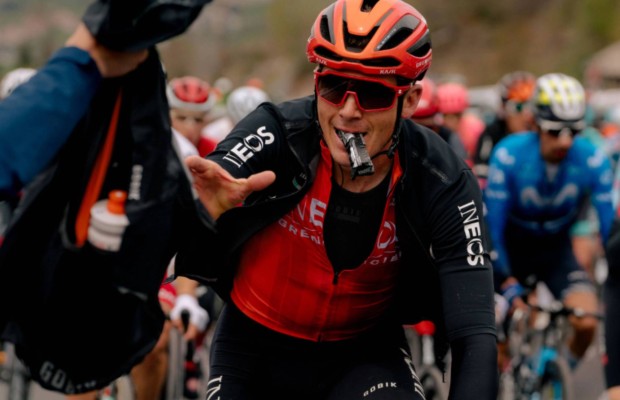
This study supports INEOS's secret to combating heat in the Tour
France does not rule out suspending stages of the Tour due to the heatwave
When to skip training and rest without feeling guilty
Free aero gains for your bike: small changes that make you faster
More power, less fatigue: how nitrates could help you on the bike
An indoor trainer can do more for your training than you think: here are 7 reasons to own one
The heat became one of the main protagonists of the stage. After crossing the finish line, Tom Pidcock explained to Cyclism’Actu how obtaining water had become a priority within the peloton.
“It was like a war zone, everyone trying to get bottles. I think today we used about 10,000 bottles in the peloton,” the Briton stated.
The situation does not seem to be improving immediately. The fourth stage is being contested with temperatures close to 37 °C.
So far, no other specific modifications for the race have been announced, although the Tour organization has recommended that spectators seek shade whenever possible, wear caps or hats, and drink water regularly even before feeling thirsty.
Cyclists call for deeper measures
The relaxation of the feeding rules comes at a time when some riders are calling for broader solutions in the face of extreme temperatures.
Matteo Trentin has been one of the most critical. The Tudor Pro Cycling rider believes that the problem is no longer limited to competing for several hours under very high temperatures, but also to the difficulties that riders face in recovering after each stage.
“It has always been hot, but these recent heat waves are very different. It no longer cools down at night. Climate change is here. It’s not going to arrive next year. It’s now,” Trentin explained to WielerFlits.
The Italian believes that professional cycling will have to rethink some aspects of race organization if these situations become increasingly frequent.
“Right now it’s very difficult to change a plan that has been prepared for months. But for the future, we need to sit around a table and start thinking about it. Maybe starting at 12 under the sun isn’t a smart idea,” he added.
When directly asked if he considered it responsible to compete under these conditions, Trentin was even more emphatic: “No, it’s not. If I were a normal person, I wouldn’t go out at this time of day.”
A temporary measure that will be under evaluation
The UCI has clarified that the modification of the feeding rules is initially being introduced as a trial. Its continuation will depend on the evolution of the weather conditions, its effectiveness in improving the hydration of the riders, and the possible consequences it may have on the development of the race.
For now, the Tour de France is responding to the extreme temperatures by facilitating teams' ability to deliver more water to their riders. An initial emergency measure while the debate within the peloton increases over whether professional cycling needs deeper solutions to compete during heat waves.
También puede interesarte
Road
This study supports INEOS's secret to combating heat in the Tour
Road
France does not rule out suspending stages of the Tour due to the heatwave
Training
When to skip training and rest without feeling guilty
Road
Free aero gains for your bike: small changes that make you faster
Nutrition
More power, less fatigue: how nitrates could help you on the bike
Training
