The lactate product Pogačar used at the Tour is now on sale: what it promises and what the science says
One of the sports nutrition products that generated the most anticipation during the Tour de France 2026 has just hit the market. Enervit is now selling the C2:1PRO Lactate Gel Mix, the formula with exogenous lactate developed alongside the UAE Team Emirates-XRG and used by Tadej Pogačar during the French race. Its price is 34 euros for four units, but its launch comes with a question that still lacks a conclusive scientific answer: Does it really improve cyclists' performance?
Enervit puts on sale the lactate used by Pogačar in the Tour de France
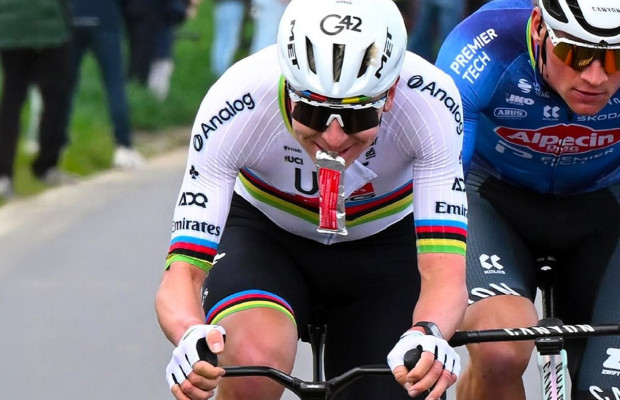
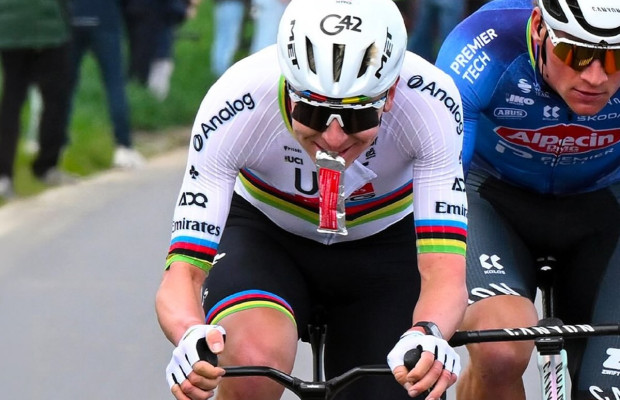
During the last Tour de France, images of Tadej Pogačar consuming a product in a silver wrapper sparked speculation about a new nutritional strategy within the UAE Team Emirates-XRG. Shortly thereafter, it was confirmed that the team was using exogenous lactate, a substance they had been researching for years and which now, for the first time, was coming to competition with a formulation specifically developed for their riders.

Three months later, the Enervit C2:1PRO Lactate Gel Mix is now available for purchase on the brand's official website. It is sold in packs of four units for 34 euros, which places each dose at 8.50 euros, a high price compared to conventional energy gels.
RECOMENDADO
The path of exogenous lactate to the Tour: an initial failure and a science yet to be proven
"We don't use it all the time": Pogacar's nutritionist explains how they use lactate in the Tour
Reserve steps up to 32-inch wheels with its new carbon XC wheelsets
Garmin unveils the new Edge Explore 3 and 3 Plus: advanced navigation and voice control from €399
O’Connor, Sivakov and De Plus join Decathlon amid battle over Seixas’ future
“OK, Garmin”: the new Edge 1060 introduces a new way to interact with your GPS
Its commercial launch represents the next step in a project involving Enervit, physiologist George Brooks, and sports metabolism specialist Iñigo San Millán, along with the UAE performance team. But it also brings to consumers a nutritional technology on which there are still significant scientific discrepancies.
What the new Enervit lactate gel contains and how to use it
The product maintains the formulation that Enervit presented during the Tour. Each package contains 90 grams of carbohydrates, combining glucose and fructose in a 2:1 ratio, and another 10 grams of sodium lactate. It also includes vitamin B1.
Although marketed as Gel Mix, it is not designed to be consumed directly like a conventional gel. Each 130 ml package must be diluted in a bottle with between 500 and 750 ml of water and consumed progressively during exercise.
View this post on InstagramAdvertising
The brand itself recommends its consumption especially during the last two hours of prolonged and high-intensity endurance activities, coinciding with the moments when energy depletion can be most decisive.
Another relevant fact is its sodium content. Each dose provides approximately 2,050 mg, an amount that should be considered when combining the product with other isotonic drinks, gels, or salt supplements.
UAE had already attempted to use lactate in 2022, but the results were unconvincing
The history of this product goes back much further than the last Tour de France. As we explained when analyzing the first attempts of UAE with exogenous lactate, the team had experimented in 2022 with a drink that combined polylactate and a high amount of carbohydrates.
That formulation did not achieve the expected results. The amount of available lactate was too low to obtain a noticeable effect, and its taste did not convince the riders, leading to the project's abandonment.

However, interest in this molecule remained. Enervit continued working on a new formulation that was tested during the 2024 and 2025 seasons before being used during the 2026 Tour.
The goal was to find a way to provide an additional source of energy that could complement carbohydrates, whose intake has significantly increased in professional cycling in recent years.
Gorka Prieto-Bellver, nutritionist for the UAE Team Emirates-XRG, explained during the Tour how they were using lactate. The team did not administer it systematically, but only on certain demanding days.
Among the stages where its use was confirmed were the inaugural team time trial and stage 14, which passed through the Pyrenees. The nutritionist also acknowledged that they still needed to continue researching to accurately understand its real impact on performance.
This caution contrasts with the message that now accompanies the commercial launch, where Enervit presents lactate as an additional energy source capable of contributing to maintaining effort for longer.
Why Enervit believes lactate can improve performance
The theory supporting the product is based on a well-known physiological reality. Lactate is not simply a waste product that appears when muscles work at high intensities, as it was considered for decades. It also plays important roles in energy metabolism and can be used as fuel by various tissues.
One of the main researchers of these mechanisms is George Brooks, author of the theory known as Lactate Shuttle, which describes how the body produces, transports, and reuses lactate among different cells and tissues.
Enervit attempts to leverage that mechanism through the ingestion of sodium lactate. The company claims it can provide additional energy through metabolic pathways different from those used by glucose and fructose, and that it could help preserve some glycogen stores.
In its commercial presentation, it also states that preliminary results indicate lactate oxidation is approximately 60% higher than glucose during the first 45 minutes after ingestion. Additionally, it attributes to sodium lactate a possible contribution to acid-base balance during intense efforts.
However, there is a fundamental difference between demonstrating that the body can use lactate as fuel and proving that ingesting it in a supplement improves sports performance. That lactate plays an energetic role in the body does not necessarily mean that adding it to a drink allows a cyclist to produce more watts, delay fatigue, or perform better in competition.
From the University of Granada, questioning its efficacy and warning of possible negative effects
Not all researchers share Enervit's optimism. One of the most critical positions came precisely during the Tour de France, when Jesús Rodríguez Huertas, professor of Physiology at the University of Granada, published a warning about the use of gels with exogenous lactate.
In a dissemination intervention released by UGR on July 28, Rodríguez Huertas questioned whether the consumption of such products provides the benefits claimed by their manufacturers. He did not refer to any in particular since Enervit was not the first to market it.
His explanation is based on the role played by lactate produced naturally by the muscle during exercise. According to the researcher, introducing lactate from the outside could interfere with some of the metabolic mechanisms involved in energy production.

The professor was particularly emphatic in assessing its sports utility: "They don't work." He also pointed out that research conducted in his laboratory indicates that the exogenous supply of lactate during exercise has limitations for its muscular utilization and may impair certain mitochondrial functions.
Rodríguez Huertas believes that commercial campaigns exploit a real physiological basis, the importance of lactate in metabolism, to justify a practical application that still lacks sufficient evidence.
The available studies also do not allow for definitive conclusions
Research on oral lactate supplementation remains limited, and its results are not completely uniform.
One of the studies that helps to understand this uncertainty was published in August 2024 in the scientific journal Nutrients. It was a randomized, double-blind, placebo-controlled trial involving 15 physically active individuals.
The researchers found no significant improvements in indicators such as maximum oxygen consumption, ventilatory threshold, or power corresponding to the lactate threshold. However, they did observe an average increase of approximately 4% in sustained power during a 20-minute cycling test.
This last result points to a possible positive effect, although the authors themselves cautioned against interpreting it too broadly due to the small sample size and variability among participants.
Additionally, the study used a different dose and supplement than those used in the new Enervit, for example, and its participants were not professional cyclists competing during multi-hour stages.
Other previous studies had also not found consistent improvements in time to exhaustion when adding lactate to carbohydrate drinks.
Therefore, the existing scientific data does not allow us to assert that exogenous lactate is completely useless in any circumstance, but it also does not demonstrate that it provides reproducible advantages in endurance cycling or that the commercial formulation improves performance compared to a conventional drink with an equivalent amount of carbohydrates.
From the Tour's bottles to stores, with research still ongoing
The arrival of the C2:1PRO Lactate Gel Mix on the market represents an important step for Enervit, which has turned several years of development alongside one of the most prominent teams in the peloton into a product accessible to any cyclist.

Pogačar's participation, the collaboration of George Brooks and Iñigo San Millán, and the tests conducted by UAE Team Emirates-XRG provide relevant sports and scientific context, but do not replace the independent trials necessary to determine its efficacy.
So far, no published clinical results on the commercial formulation have been presented that allow us to establish how much performance improves, under what conditions, or what differences it presents compared to a nutritional strategy based solely on carbohydrates.
Exogenous lactate has made the definitive leap from professional cycling to the market, but its true utility as a sports supplement remains an open question.
También puede interesarte
Nutrition
The path of exogenous lactate to the Tour: an initial failure and a science yet to be proven
Nutrition
"We don't use it all the time": Pogacar's nutritionist explains how they use lactate in the Tour
Mountain bike
Reserve steps up to 32-inch wheels with its new carbon XC wheelsets
Bike Equipment
Garmin unveils the new Edge Explore 3 and 3 Plus: advanced navigation and voice control from €399
Road
O’Connor, Sivakov and De Plus join Decathlon amid battle over Seixas’ future
Bike Equipment
