The path of exogenous lactate to the Tour: an initial failure and a science yet to be proven
The use of exogenous lactate by UAE Team Emirates-XRG during the 2026 Tour de France has been one of the most discussed nutritional innovations of the year. However, this bet did not originate a few months ago. In fact, Tadej Pogačar's team had already attempted to develop a similar product years ago, although that first experiment was ultimately discarded after failing to deliver the expected results.
Before the Tour de France, UAE had already tested exogenous lactate... and the experiment ended up in a drawer
According to The Times, UAE worked in 2022 with a formulation based on polylactate combined with a high amount of carbohydrates. The goal was the same as that pursued by the current product: to leverage lactate as an additional source of energy to optimize performance in long-duration efforts and reserve a greater amount of glycogen for the decisive moments of the race.
The tests conducted on the bike, however, did not convince the team. The concentration of lactate provided by that drink was too low to produce a noticeable effect, and moreover, the taste was so unpleasant that the riders themselves refused to use it. With those limitations, the project was shelved, and UAE continued to rely on conventional nutritional strategies.
Four years later, lactate returns to the Tour
The failure of that first attempt did not mean the end of the research. Over the past few years, various companies and scientific groups have continued to work to solve one of the major problems of exogenous lactate: achieving a stable formulation, with a sufficient concentration that can be consumed during high-demand competitions.
RECOMENDADO
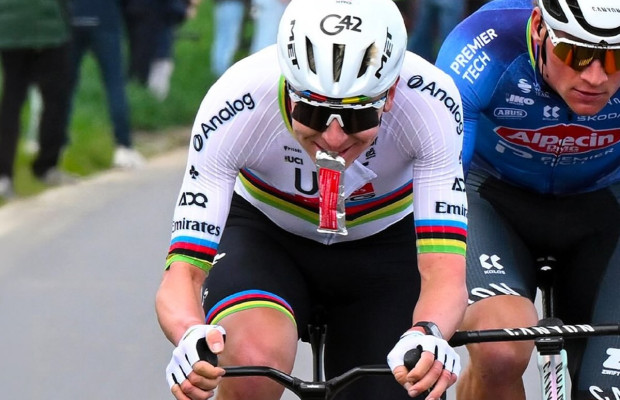
"We don't use it all the time": Pogacar's nutritionist explains how they use lactate in the Tour
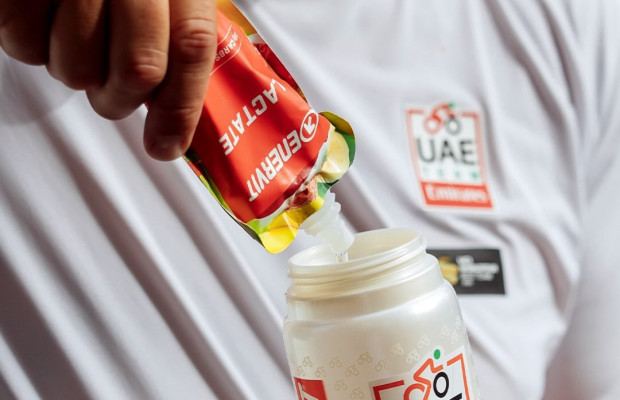
Confirmed: Pogacar is taking lactate products in the Tour de France
The first lactate gels are on sale: they cost 5 euros and can only be purchased two per person
When to skip training and rest without feeling guilty
Free aero gains for your bike: small changes that make you faster
More power, less fatigue: how nitrates could help you on the bike
This work culminated this year in the product developed by Enervit together with UAE Team Emirates-XRG, used publicly for the first time during the Tour de France. According to the Italian company itself, the drink used by the team contained 90 grams of carbohydrates, 10 grams of sodium lactate, and vitamin B1, a formulation that was used only in very specific stages and not systematically throughout the race.
The team's own strategy suggests that it continues to be a product in the validation phase, reserved for specific days when they believe it can provide an additional benefit.
High expectations... but still few scientific evidences
The emergence of exogenous lactate has generated enormous expectations within professional cycling, although the available scientific evidence remains limited.
The hypothesis about its possible benefits is not new. Since the 1990s, research such as that conducted by physiologist George Brooks has demonstrated that lactate is not only a product associated with fatigue but also a fuel that can be reused by muscles, the heart, and even the brain. That theory, known as Lactate Shuttle, laid the groundwork for attempting to administer lactate exogenously during exercise.
However, translating that idea into a truly effective supplement has proven much more complicated. To date, the trials conducted on athletes remain a small sample, and there is still no solid evidence demonstrating consistent performance improvements in competition.
The potential benefit could be another
Although initially the interest focused on a possible increase in performance, some of the more recent hypotheses suggest that the main benefit could be related to central fatigue.
Various studies have shown that the brain can use lactate as fuel and that this molecule also plays signaling functions, although there are still not enough studies to confirm that its exogenous administration consistently reduces the perception of effort during exercise.
For now, that hypothesis needs to be confirmed with higher quality studies conducted in real competition situations. Meanwhile, exogenous lactate remains one of the most promising lines of research in sports nutrition, but also one of the ones with the most unanswered questions.
También puede interesarte
Nutrition
"We don't use it all the time": Pogacar's nutritionist explains how they use lactate in the Tour
Nutrition
Confirmed: Pogacar is taking lactate products in the Tour de France
Nutrition
The first lactate gels are on sale: they cost 5 euros and can only be purchased two per person
Training
When to skip training and rest without feeling guilty
Road
Free aero gains for your bike: small changes that make you faster
Nutrition
