Stage 9 of the Tour is shortened due to the heatwave: new schedule, route, and favorites
The 2026 Tour de France will close this Sunday its first week with a stage completely different from the previous two days. After the sprints in Bordeaux and Bergerac, the sprinters will disappear from the fight for victory to make way for the breakaway specialists on a route without major climbs, but practically without a single kilometer of rest.
Tour de France 2026: stage 9 | Fewer kilometers and an open battle for the breakaway
The red alert due to the heatwave in the Corrèze department has forced a modification of the stage between Malemort and Ussel. The organization has removed a 30-kilometer loop planned at the beginning of the day, reducing the distance from the initially scheduled 185.5 kilometers to about 155.
The change considerably shortens the stage, but does not eliminate any of its main difficulties. The Côte de Naves, the tough Suc au May, the Côte de la Croix du Pey, and Mont Bessou remain on the route of a day that will accumulate nearly 2,800 meters of total ascent and appears as the best opportunity for the breakaway so far in the Tour.

RECOMENDADO
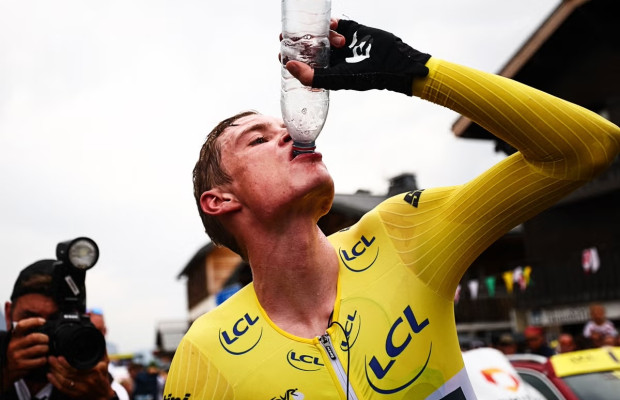
France does not rule out suspending stages of the Tour due to the heatwave
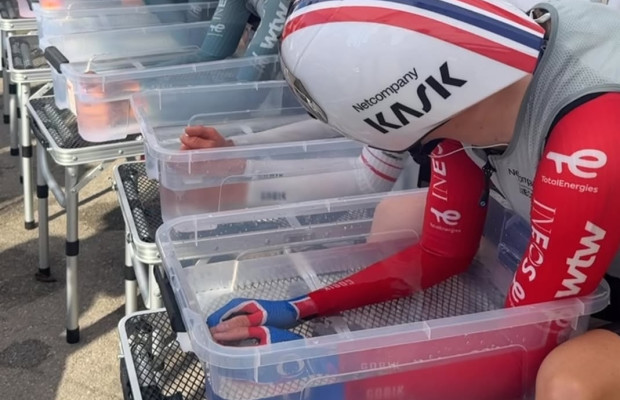
This study supports INEOS's secret to combating heat in the Tour
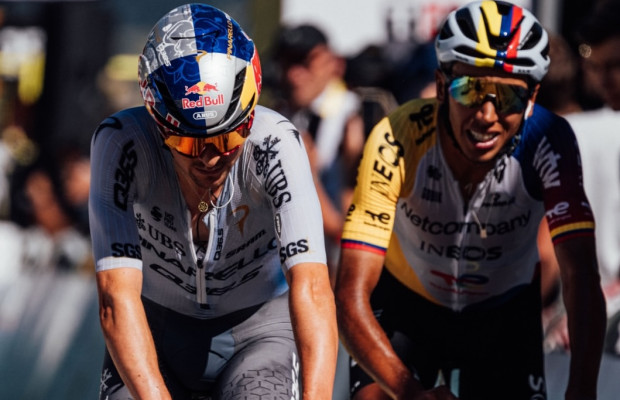
"It was like a war zone": Pidcock succumbs to the heat of the Tour
When to skip training and rest without feeling guilty
Free aero gains for your bike: small changes that make you faster
More power, less fatigue: how nitrates could help you on the bike
Key points and schedule for stage 9 of the Tour de France 2026
- Start: 13:45 h (CEST)
- Expected finish: around 17:30 h (CEST)
- Route: Malemort - Ussel
- Distance: approximately 155 km
- Total ascent: 2,778 meters
- Type of stage: medium mountain
The decision to modify the route responds to the extreme temperatures that have accompanied the Tour for practically the entire first week. Corrèze has been placed on red alert by Météo-France, and the organization has opted to eliminate the initial loop south of Malemort.
The race will start in the initially planned location and will recover the original route in Lanteuil. From that point, the profile will not suffer any further modifications.
The reduction in distance may have an important consequence: the riders will arrive fresher at the decisive area, and the battle to enter the breakaway may become even more intense.
The intermediate sprint may delay the formation of the breakaway
Although everything points to a victory from the breakaway, there is a first element capable of influencing the start of the day.
The intermediate sprint appears just 15 kilometers after the start, and Mads Pedersen has enough reasons to ask Lidl-Trek to keep the peloton grouped until that point. Every opportunity to score points is important in the fight for the green jersey.
If Lidl-Trek decides to control the first attacks, the real battle to form the breakaway could begin immediately after.
And the terrain that awaits next is perfect for it.
After a few more favorable kilometers, the route enters a practically uninterrupted succession of ascents, descents, false flats, and rolling roads. There is no major climb capable of deciding the stage by itself, but there are enough difficulties to make controlling the race extremely complicated.
The Côte de Naves will be the first scoring ascent. Its 2.2 kilometers at 7.3% can serve to make an initial selection, although the road will continue to gain height after the summit. Shortly after, the place where the breakaway can definitively break apart will arrive.
The Suc au May can turn a large breakaway into an individual battle
The Suc au May will be the hardest climb of the day. It is only 2.7 kilometers long, but it has an average gradient of 9.7%, and its last kilometer is around 12%.
After dozens of kilometers of attacks and changes of pace, a climb of these characteristics can eliminate the weaker riders and split a large breakaway into several groups. But there will be no rest after the summit.
Only 500 meters of descent separate the top from another half-kilometer rise at 6.6%. It will be one of the many points on the route where a rider can take advantage of the fatigue of their rivals to try to break away.
The Côte de la Croix du Pey will arrive 55.5 kilometers from the finish with its 4.3 kilometers at 5.9%. It does not present as high percentages as the Suc au May, but it comes when the accumulation of efforts should already be considerable.
From there, there will still be more than 30 kilometers of uneven terrain before reaching Mont Bessou.
The last scoring ascent is only 600 meters long, although its first 400 meters reach an average gradient of 10%. It will be summited 24 kilometers from Ussel and represents the last clear opportunity to launch an attack before the final stretch.
After that, an equally uncomfortable route awaits, with descents, new climbs, and false flats before a finish where the last 500 meters rise at 4.6%.
If several riders reach Ussel together, they will still need to reserve energy for a sprint uphill.
Movistar and Lidl-Trek have several options to break the race
Movistar Team appears with one of the most interesting lineups for a stage of these characteristics. Pablo Castrillo should feel more comfortable than on the route of the fourth day, as the succession of climbs and the difficulty of controlling the race favor his endurance and offensive style. Raúl García Pierna, fourth in Foix, has shown to arrive at the Tour in excellent shape, while Javier Romo offers a third alternative that is especially dangerous if he manages to save energy to attack during the final part.
Lidl-Trek can start the stage working for Mads Pedersen's interests in the intermediate sprint and completely change strategy afterward. Quinn Simmons seems to be one of the riders best suited to the route due to his power, endurance, and ability to attack from afar, while Mathias Vacek also has the necessary characteristics to survive the climbs and arrive with options in Ussel. Pedersen cannot be ruled out either if the race ends up gathering a small group, although controlling such a rugged day to prepare for his arrival seems much more complicated than in Foix.
EF Education-EasyPost may bet on Alex Baudin or Michael Valgren, while Harold Tejada, Sergio Higuita, Marco Frigo, and Maxim Van Gils appear among the riders capable of contesting victory from the breakaway. The large number of candidates and the absence of a team with clear reasons to take on the chase make getting the right move just as important as being the strongest rider.
Stage 9 will be shorter than expected, but not necessarily easier. The organization has eliminated 30 kilometers to adapt the race to the red heat alert, while all the major climbs remain intact.
También puede interesarte
Road
France does not rule out suspending stages of the Tour due to the heatwave
Road
This study supports INEOS's secret to combating heat in the Tour
Road
"It was like a war zone": Pidcock succumbs to the heat of the Tour
Training
When to skip training and rest without feeling guilty
Road
Free aero gains for your bike: small changes that make you faster
Nutrition
