Pogačar broke cycling again: close to 7 W/kg and two records in Andorra after his first La Vuelta masterclass
The first major mountain stage of La Vuelta 2026 required just 105 kilometers to showcase how far Tadej Pogacar can go. The Slovenian attacked about 50 kilometers from the finish line at the Collada de Beixalís, turning the second half of the Andorran day into an individual time trial in which, besides winning the stage and opening huge gaps between the favorites, he set new ascent records at Beixalís and the Coll d'Ordino.
The times allow us to quantify a performance that had already seemed impressive at first glance. Pogacar completed Beixalís in 17:34, with an estimated power close to 7 W/kg, and then took 23:22 to climb Ordino. Two records that once again place the world champion at the performance levels he showed during the last Tour de France.
Pogacar breaks records in major ascents again
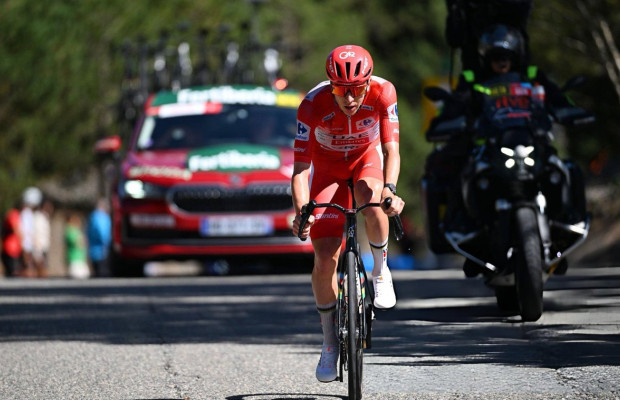
The chosen setting to break the race was the Collada de Beixalís, a first-category climb of 6.5 kilometers at 8.5% with a 554-meter elevation gain. Decathlon CMA CGM had taken on much of the responsibility in the peloton and toughened the race thinking of Felix Gall, but the decisive move ultimately came from Pogacar. The leader of UAE Team Emirates-XRG seemed not to have planned to attack so early, but Decathlon's move made him accelerate on the first slopes, and only Gall managed to respond initially.
The Austrian's resistance lasted little. Pogacar maintained the acceleration, was left alone, and began a breakaway of about 50 kilometers that would end directly at the finish line in Andorra la Vella. Moreover, it was his furthest winning attack so far in a Grand Tour. 
17:34 and nearly 7 W/kg to shatter the Beixalís record
RECOMENDADO
50 kilometres solo and a win: Pogačar turns Andorra into a masterclass
Andorra could blow La Vuelta wide open: Pogačar faces his first big opportunity
Pogačar wins a thrilling time trial and takes the red jersey on the first day of La Vuelta 2026

Sign up first, train later: why entering a race can change the way you train
Cycling improves how we think, remember and process information: a new study confirms it
From struggling to enjoying it: tips to build confidence on descents
The first particularly striking data appeared upon reaching the summit of Beixalís. Pogacar completed the 6.5 kilometers at 8.5% in 17 minutes and 34 seconds, which means climbing a hill of this gradient at a speed exceeding 22 km/h.
The previous competitive benchmark was 18:58, a time associated with Sepp Kuss in the 2021 Vuelta and also with the ascent of the favorites' group in 2018. The Slovenian thus lowered the benchmark by 1 minute and 24 seconds.
Even more revealing is the comparison with those who were behind. The first chasing group took approximately 19:14, meaning Pogacar gained around 1:40 only during the ascent.
Performance estimates place his effort around 7 W/kg during those 17:34 (the estimate comes from Pogacar, weighing about 73kg with the bike, covering approximately 6.5 km with 554 meters of elevation gain, 8.5%, in 17:34 and recording a VAM close to 1,900 m/h).
These are enormous figures, although context also matters, and yesterday it was an effort of less than 18 minutes, with Beixalís appearing relatively early in a stage of just 104.8 kilometers. Pogacar could tackle the climb much fresher than in the decisive major ascents of the second or third week of a Grand Tour.
The problem for his rivals is that this was only the beginning.
Ordino confirmed that Pogacar could maintain the lead
After reaching the summit of Beixalís, Pogacar did not wait for company. He descended solo and then faced the Coll d'Ordino, another first-category climb of approximately 9.9 kilometers at 7%. And he was again the fastest.
The Slovenian completed the ascent in 23:22, at a speed close to 25 km/h, setting another new benchmark. Published estimates place this second effort around 6.8 W/kg.
What is significant in this case was not only the record but that Pogacar achieved such performance after having made the attack at Beixalís, his descent, and several kilometers solo.
Behind him were riders of the caliber of Felix Gall, Primoz Roglic, Richard Carapaz, or Sepp Kuss. The chasing group took about 1:20 more than Pogacar to complete Ordino.
The advantage had stopped being built through an explosive attack. Pogacar was simply maintaining a climbing pace that his main adversaries could not replicate.
When he reached the summit of Ordino, the race was already completely broken. There were still the descent and La Comella before returning to Andorra la Vella, but the gap was sufficient for the Slovenian to reach the finish line after about 50 kilometers solo.
He won by 2:39 over Jarno Widar, while Felix Gall was third, and he left the day with 3:21 over Primoz Roglic and 3:32 over Enric Mas in the general classification.
From Tourmalet and Alpe d'Huez to Beixalís and Ordino
The records from Andorra come just a few weeks after Pogacar strung together several similar performances in the Tour de France.
At the Tourmalet, the Slovenian completed the 16.89 kilometers of the Sainte-Marie-de-Campan side in 43:08, at an average of 23.5 km/h and with an approximate VAM of 1,875 m/h. Estimates placed that complete ascent around 6.4 W/kg, while the final five kilometers, completed in about 13:12, were estimated at around 7.2 W/kg. Here we analyze all the data from that ascent and the subsequent descent of the Tourmalet.
But probably the most striking record of the Tour came later at Alpe d'Huez. Pogacar completed his 13.8 kilometers in 35:27, shattering one of the most well-known records in cycling history: 36:40 by Marco Pantani in 1995. He thus lowered a benchmark that had stood for three decades by more than a minute. This was Pogacar's historic record at Alpe d'Huez.
The differences between these ascents make it necessary to avoid direct comparisons solely through W/kg. It is not the same to sustain a certain power for 17 minutes as it is to do so for more than half an hour, nor to face a climb after 50 kilometers as it is to do so after several hours of a Tour stage.
But the succession of records does make it clear that Pogacar's level is currently unattainable for anyone in the current peloton.
In just a few weeks, Pogacar has established new benchmarks in Tourmalet, Alpe d'Huez, Collada de Beixalís, and Coll d'Ordino. And in Andorra, he demonstrated again that when he pushes the pace to around 7 W/kg in efforts of this type, it is currently extremely difficult to find someone in the peloton capable of following him.
La Vuelta has just begun, and there is still much mountain ahead, but stage 4 has left a first performance reference that is quite intimidating for those who intend to challenge him for the general classification.
También puede interesarte
Road
50 kilometres solo and a win: Pogačar turns Andorra into a masterclass
Road
Andorra could blow La Vuelta wide open: Pogačar faces his first big opportunity
Road
Pogačar wins a thrilling time trial and takes the red jersey on the first day of La Vuelta 2026
Training
Sign up first, train later: why entering a race can change the way you train
Training
Cycling improves how we think, remember and process information: a new study confirms it
Road
