Pogacar's data to shatter the Tourmalet record: 1875 m/h of VAM, 6.4 W/kg, and over 100 km/h downhill
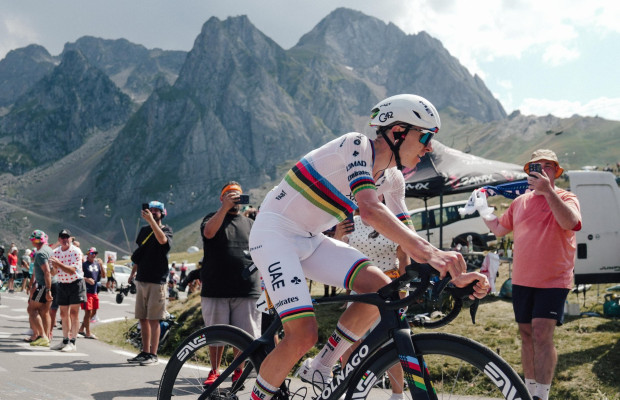
Tadej Pogacar's exhibition in the sixth stage of the 2026 Tour de France left huge gaps in the general classification, but the data known after the race allows for an even better assessment of what happened on the Tourmalet. The Slovenian completed the ascent at an average speed of 23.5 km/h, reached an approximate VAM of 1,875 m/h, and needed just over 43 minutes to set a new record on the Sainte-Marie-de-Campan side.
With these figures, Pogacar shattered the Tourmalet record: 1,875 m/h VAM, 6.4 W/kg, and over 100 km/h descending
And the performance did not end upon reaching the 2,115 meters of altitude at the summit. Pogacar immediately began a descent where he exceeded 100 km/h, completed the Strava segment at an average speed of 72.2 km/h, and also set the best recorded time on this descent.
23.5 km/h average speed to climb the Tourmalet
The segment recorded on Strava allows us to quantify Pogacar's ascent. The world champion completed 16.89 kilometers in 43:08, with 1,346 meters of positive elevation and an average gradient of 8%. His average speed was 23.5 km/h.
The VAM, one of the traditionally used indicators to measure cyclists' performance in climbs, reached approximately 1,875 meters of elevation per hour.
RECOMENDADO
Pogacar crushes the Tour at the Tourmalet and regains the yellow jersey with a historic performance
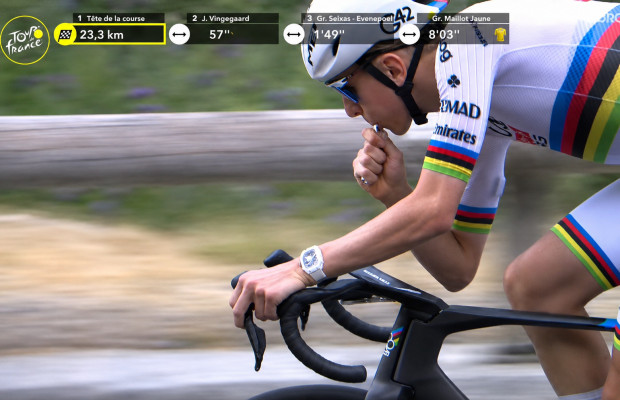
Is Pogacar using lactate gels in the Tour de France?

The smart bed that Pogacar sleeps on during the Tour: this is how the UAE's rest system works

Pogacar beats everyone and takes yellow in stage 3 of the 2026 Tour
Which workouts do you enjoy most, and what do they reveal about you as a cyclist?
Short on time to train? Here’s how to keep improving on the bike
Power estimates place the total effort around 410 watts or 6.4 W/kg. These are external calculations and not data from Pogacar's power meter, so they should be interpreted as an approximation.
UAE toughened the Tourmalet before Del Toro and Pogacar's attack
The record began to be built long before Pogacar was left alone.
UAE Team Emirates-XRG took control of the race from the early part of the Tourmalet after the Col d’Aspin had already begun to select the group. Tim Wellens, Felix Großschartner, Brandon McNulty, and Adam Yates took turns until leaving the final work in the hands of Isaac del Toro.
About 5 kilometers from the summit, the Mexican accelerated with Pogacar on his wheel. None of the other favorites could immediately follow the change of pace, and Jonas Vingegaard opted to maintain his own rhythm.
Del Toro still stayed alongside his leader for a moment before giving way and leaving Pogacar alone on the way to the summit.
Vingegaard initially managed to stabilize the gap around 9 seconds, but the world champion continued to increase the pace. In the last two kilometers, he opened up another 20 seconds and finished the climb with half a minute's advantage over the Dane.
Estimates place those final 5 kilometers, completed in approximately 13:12, around 465 watts and 7.2 W/kg.
It was the decisive stretch of the ascent where Pogacar built much of the gap that he would continue to extend during the rest of the stage.
More than two minutes faster than the previous Tourmalet record
The new record represents a huge leap compared to the previous known references on this side.
Tony Rominger and Zenon Jaskula had set a time of 45:50 in 1993 that remained as a reference for three decades.
In the 2023 Tour de France, Pogacar and Jonas Vingegaard managed to improve that record by 13 seconds, leaving the record at 45:37.
Just three years later, Pogacar has lowered his own mark by more than two minutes.
The various published measurements place the ascent between 43:02 and 43:12 depending on the point used to establish the start and finish. The Strava segment shown by Pogacar specifically records 43:08.
Vingegaard also significantly surpassed the previous reference. The Dane completed the ascent in 43:32, a time that under any other circumstances would have meant a new record, but this time left him 30 seconds behind Pogacar at the summit.
From 23.5 km/h climbing to 72.2 km/h average in the descent
Pogacar did not use the summit of the Tourmalet as the end of his effort. There were still 43 kilometers to the finish in Gavarnie-Gèdre, and the first stretch was the rapid descent of the pass. The Slovenian completed the 14.85 kilometers of the segment recorded on Strava in 12:21. The average speed was 72.2 km/h.
At the fastest points of the descent, he exceeded 100 km/h and also set the best recorded time on Strava for this segment of the Tourmalet descent.
The gap to Vingegaard, which was 30 seconds at the summit, quickly increased during the descent. Pogacar took advantage of his speed in the descent to continue widening the gap before facing the last part of the stage.

From the Tourmalet record to winning with 2:38 over Vingegaard
After the descent, the climb to Gavarnie-Gèdre awaited, an ascent of 18.7 kilometers at an average gradient of 3.7%.
Pogacar maintained his solo effort while Vingegaard tried to limit the losses behind and the rest of the favorites reorganized in a chasing group.
The world champion ended up winning the stage after completing the last 43 kilometers solo. Vingegaard arrived 2:38 later, and Isaac del Toro led the next group at 2:57.
A difference built from the acceleration of UAE Team Emirates-XRG and Del Toro 5 kilometers from the summit of the Tourmalet, continued with a record ascent of just over 43 minutes, and capped with a descent where Pogacar was again the fastest.
También puede interesarte
Road
Pogacar crushes the Tour at the Tourmalet and regains the yellow jersey with a historic performance
Nutrition
Is Pogacar using lactate gels in the Tour de France?
Training
The smart bed that Pogacar sleeps on during the Tour: this is how the UAE's rest system works
Road
Pogacar beats everyone and takes yellow in stage 3 of the 2026 Tour
Training
Which workouts do you enjoy most, and what do they reveal about you as a cyclist?
Training
