From great favorite to withdrawal: what went wrong for Pauline Ferrand-Prévot in the 2026 Tour
Just a year ago, I was writing one of the greatest stories in modern cycling. Pauline Ferrand-Prévot returned to the road after a decade focused almost exclusively on mountain biking and, against all odds, won the Tour de France Femmes 2025. Twelve months later, the Frenchwoman has abandoned the race before the eighth stage, far from the expected level and leaving an inevitable question: what happened to Pauline Ferrand-Prévot?
What happened to Pauline Ferrand-Prévot? From a dream return to an unrecognizable Tour that leaves many questions
Neither the rider nor Visma Lease a Bike have explained the reasons, likely they haven't even found them yet, for such a significant drop. What we do have are facts, statements, and some well-founded hypotheses that help understand why the reigning champion never became a protagonist in this edition.
From absolute dominance in MTB to the most unexpected return to the road
In 2025, at 32 years old, Ferrand-Prévot decided to definitively close her chapter in mountain biking. She did so after winning the Olympic gold in Paris and being the reigning world champion in XCO, putting an end to a virtually unmatched record in the discipline.
Her next goal was to return to the road, a discipline in which she had also reached the top by becoming world champion in Ponferrada 2014. However, the challenge seemed almost impossible. More than ten years had passed since she had regularly competed at the highest level of road cycling, and the women's peloton had evolved enormously during that time.
RECOMENDADO
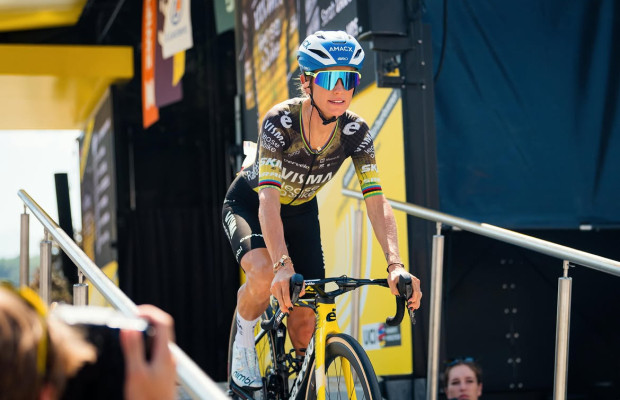
Pauline Ferrand-Prévot considers the Tour already lost and announces a change in strategy
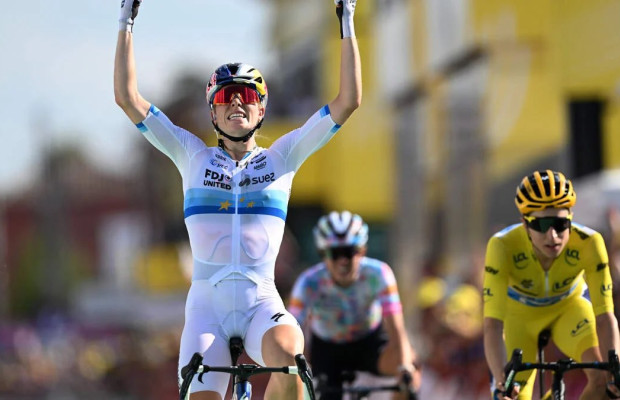
Vollering wins stage 5, Reusser keeps the yellow jersey, and Pauline continues to lose time in the Tour de France Femmes
New Specialized Pathfinder 29x2.2: more volume to ride faster on gravel
Colnago creates a unique hand-painted V5Rs to celebrate the UAE Team L’IMAD Tour
Road shifters on a MTB? 5DEV offers $25,000 for winning Leadville with them
3 one-hour workouts to improve speed, strength and endurance
Despite the doubts, Ferrand-Prévot signed with Visma Lease a Bike, making it clear from day one what her goal was: to win the Tour de France Femmes. An ambition that many considered unrealistic and yet she ended up fulfilling in her first season back, a story we already told when she explained how she faced that change of discipline and the start of a new phase in her career.
In 2026, she was no longer a surprise: she was the big favorite
After winning the Tour in 2025, no one doubted her anymore. Visma renewed her contract until at least 2028 and confirmed her as one of the major leaders of the project, with an eye also on the Los Angeles Olympic Games.
Her preparation followed a pattern very similar to the one she had used during her years in mountain biking: very few competitions and all planning oriented towards a single goal. Before the Tour, she had barely accumulated a dozen days of competition, a strategy that had worked for her before. But this time, the result was completely different.

The first signs appeared long before the abandonment
Although illness forced Ferrand-Prévot to abandon before the eighth stage, the problems had appeared much earlier. From the first days, she was losing time compared to the main favorites and never conveyed the feeling of being able to fight for the general classification.
The time trial in Dijon was the first major warning. Besides the time lost, the position she used on the bike caught attention. Many analysts and fans pointed out that she was riding much more upright than usual for a discipline where aerodynamics is crucial.
The Frenchwoman herself later responded to those criticisms, explaining that this was the position that allowed her to be faster and that it corresponded to her own feelings on the bike. However, the improvement never came.
In the following stages, she continued to lose time and, even before facing Mont Ventoux, publicly acknowledged that she was already giving up on this Tour and that it would be necessary to analyze with the team what had gone wrong in her preparation.
The queen stage definitively confirmed that she was not at the level of the best. Ferrand-Prévot fell behind very early on the slopes of Ventoux, finished more than ten minutes behind Kasia Niewiadoma, and the next day she did not start due to illness.
Was it just the illness?
Ferrand-Prévot later explained that she fell ill on Friday night and that this was the reason for her abandonment before stage 8. She also acknowledged that "my level during the race was nowhere near where it should have been to fight at the front", although she insisted that she does not regret the preparation she undertook and promised to come back stronger next year.
These statements make it clear that the illness explains the abandonment, but not necessarily the poor performance shown throughout the previous week, when she had already lost contact with the best climbers.
A theory points directly to the preparation
Precisely on that issue, Paul Brousse, the French women's national coach, has spoken. Without claiming to know the internal workings of Visma, Brousse raised an interesting hypothesis: Ferrand-Prévot seemed to arrive physically very prepared, but it gave the impression that she had reached the Tour without sufficient recovery.
As he explained to RMC, the team might have increased the training load even more to respond to the enormous leap in level that the women's peloton has experienced.
"She looked tired, as if she hadn't recovered enough. Perhaps they tried to push a little harder than in other years and, when it came time to reduce the load before the Tour, that rest was no longer sufficient."
It remains a hypothesis, but it gains relevance coming from one of the people who knows French women's cycling best and because it fits with a widely accepted reality in high performance: training more does not always mean performing better.
Neither Ferrand-Prévot nor Visma have yet explained what exactly happened during the preparation. The team director, Rutger Tijssen, confirmed after the Tour that they will review all the work done when the Frenchwoman fully recovers to understand what was done well and what can be improved for 2027.
También puede interesarte
Road
Pauline Ferrand-Prévot considers the Tour already lost and announces a change in strategy
Road
Vollering wins stage 5, Reusser keeps the yellow jersey, and Pauline continues to lose time in the Tour de France Femmes
Gravel
New Specialized Pathfinder 29x2.2: more volume to ride faster on gravel
Road
Colnago creates a unique hand-painted V5Rs to celebrate the UAE Team L’IMAD Tour
Mountain bike
Road shifters on a MTB? 5DEV offers $25,000 for winning Leadville with them
Training
