Do cycling teams “spy” on each other? Lefevere reveals what they did with Pogačar’s bike
In professional cycling, it has always been taken for granted that teams and brands are constantly observing each other. A new bike that appears in a race, a different technical solution, an unusual position, or a component that has not yet been officially presented are examined, photographed, and commented on as soon as they arrive in the paddock. The feeling is that everyone tries to gather as much information as possible about their rivals, although we rarely know of a specific case that confirms how far that curiosity can go.
Patrick Lefevere has just shared a rather illustrative story. It features Tadej Pogačar's bike and four mechanics from the then Soudal Quick-Step.

Four Quick-Step mechanics had Pogačar's bike to themselves for a few minutes
Lefevere recounted the story in his column in Het Nieuwsblad. It happened about two years ago during a winter stay at the Suitopia hotel in Spain, where the Belgian team was staying.
RECOMENDADO
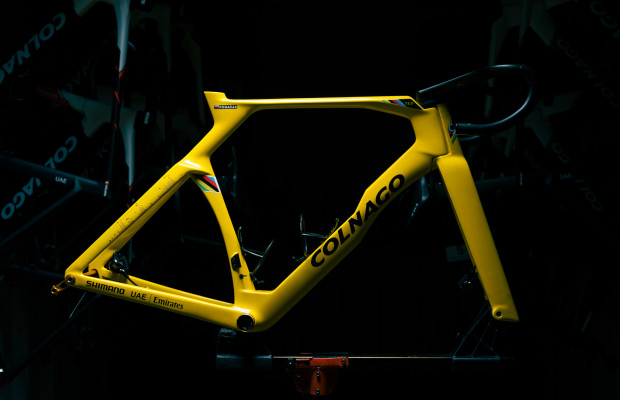
Colnago gifts an exclusive Y1Rs to each UAE rider to celebrate Pogacar's Tour
Colnago creates a unique hand-painted V5Rs to celebrate the UAE Team L’IMAD Tour
The Megamo West 2027 gets a new range from €2,399 and remains a great choice

The new cycling regulations in Spain are here: everything that changes from 1 October (this Thursday)

What do the colours of the rainbow jersey mean, and who was the first World Champion?
How much prize money does La Vuelta 2026 offer? Here’s what Enric Mas has earned and how it compares with the Tour and Giro
Pogačar rode his bike there to visit his partner, Urška Žigart, who was also at the hotel. At one point, they both decided to go to the sauna, and the Slovenian asked if he could leave his bike in the room used by Quick-Step in the meantime.
It seems that Pogačar did not think much of the matter. For the mechanics who stayed there, however, having the bike of the best cyclist in the world at their disposal and without its owner present was an opportunity hard to pass up.
According to Lefevere, as soon as Pogačar disappeared from their sight, four mechanics went straight to the bike. They weighed it, took measurements, and analyzed everything they could during the time they had available.
They did not disassemble anything, although Lefevere himself jokes that, from what he later learned, they were not too far from doing so.
The scene graphically confirms something that is usually assumed within professional cycling. Teams want to know what their rivals are using, how they use it, and if there is any solution that could explain a performance difference or that might be interesting to transfer to their own equipment.
And few bikes could spark more interest than Pogačar's.
What did they find on Pogačar's bike?
Perhaps the most curious aspect of the story is that, despite all the interest from the Quick-Step mechanics, no major technical secret was revealed.
Lefevere recalls that Colnago had previously carried a certain reputation for making somewhat heavier bikes than some competitors, but that impression no longer matched what they had in front of them.
What really caught the mechanics' attention was the Slovenian's position on the bike.
Specifically, they noticed the setback of the saddle relative to the bottom bracket. The conclusion of the Quick-Step mechanics was that Pogačar used a rather forward position.
It was probably one of the most interesting pieces of data they could obtain without starting to disassemble components. The measurements of a bike allow for a fairly precise understanding of how a rider is positioned on it, and in the case of a cyclist with Pogačar's performance, any particularity is especially attractive to technicians and biomechanists.

Lefevere concludes this part of the story with humor. In light of the suspicions about motors that have periodically accompanied the great dominators of cycling, the Belgian points out that his mechanics were able to confirm that there was none on that bike.
Lefevere: outside of races, Pogačar can go completely unnoticed
The anecdote also serves Lefevere to explain the impression he has of Pogačar during their encounters outside of competition.
The former head of Quick-Step admits that he has never had a particularly close relationship with him, but he has seen him several times when there were no races or cameras around. And he assures that his behavior in those situations fits the image of normalcy that he usually projects publicly.

During those stays at Suitopia, Pogačar and Žigart could simply sit together in the hotel lobby without causing too much commotion. Lefevere points out that someone who did not follow cycling would hardly have imagined that the casually dressed young man was the best cyclist in the world.
For the Belgian, that naturalness is also one of the reasons why Pogačar continues to enjoy enormous popularity despite winning so frequently. Lefevere believes he possesses a drive for victory that he has not seen since Eddy Merckx, but that this competitive voracity does not seem to have changed his behavior when he gets off the bike.
También puede interesarte
Road
Colnago gifts an exclusive Y1Rs to each UAE rider to celebrate Pogacar's Tour
Road
Colnago creates a unique hand-painted V5Rs to celebrate the UAE Team L’IMAD Tour
Gravel
The Megamo West 2027 gets a new range from €2,399 and remains a great choice
Road
The new cycling regulations in Spain are here: everything that changes from 1 October (this Thursday)
Road
What do the colours of the rainbow jersey mean, and who was the first World Champion?
Road
