Carbon, aluminium, voice control and 120 hours of battery life: the COROS DURA 2 SOLAR aims to be the best bike computer on the market
COROS has just presented the second generation of its GPS cycling computer, the new DURA 2 SOLAR. A model that represents a significant leap from its predecessor and arrives with a completely renewed design, a larger screen, and new navigation and training features. The brand maintains one of its main hallmarks, the autonomy of up to 120 hours with solar charging, but now bets on a more sophisticated device, also in its construction and price.
The COROS DURA 2 SOLAR makes a category leap with carbon, aluminum, and a much larger screen
When COROS presented its first DURA in 2024, it managed to capture the market's attention with a combination that was difficult to find until then: advanced navigation, extraordinary autonomy, and a price of 289 euros. In our in-depth test of the COROS DURA, we already highlighted its ease of use, connectivity, and especially the peace of mind provided by a battery capable of lasting weeks of training.

Two years later, COROS changes strategy with the DURA 2 SOLAR. The new generation retains that philosophy but clearly targets the premium segment, where design, materials, and user experience take as much prominence as performance.
RECOMENDADO
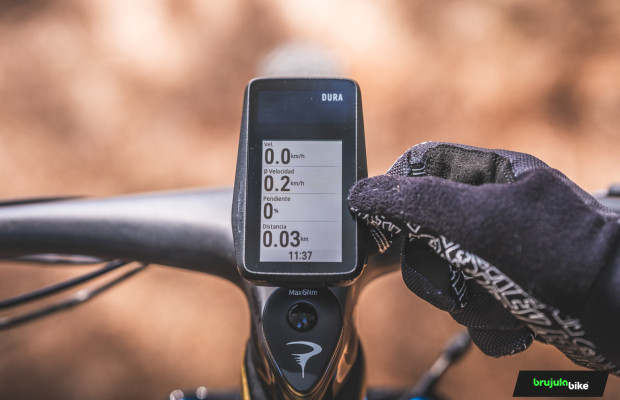
The COROS DURA is updated with smarter navigation and the renewed App 4.0
Sea Otter Europe sets a new attendance record with nearly 80,000 visitors for its 10th anniversary
Aerobag cycling airbag named one of TIME’s Best Inventions of 2026
Movistar signs Paula Blasi on one of the biggest contracts in women’s cycling
Red Bull isn’t afraid of the risks of Paris-Roubaix and encourages Evenepoel to give it a go
Öhlins enters the gravel market with a new 40mm suspension fork weighing under 1,250g
The transformation begins with its construction. COROS has used a structure that combines anodized aluminum alloy with a braided carbon fiber back. The upper aluminum frame features a sleek profile of just 5.7 mm at its thinnest point, aiming to reduce visual bulk and enhance aerodynamic integration with the handlebars.

All this with a claimed weight of only 99 grams for the device, which increases to 138 grams with one of the brand's new mounts.
The other major change is in the screen. The DURA 2 SOLAR incorporates a third-generation SHARP Memory-in-Pixel touchscreen measuring 3.5 inches, considerably larger than the 2.7 inches of the first model.

This screen, developed specifically for COROS, offers a resolution of 336 x 620 pixels, an aspect ratio of 17:9, an approximate density of 200 pixels per inch, and a refresh rate of 38 Hz. It also features an anti-reflective treatment to improve visibility outdoors.

The larger available surface allows for more comfortable viewing of maps and training data, while the new processor promises much faster map rendering and a smoother response when navigating through them.
Touchscreen, haptic buttons, and voice control
COROS has also completely rethought the way to interact with the cycling computer.
The DURA 2 SOLAR offers three control systems: touchscreen, buttons, and voice commands. The latter allows users to start and stop activities, add points of interest, control multimedia playback, or navigate through menus without resorting to the screen.

The physical controls combine two conventional side buttons with two haptic buttons integrated into the solar panel area. The latter detect pressure and provide feedback through vibration and sound.

Unlike capacitive controls, they work even with thick gloves, which is particularly interesting for MTB, gravel, and winter cycling.
The touchscreen has also been designed to distinguish between user taps and raindrops, preventing accidental movements when it rains. However, COROS acknowledges that its touchscreen functionality may be limited when it is completely soaked. Therefore, all important functions during movement can only be used via the buttons.
Up to 120 hours of autonomy and two additional hours for every hour of sunlight
Despite the hardware renewal, COROS did not want to give up the main argument with which it made its name in the cycling computer market.
The DURA 2 SOLAR announces more than 120 hours of operation on a single charge, not counting the energy that its solar system can provide.

With direct exposure to sunlight, the integrated panel can generate enough energy to add up to two hours of autonomy for every hour of solar charging. That is, it maintains the 2:1 recharge ratio that the first generation already offered.
However, there is an important detail for those who prioritize maximum GPS accuracy. When using the complete satellite positioning system in dual-frequency mode, the announced autonomy is 70 hours, also not counting solar contribution.
These figures continue to place autonomy among the main arguments of the device, especially for ultradistance cyclists, bikepackers, or those who undertake several consecutive training days without frequent access to a power outlet.
Renewed navigation with route recalculation without coverage and automatic ascent detection
One of the most relevant functional novelties is in navigation. The DURA 2 SOLAR uses Mapbox mapping and incorporates street and trail names, visual indications about the type of surface, turn-by-turn navigation, and a new route recalculation system.
When the cyclist deviates from the planned route, the device can generate an alternative without needing mobile coverage. To do this, it is necessary to keep it connected via Bluetooth to the smartphone, as the calculation is done in the COROS app using previously downloaded maps.

Therefore, it is not a completely independent recalculation from the phone, although it does allow continued navigation in areas without data signal. If the necessary maps have not been downloaded in advance, an internet connection will be essential.
The system can detect a deviation of approximately 20 meters and allows users to configure whether they want to receive only a notification or automatically start recalculation.
Another interesting addition is the detection of ascents without needing to follow a previously loaded route. This function provides information about climbs during improvised rides, without relying solely on a planned itinerary.
COROS has also worked on the speed at which maps are displayed. The processor allows users to scroll, zoom in, and zoom out of the mapping using touch gestures, with a response that the brand claims to have improved compared to the previous generation.
More training features and connection with the COROS ecosystem
The DURA 2 SOLAR expands its possibilities as a training tool, both from the device itself and through the brand's app.
Among the new features are new performance metrics specific to cycling and real-time tracking, as well as a complete integration with COROS sports watches and heart rate sensors.

All recorded activities are synchronized with the app, where users can view data from each outing and analyze training progress. If the cyclist also uses a COROS watch or a brand arm heart rate monitor, the platform can combine the information to provide a more complete view of their physical condition and recovery.
The app allows users to create routes and synchronize them with the cycling computer, as well as access structured training and free plans developed by trainers and athletes linked to COROS.

It also introduces more flexibility during structured sessions. It is now possible to temporarily pause a training session without interrupting the activity recording, as well as to start a planned session when already pedaling for some time.

Regarding connectivity, COROS maintains compatibility with external services such as Strava, Komoot, Ride with GPS, TrainingPeaks, and TrainerRoad, as well as offering connection with electronic components and cycling sensors.
However, the brand confirms that it does not plan to incorporate a store or library of third-party applications. Its strategy will continue to focus on directly integrating the services and functionalities it considers most useful for cyclists.
Another novelty will arrive via software before the end of 2026, when the incorporation of several customizable bike profiles is planned.
For its part, the first COROS DURA will cease to be marketed, although it will continue to receive software updates, including some features debuted in this second generation.

Technical specifications of the new COROS DURA 2 SOLAR
-
Screen: Third-generation SHARP Memory-in-Pixel touchscreen, 3.5 inches.
-
Resolution: 336 x 620 pixels, 17:9 ratio.
-
Density and refresh rate: approximately 200 ppi and 38 Hz.
-
Construction: carbon fiber and anodized aluminum alloy.
-
Weight: 99 grams without mount and 138 grams with mount.
-
Autonomy: more than 120 hours without solar recharge.
-
Dual-frequency GPS autonomy: 70 hours.
-
Solar charging: up to two additional hours of operation for every hour of direct sunlight exposure.
-
Controls: touchscreen, side buttons, haptic buttons, and voice commands.
-
Navigation: Mapbox maps, turn-by-turn directions, route recalculation, and ascent detection without a loaded route.
-
Additional features: real-time tracking, structured training, and performance metrics.
-
Integrations: Strava, Komoot, Ride with GPS, TrainingPeaks, TrainerRoad, and COROS ecosystem.
-
Maps and app: free, no mandatory subscription.
Price and availability of the COROS DURA 2 SOLAR
The technological leap also comes with a price increase compared to the original model.
The new COROS DURA 2 SOLAR will be available in different configurations, with the option to purchase only the device or combine it with a specific aluminum mount. COROS offers mounting options for conventional round handlebars and for bikes with integrated handlebar and stem sets.

The announced prices for Spain are as follows:
- COROS DURA 2 SOLAR without mount: 499 €.
- COROS DURA 2 SOLAR with standard aluminum mount: 549 €.
- Standard aluminum mount separately: 79 €.
Regarding its commercial launch, the new DURA 2 SOLAR will hit stores in early November 2026, with the exact date still pending confirmation.
You can see all the information on the official Coros website.
También puede interesarte
Bike Equipment
The COROS DURA is updated with smarter navigation and the renewed App 4.0
Road
Sea Otter Europe sets a new attendance record with nearly 80,000 visitors for its 10th anniversary
Road
Aerobag cycling airbag named one of TIME’s Best Inventions of 2026
Road
Movistar signs Paula Blasi on one of the biggest contracts in women’s cycling
Road
Red Bull isn’t afraid of the risks of Paris-Roubaix and encourages Evenepoel to give it a go
Gravel
