A new sponsor changes the Tour de France white jersey, and not everyone is happy about it
Castelli has not yet debuted its new jerseys in the Tour de France, but one of them is already generating a lot of buzz. The Italian brand has revamped the four leader jerseys for 2027 and, contrary to what one might expect, it is not the yellow jersey that is attracting the criticism. The focus is on the white jersey, which will be worn by the best young riders, and which will incorporate striking violet stripes for the first time.
The new white jersey of the Tour de France 2027 sparks controversy over its color change
The presentation of the new jerseys took place on October 22 in Paris, coinciding with the unveiling of the route of the Tour de France 2027. Castelli then showcased its designs for the four main classifications, both for the men's race and the Tour de France Femmes.

The changes affect all the jerseys, although most are quite subtle. The exception is the white jersey, reserved for the best young rider in the general classification, which now incorporates violet trim on the collar, the ends of the sleeves, and the bottom.
RECOMENDADO
Castelli returns to the Tour de France yellow jersey 33 years later

The UCI changes the rules for 2027: winning the MTB World Championships will earn more points than a Tour de France stage win

Zwift expands Watopia with three new islands and 17 kilometres of roads along the ocean

One jersey for the whole winter? Our review of the Gobik Weezer

Etxeondo returns to Movistar Team: the historic Reynolds and Banesto partnership is back in 2027

Evenepoel gets ahead of the competition and has already checked out the course for the next Olympic Games
The choice is not purely an aesthetic decision by Castelli. The reason is the arrival of Sanofi as the new sponsor of this classification. The French pharmaceutical company announced its agreement with ASO on October 16, and violet, one of the colors of its corporate identity, has become part of the design.
The agreement affects both races and Sanofi will use its presence in the Tour to develop health awareness campaigns, prevention, and scientific knowledge.
However, the incorporation of its corporate color into one of the historical symbols of the race has not been well received by some fans.
Social media revives a controversy that seemed forgotten
The first images of the white jersey have provoked very different reactions. On social media, criticisms have multiplied regarding the contrast between white and violet, with comparisons to other teams' kits and comments questioning the need to modify such a recognizable garment.

On Reddit, a post mocks the changes introduced by ASO in recent years. Some users believe that the identity of the jerseys is being sacrificed to give prominence to sponsors. Although the truth is that the original design of the jerseys is primarily due to the sponsors. The yellow was chosen as a reference to the color of the pages of the newspaper L’Auto and the green for being the color used by the lawnmower manufacturer that sponsored the prize.

Not all opinions are negative. Other fans remember that white remains the predominant color and consider the reaction to relatively small stripes to be exaggerated. There are also those who acknowledge that greater differentiation may help identify the young leader within the peloton.
The debate has a recent precedent. In 2023, ASO modified the shade of the green jersey for the points classification, which changed from a very visible lime green to a much darker one to fit the corporate image of Škoda.

That decision also received numerous criticisms, especially for the difficulty in distinguishing the wearer of the green jersey in television images. Even among the riders, there was no consensus. Mads Pedersen defended the new color, while other cyclists preferred the greater visibility of the previous one.
Now the change is less profound, but it raises the same question: to what extent should sports symbols adapt to the commercial identity of their sponsors?
Castelli had aimed to respect the history of the Tour
It is curious that this controversy has arisen precisely with the return of a brand that has insisted on respecting the tradition of the Tour de France.
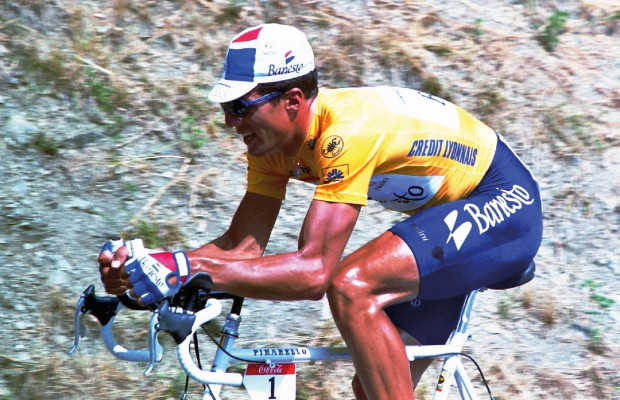
As previously announced with the agreement between Castelli and ASO to recover the leader jerseys, the Italian brand will replace Santini starting in 2027, regaining a responsibility it held between 1989 and 1994, during the victories of Greg LeMond and Miguel Indurain.

In the other three jerseys, Castelli has been much more conservative. The yellow incorporates special pigments to intensify its color, as well as the signature of Henri Desgrange and a detail with the French flag hidden next to the zipper. In the polka dot jersey, the Castelli scorpion is integrated within one of the red circles, while the green maintains its current shade.
The four garments also share small nods to the Tour, such as the hexagonal zipper pulls and the stage profiles reproduced through tiny dots on the elastic bands.

Steve Smith, global brand manager of Castelli, explained during the presentation the importance they had given to that legacy:
"For any cycling apparel brand, making the yellow jersey represents the greatest honor possible. We wanted these jerseys to be truly special, which is why every little detail comes from our deep respect for what they represent for this sport and for the riders who earn them."
He added: "Beyond improving performance and aerodynamics, every element has been designed to honor that legacy."
También puede interesarte
Road
Castelli returns to the Tour de France yellow jersey 33 years later
Road
The UCI changes the rules for 2027: winning the MTB World Championships will earn more points than a Tour de France stage win
Road
Zwift expands Watopia with three new islands and 17 kilometres of roads along the ocean
Bike Equipment
One jersey for the whole winter? Our review of the Gobik Weezer
Road
Etxeondo returns to Movistar Team: the historic Reynolds and Banesto partnership is back in 2027
Road
