“We're furious”: Cyclists call for better helmets and greater safety following the death of Finlay Tarling
"We are speechless and filled with rage"
The CPA issued a strong statement after the news of the young British rider's death.
"We are speechless and filled with rage," the union stated. "It is not fair that the life of a young athlete ends this way and we are furious that even today it is not possible to prevent such serious accidents."
The Volta a Portugal used a mobile road closure during the stage. This system creates a bubble around the race using organizational and police vehicles that temporarily cut off crossings and access points. Once the competition passes, the roads gradually reopen. The problem arises when there are cyclists far behind the peloton.
The weak point of mobile closures
Adam Hansen, president of the CPA, explained to BBC Sport that drivers may interpret that the race has ended once they have passed the breakaway and the main peloton, even if there are still riders behind.
RECOMENDADO
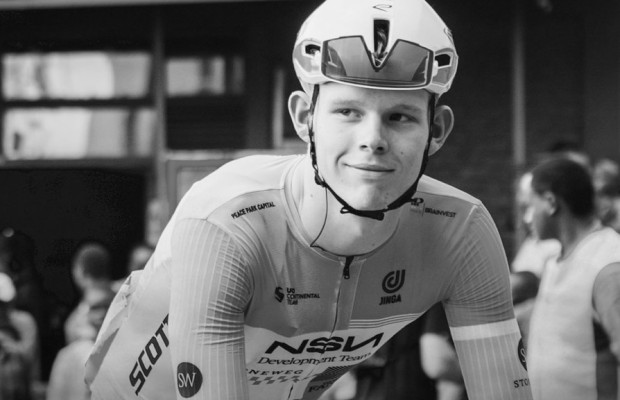
Finlay Tarling dies at 19 in the Volta a Portugal after a car accident
When to skip training and rest without feeling guilty
Free aero gains for your bike: small changes that make you faster
More power, less fatigue: how nitrates could help you on the bike

An indoor trainer can do more for your training than you think: here are 7 reasons to own one
How to change the feel of the brakes without having to buy new ones
"When the breakaway or the main group passes, sometimes drivers think that is the whole race. But in reality, there are riders behind, and in some mountain stages, the difference can be 45 minutes", Hansen explained.
The information that emerged later about the accident helps to understand why the CPA points out this problem.
According to statements from Carlos Catanario, of the Portuguese police, reported by RTP, Tarling was trying to make up ground during a descent while the peloton was ahead, divided into several groups. The broom vehicle, which marks the back of the convoy and the end of the mobile closure, was still behind the British cyclist.
The driver involved reportedly remained stopped while part of the race passed and then re-entered the road before the broom vehicle passed. He was driving against the direction of the competition when the collision occurred. The police investigation is still open and will need to clarify the circumstances and possible responsibilities definitively.
The difficulty of closing hundreds of kilometers
Hansen acknowledges that ensuring an absolute closure is extremely complicated. A stage can exceed 150 kilometers and cross hundreds of intersections, secondary roads, paths, and private accesses.
"Closing every road and every entrance is difficult," admitted the CPA president.
Precisely there lies one of the greatest safety challenges in cycling: temporarily converting hundreds of kilometers of public roads into a completely protected competition area.
The problem is not new. Max Schachmann was hit by a car that had accessed the route of Il Lombardia in 2020, and other incidents and dangerous situations with vehicles not involved in the races have been recorded in recent years.
The CPA also wants to review helmet safety
Hansen has taken advantage of the debate to introduce another issue he considers necessary to address: the safety standards of helmets used by professionals.
"One thing we need to review is the helmets. They need significant improvement", he stated.
The CPA president specifically points to the European standard EN 1078 and believes that the minimum requirements set for cycling helmets may fall short of the actual conditions of a professional race.
Hansen cites 19.5 km/h as a reference for the impact tests associated with certification and questions whether it is sufficient for a sport where riders can easily exceed 80 km/h during a descent.
This does not mean that current helmets are designed only to protect up to 19.5 km/h. The figure corresponds to the conditions of certain certification tests. Hansen's point is that helmets intended for professional cycling may need specific standards that better reflect the speeds and risks of competition.
Races are getting faster
The debate comes at a time when speeds in professional cycling continue to rise. Advances in aerodynamics, materials, training, and nutrition, combined with an increasingly aggressive way of competing, have significantly increased the pace of races.
During the last Tour de France, for example, stage 11 reached an average speed of 50.91 km/h, the fastest in the history of the race.
Tarling's death also adds to other recent fatal accidents, although occurring under different circumstances, such as those of Gino Mäder in the Tour de Suisse 2023 and Muriel Furrer in the Zurich World Championship 2024.
Criticism has also come from outside the CPA. Former professional cyclist Jérôme Pineau described the safety measures of the Volta a Portugal as "catastrophic" and called for greater oversight from the UCI regarding the ability of organizers to protect the routes.
The death of Finlay Tarling has thus once again placed safety at the center of professional cycling. The CPA demands a review of two different but fundamental areas: how a race is protected from external traffic and whether the equipment of cyclists is evolving at the same pace as the speeds currently reached by the peloton.
También puede interesarte
Road
Finlay Tarling dies at 19 in the Volta a Portugal after a car accident
Training
When to skip training and rest without feeling guilty
Road
Free aero gains for your bike: small changes that make you faster
Nutrition
More power, less fatigue: how nitrates could help you on the bike
Training
An indoor trainer can do more for your training than you think: here are 7 reasons to own one
Mechanics
