The heatwave in Spain takes down Lael Wilcox and her attempt at the round-the-world record
Just two weeks ago, Lael Wilcox started in Chicago one of the most ambitious challenges ever faced by a female ultracyclist. The American wanted to become the fastest person in history to cycle around the world, breaking the absolute record of 78 days, 14 hours, and 40 minutes set by Mark Beaumont in 2017. But the challenge has ended sooner than expected.
Lael Wilcox abandons her world record attempt after suffering heat exhaustion during a European heatwave
Wilcox announced her withdrawal from the attempt after suffering heat exhaustion while crossing France during the intense heatwave affecting much of Europe. The ultracyclist had been traveling for 14 days and had covered nearly 4,800 kilometers when, upon the recommendation of her own support team, she decided to end the adventure.

The news is particularly striking because Wilcox had approached this project with much more thorough preparation than any other challenge in her career.
RECOMENDADO
What do the colours of the rainbow jersey mean, and who was the first World Champion?

How much prize money does La Vuelta 2026 offer? Here’s what Enric Mas has earned and how it compares with the Tour and Giro
Sign up first, train later: why entering a race can change the way you train
Cycling improves how we think, remember and process information: a new study confirms it
From struggling to enjoying it: tips to build confidence on descents
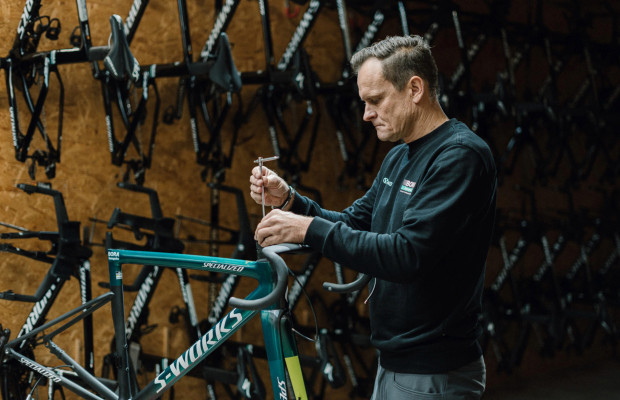
Are you properly positioned on your bike? These are the measurements you should check
The American, who in 2024 became the fastest woman to complete a bicycle tour around the world after covering 29,169 kilometers in 108 days, 12 hours, and 12 minutes, was now looking to reduce that record by almost a month to also surpass Beaumont's absolute mark.
To achieve this, she had organized a complete support team for the first time, had subjected her position and equipment to aerodynamic tests in the Specialized wind tunnel, and even shaved her head after finding that it could slightly improve her aerodynamic efficiency and simplify daily logistics during the trip.
Her goal was to maintain an average of 386 kilometers per day for nearly three consecutive months.
The heat began to take its toll in Spain
After leaving Chicago on June 7 and completing the first part of the route through North America, Wilcox landed in Europe just as a new heatwave began to spread across the continent.
The cyclist explained that the problems began shortly after arriving in Spain, where she encountered extreme temperatures associated with what she described as a true “heat dome.”
For several days, she tried to maintain the planned pace using all possible strategies to combat the high temperatures. On her social media, she showed how she constantly used ice to try to lower her body temperature during the stages.
Even so, the sensations worsened day by day. “It’s hitting me every day,” she joked in a post made on Saturday.

According to Wilcox herself, she had been suffering from nausea for several days while trying to maintain the necessary pace to still be in contention for the record.
The situation worsened on Sunday morning when she began to vomit just an hour after starting the day. By that point, she had already lost time compared to the planned schedule, and the team accompanying her began to seriously worry about her physical condition.
“It’s almost a miracle that I haven’t fainted. I’ve never tried this hard,” she confessed in a video posted on Instagram.

Finally, when she reached Fontainebleau, south of Paris, and with weather forecasts indicating that the heatwave would continue to accompany her route for much of the European journey, the final decision came.
One of her team members informed her that she was showing all the symptoms consistent with heat exhaustion and recommended that she stop the attempt.
“I’ve reached a point where I no longer enjoy how hard it is. I’m just trying to survive. Every day I thought it could be the last, and I guess today has been that day,” she explained emotionally.
Beyond the sporting aspect, Wilcox wanted to highlight the role that weather conditions have played in the outcome of the attempt.
“I think I’m stronger than ever, but it’s just not working. This is another lesson about climate change, and every year I have more experiences like this,” she stated.

The American explained that during the planning of the challenge, her main concern was the wildfires that usually affect the western United States during the summer, a problem she expected to encounter later in the route. However, she did not anticipate that extreme temperatures could cause health issues so soon.
“We expected a big challenge, but not health problems,” she summarized.
Wilcox's withdrawal comes at a time when the impact of high temperatures on cycling is generating increasing concern.
In Wilcox's case, the combination of extreme temperatures and a daily effort close to 400 kilometers ultimately became an insurmountable barrier.
Her attempt to become the fastest person to cycle around the world thus stops in France, just two weeks after starting. However, after already having set the women's record in 2024 and having established herself as one of the great figures in world ultracycling, few doubt that she will consider taking on a challenge of this magnitude in the future.
También puede interesarte
Road
What do the colours of the rainbow jersey mean, and who was the first World Champion?
Road
How much prize money does La Vuelta 2026 offer? Here’s what Enric Mas has earned and how it compares with the Tour and Giro
Training
Sign up first, train later: why entering a race can change the way you train
Training
Cycling improves how we think, remember and process information: a new study confirms it
Road
From struggling to enjoying it: tips to build confidence on descents
Road
