The 2027 Giro d’Italia Women goes big on the mountains, with a decisive finish at the foot of Mont Blanc
The 2027 Giro d'Italia Women already has its route, and the mountains will be its main protagonist. The race, which will take place from May 29 to June 6, will accumulate 17,450 meters of positive elevation gain over just nine stages, with two mountain finishes, a time trial climb, and a final alpine stage that promises to keep the fight for the maglia rosa open until the end.
The 2027 women's Giro presents a route with 17,450 meters of elevation gain and four major stages to decide the overall
The route of the 38th edition of the Giro d'Italia Women was presented this Tuesday in Rome alongside that of the men's race. RCS Sport has designed a race of 1,132 kilometers that will start on the Tuscan coast, cross Liguria and Lombardy, and finish in the Aosta Valley, under the Mont Blanc massif.
The main feature of the course is the concentration of significant mountain difficulties. Participants will face 17,450 meters of positive elevation gain, approximately 44% more than in 2026, spread over nine consecutive days of competition without a rest day.

RECOMENDADO
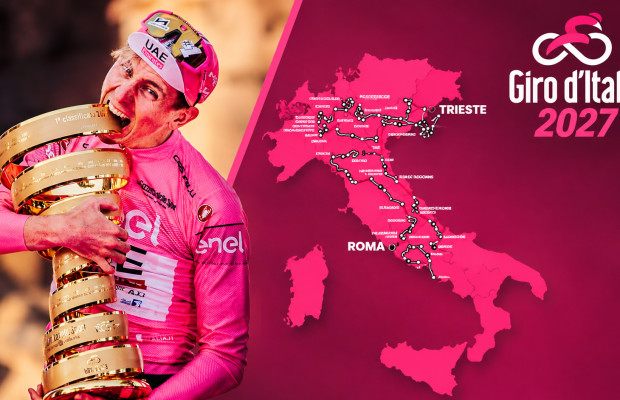
The 2027 Giro d’Italia brings back its wildest version yet: double Mortirolo, Gavia, Zoncolan, and a mountain time trial in a route with over 50,000 meters of elevation gain
Ghost announces it is shutting down for good after 33 years, becoming another victim of Accell’s crisis
Why do your legs feel heavy when you start a workout, only for that feeling to disappear later? Science has an explanation
Lorenzo Finn, cycling’s new prodigy, joins the WorldTour at just 19
What we didn’t see of the new Orbea Oiz: prototypes and blind testing on the road to victory

Still got it: Dumoulin flies in New York to set a new personal best
The first half will offer opportunities for different profiles of riders, but the route will begin to select the contenders for the overall in the fourth stage, finishing at Passo della Presolana. Two days later, one of the most demanding stages will arrive, featuring Passo San Marco and the final climb to Madesimo-Valle Spluga.
However, the organization has reserved the climax for the last weekend. An 11-kilometer individual time trial uphill will precede a high mountain stage with nearly 4,000 meters of elevation gain, where the winner of the general classification will be decided.
From Passo della Presolana to Madesimo, the first significant differences will come in Lombardy
The Giro will start on Saturday, May 29, in Viareggio, with a 124-kilometer stage that will include four ascents of Pitoro. Although the finish is flat, the accumulated difficulties could complicate a mass arrival.
The second stage, between Massa and Genoa, will follow the Ligurian coastline over a route of 139 kilometers and 2,100 meters of elevation gain. Passo del Bracco and the climb to San Martino di Noceto will provide terrain for attacks before reaching the Italian city.
The third stage, 171 kilometers between Cogorno and Viadana, will be the longest of this edition. After overcoming Passo del Bocco in its first part, the peloton will find more favorable terrain for sprinters.
The first serious test for the favorites will come on Tuesday, June 1. The fourth stage, between Credaro and Passo della Presolana, will accumulate 3,500 meters of elevation gain in just 131 kilometers. Before the final ascent, the riders will have to overcome several climbs, including Ganda and Colle di Zambla.
The final climb to Presolana features 11.6 kilometers at an average gradient of 5.4%, with sections reaching 10%. It will be the first opportunity to see which riders are in a position to contest the maglia rosa.
After a fifth stage that is practically flat with a start and finish in Cassano d'Adda, another of the fundamental stages will arrive.
On Thursday, June 3, the peloton will depart from Bergamo to tackle 137 kilometers to Madesimo-Valle Spluga, with 3,550 meters of elevation gain. The main difficulty will be Passo San Marco, with 19.6 kilometers at an average of 7.4% and ramps of up to 15%.
This ascent, whose highest point is at 1,987 meters above sea level, will be the peak of the race. After a long descent and a valley section, the riders will face the climb to Madesimo, 19.3 kilometers at 6.3%, with a particularly demanding final section.
The combination of both climbs could cause significant differences and leave the overall classification much more defined before the last two mountain stages.
An uphill time trial and Colle San Carlo will decide the Giro on the last weekend
After a seventh stage between Carugate and Rho, favorable on paper for sprinters, the race will move to the Aosta Valley for its conclusion.
On Saturday, June 5, an 11-kilometer individual time trial will take place in Valdigne, completely oriented towards climbing specialists. The route will present around 500 meters of positive elevation gain according to the stage sheet and maximum gradients of 9%.
The uphill time trial will require a very different effort than the previous stages and will force the favorites to compete individually, without the protection of their teammates.
But the final word will belong to the mountains. The ninth and final stage, called the Monte Bianco Stage, will cover 132 kilometers through the Aosta Valley with 3,950 meters of positive elevation gain, the highest figure of the entire edition.
The route will include four major difficulties, with ascents to Doues, Verrogne, Saint-Nicolas, and Colle San Carlo. The latter will be the main obstacle of the day, with 10.5 kilometers at an average gradient of 9.8% and ramps reaching 15%.
Colle San Carlo will be crested about 25 kilometers from the finish, so any differences that may open up on its slopes will still need to be defended during the descent and the final kilometers under Mont Blanc.
The stage will partially recover roads used by the men's Giro in 2019 and will offer a final opportunity to change the overall classification, even after the demanding uphill time trial the previous day.
Demi Vollering will defend her title in a Giro designed for climbers
The presented route seems particularly favorable for the great mountain specialists, although the presence of an individual time trial introduces an additional factor in the fight for victory.
The reference will be Demi Vollering, winner of the 2026 women's Giro after staging a comeback in the last stage. The Dutch rider managed to overturn a 49-second deficit to Anna van der Breggen, demonstrating how much a great mountain day can alter the classification.
The 2027 edition raises that scenario again, but with an even greater accumulated difficulty. The combination of long climbs, mountain finishes, and a final stage that offers no margin for recovery points to a race where endurance will be as important as the ability to attack.
All stages of the 2027 Giro d'Italia Women
|
Stage and date |
Route |
Km |
Elevation + |
|---|---|---|---|
|
1 · May 29 |
Viareggio – Viareggio |
124 |
1,200 m |
|
2 · May 30 |
Massa – Genoa |
139 |
2,100 m |
|
3 · May 31 |
Cogorno – Viadana |
171 |
1,350 m |
|
4 · June 1 |
Credaro – Passo della Presolana |
131 |
3,500 m |
|
5 · June 2 |
Cassano d'Adda – Cassano d'Adda |
140 |
300 m |
|
6 · June 3 |
Bergamo – Madesimo-Valle Spluga |
137 |
3,550 m |
|
7 · June 4 |
Carugate – Rho |
147 |
1,000 m |
|
8 · June 5 |
Uphill Time Trial Valdigne |
11 |
500 m |
|
9 · June 6 |
Monte Bianco Stage |
132 |
3,950 m |
|
Total |
1,132 |
17,450 m |
The 2027 edition will therefore be a test of special toughness for the title contenders. Opportunities for sprinters will be concentrated in certain stages, while the overall will mainly be contested in the major climbs of Lombardy and the Aosta Valley.
With Colle San Carlo located in the last 25 kilometers of competition, the maglia rosa could change hands even on the last day.
También puede interesarte
Road
The 2027 Giro d’Italia brings back its wildest version yet: double Mortirolo, Gavia, Zoncolan, and a mountain time trial in a route with over 50,000 meters of elevation gain
Mountain bike
Ghost announces it is shutting down for good after 33 years, becoming another victim of Accell’s crisis
Training
Why do your legs feel heavy when you start a workout, only for that feeling to disappear later? Science has an explanation
Road
Lorenzo Finn, cycling’s new prodigy, joins the WorldTour at just 19
Mountain bike
What we didn’t see of the new Orbea Oiz: prototypes and blind testing on the road to victory
Road
