Spectacular breakdown of Jakobsen after hitting his minihook wheel
During yesterday's stage of the UAE Tour, riding on a wide road at full speed, something quite common in these days happened: a sharpener, handlebar touch, and several cyclists on the ground. An incident that would have been just another race occurrence if it weren't for the images showing how the front wheel of Fabio Jakobsen's bike had lost its tire.
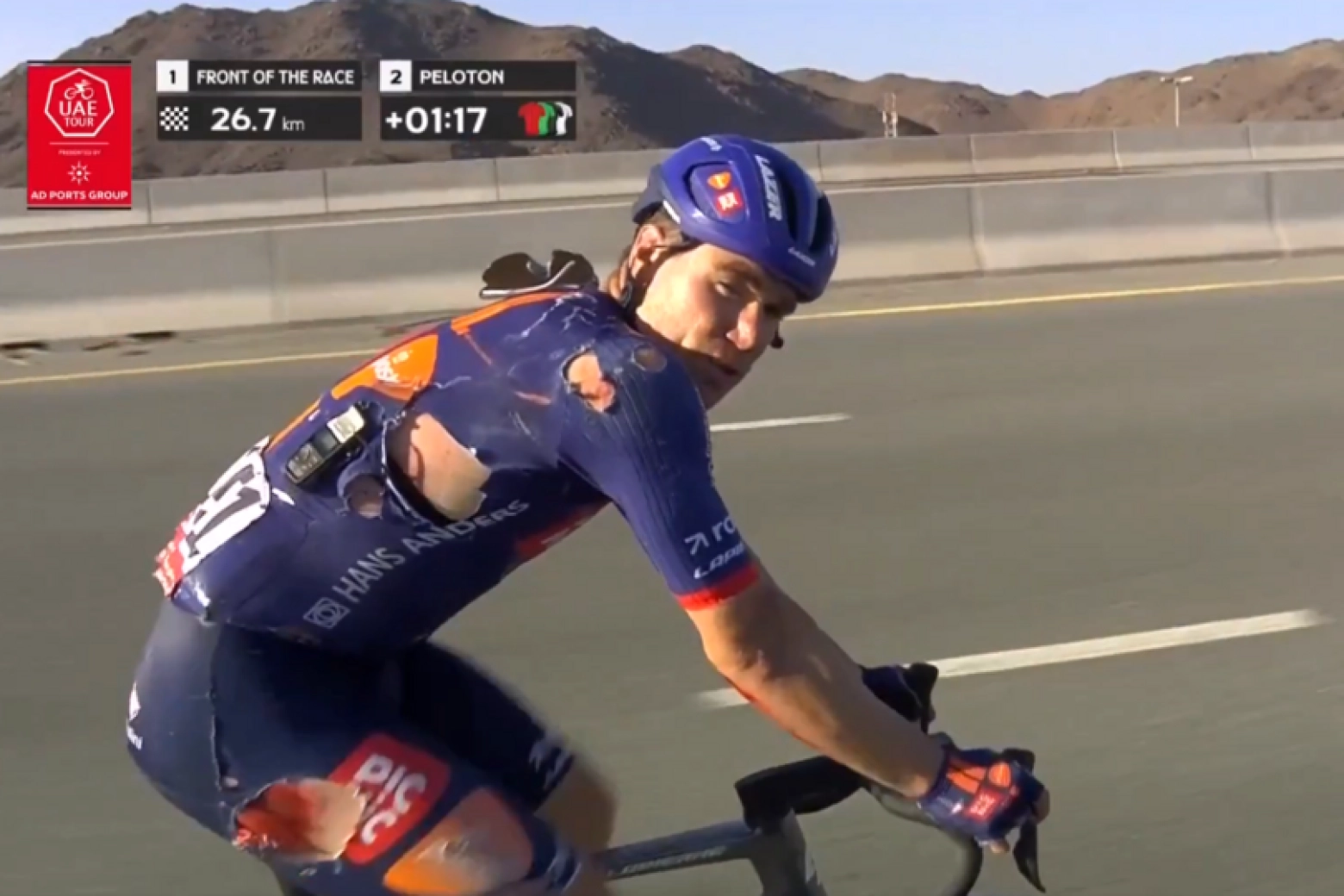
The controversy over the safety of current tubeless road wheels resurfaces
As often happens in these situations, critics of the tubeless system in road bikes soon began to appear, blaming the tire's dislodgment as the cause of the incident. However, a few minutes later, the cameras showed, in a rather distant image, how a fall occurred affecting several riders on the left shoulder of the road, and Jakobsen found himself right in the middle of it, unable to avoid it, and took a spectacular tumble, something the cyclist himself would confirm after the stage ended, fortunately without any serious injuries, just the usual abrasions.
In any case, due to the fall, the team later argued that the cyclist had hit a stone, which again calls into question the safety of current tubeless road wheels, especially considering that, as can be clearly seen in the images, Fabio Jakobsen was using mousse inside his tires, which should, in principle, add more safety against impacts and prevent the tire from coming off.
The hard fall with Jakobsen and Hayter involved, in which the bike ended up completely destroyed and with the tubolito out.#UAETour pic.twitter.com/dcd2xpQBda
— Eurosport.es (@Eurosport_ES) February 19, 2026
While doubts about safety had been limited to hookless rims and their limited specifications regarding maximum pressure, the fact is that the wheels of the Picnic-PostNL bikes, from the Italian brand Ursus, specifically the Arya R 50 model, are not hookless but use what has been termed as minihook, a reduced hook on the edges of the rims that aims to maintain the advantages of hookless while adding a bit more safety.
The fact is that there is currently no standard indicating how the minihooks of this type of rim should be, so each brand sizes them according to their experience, tests conducted, and other internal parameters. It is also curious that this has happened when the specifications of the Ursus Arya R 50 wheels state that they accept a maximum pressure of 8.5 bar.
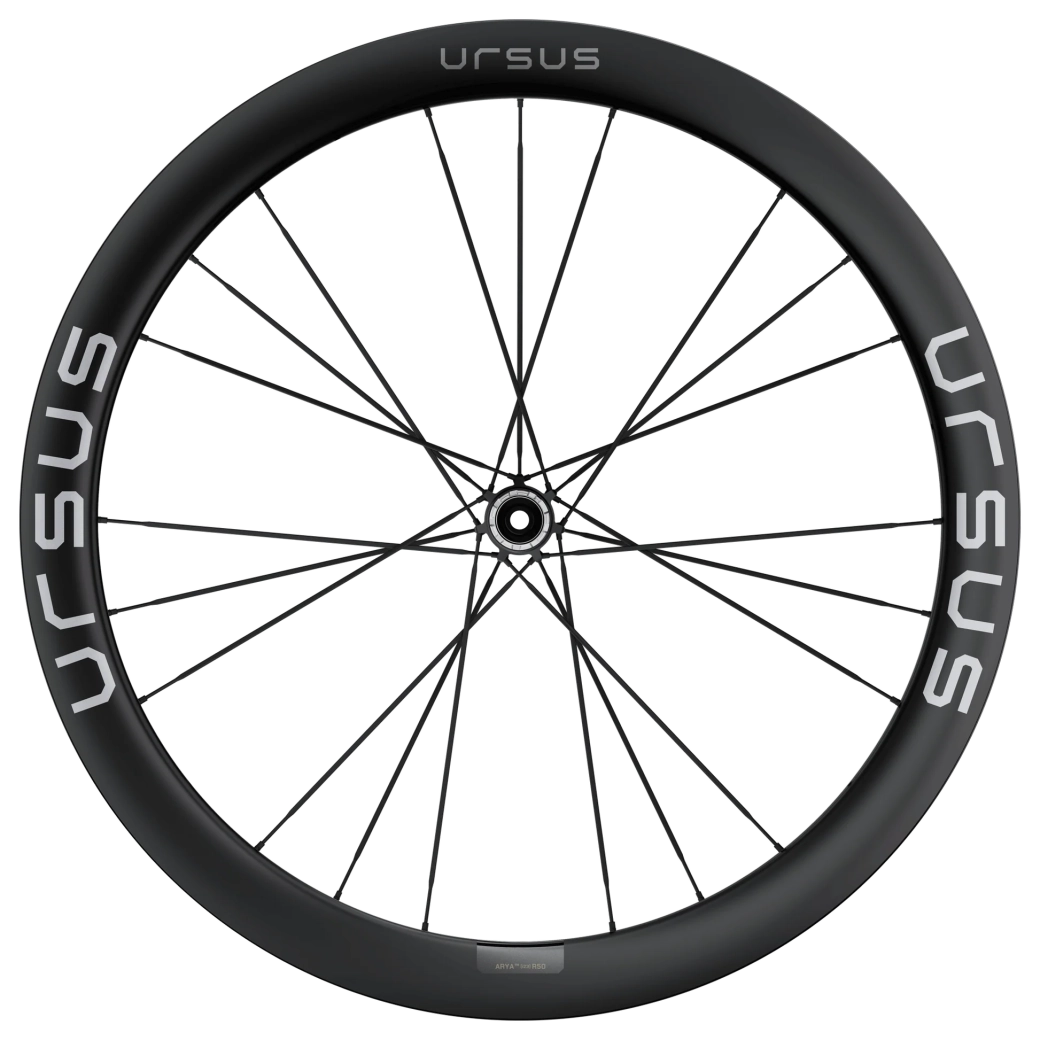
Another aspect that is not taken into account is that, just like with the incident that started the debate on hookless wheels, when in the 2024 season the dislodgment of the tire from Thomas de Gendt's bike sent him to the ground, the tires used in both cases were from the brand Vittoria. In fact, the Italian brand was forced to launch a version of 700x29c to meet safety standards for hookless rims, and apparently, the Picnic-PostNL cyclists would be using 700x30c. However, it is possible that the enormous flexibility of the sidewall of their Corsa could have something to do with these incidents.
In any case, for the peace of mind of users of this type of wheel, the truth is that such incidents are quite isolated, something we have experienced in the past. Do you remember when disc brakes started to arrive, and after every fall, a cyclist would claim that their injuries were due to a cut from the discs? How many incidents like this have occurred in recent years? When we see images of tires off their rims, it is usually as a result of an impact and not the dislodgment of these being the cause of the incident.
También puede interesarte
 Road
Road
The highest-paid cyclists in the world in 2026: Pogacar continues to lead the ranking.
 Mountain bike
SCOTT Spark RC 2026 Range: updated models, prices, and weights
 Bike Equipment
When do helmets have to be changed? Do they have an expiration date?
 Nutrition
What benefits does bicarbonate have for cyclists?
 Training
Is a cyclist born or made? The eternal debate between talent and training
 Training