Shimano revolutionises its new SPD-SLR: the cleat-and-pedal system changes after more than 20 years and won’t be compatible with previous versions
Shimano has just made one of those changes that are particularly relevant precisely because they happen so rarely. The Japanese brand has introduced SPD-SLR, its new pedal and cleat system for road cycling, leaving behind an SPD-SL architecture that had remained practically intact since its arrival in 2003.
The launch is accompanied by the new Dura-Ace PD-R9300 and Ultegra PD-R8200 pedals, as well as a new family of cleats and S-Phyre shoes specifically developed to make the most of the system. Shimano promises less weight and height, a simpler attachment, and greater adjustment possibilities. But the most important consequence is that the new SPD-SLR system is not officially compatible with the previous SPD-SL cleats.

Shimano SPD-SLR, the first major change since 2003
For more than two decades, Shimano has maintained the SPD-SL system as the reference for its automatic road pedals. Now the company has decided to redesign the entire set instead of just evolving the pedal.
RECOMENDADO
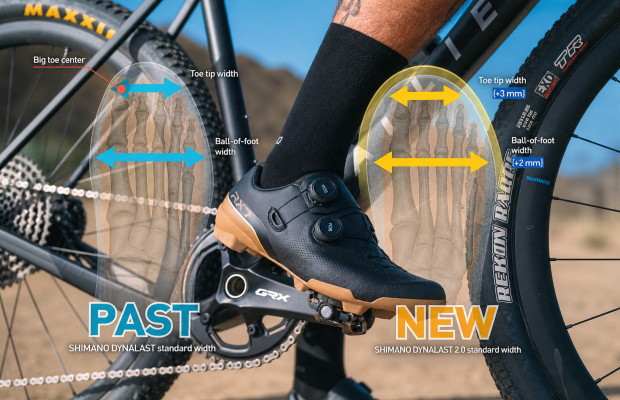
Shimano redesigns its cycling shoes to fit a wider range of foot shapes
A new 13-speed Shimano Dura-Ace is already racing at La Vuelta

When to skip training and rest without feeling guilty
Free aero gains for your bike: small changes that make you faster

More power, less fatigue: how nitrates could help you on the bike
An indoor trainer can do more for your training than you think: here are 7 reasons to own one
The new SPD-SLR is born as a system made up of pedal, cleat, and shoe. It is not mandatory to use all the new components together, but Shimano assures that this is how all the advantages expected from its development are obtained.

The main change is bringing the foot closer to the pedal axle. The pedal and cleat set reduces its height by 2.3 mm compared to SPD-SL. In Dura-Ace, the total announced height for pedal and cleat is 12.5 mm, while Ultegra is at 13.3 mm. The new shoes allow for an additional reduction of 0.7 mm.
According to Shimano, placing the foot closer to the axle improves stability and the feeling of connection with the bike, as well as favoring power transfer and control.
New Dura-Ace PD-R9300 and Ultegra PD-R8200 pedals
At first glance, the new pedals maintain much of Shimano's characteristic aesthetics, but their operation changes.

One of the innovations is in the position that the pedal adopts when it is free. The previous SPD-SL pedals were approximately at 15.5°, while the SPD-SLR reduces that angle to 10.5°. This way, there is a larger surface to find the front part of the cleat when starting the engagement, and it requires 5° less rotation to complete the movement.

Shimano has also worked on the connection between the pedal and cleat to reduce small movements or flexes that can occur when pulling the pedal during a sprint or intense climb.
The Dura-Ace PD-R9300 maintains the particular arrangement of the inner bearing next to the side of the platform, while in the Ultegra PD-R8200 it is located underneath. Shimano attributes to the Dura-Ace bearing system lower resistance to rotation and greater stiffness.

Both use an injected carbon composite body with steel contact surfaces to reduce wear.
Regarding weight, the differences between the two are minimal:
- Shimano Dura-Ace PD-R9300: 227 g per pair.
- Shimano Ultegra PD-R8200: 228 g per pair.
The Dura-Ace barely reduces a gram compared to its predecessor, while the Ultegra represents a much greater reduction, from the previous 248 g to 228 g.
A version with a 4 mm longer axle will also remain available for those who need to increase the Q-Factor.
The new cleats are lighter and allow for better adjustment of the support width
The pedal change is necessarily accompanied by new CL-SL120 cleats. Their design is thinner and does away with the rectangular washers used until now between the cleat and the screws. Thanks mainly to this simplification, the weight of the cleat and screw set drops from 71 to 55 grams.
 Shimano maintains the different angular freedom options that it already offered with SPD-SL, identified by the traditional red, blue, and yellow colors. A new gray cleat is added to facilitate adaptation to shoes that require a greater placement margin.

The new cleats also offer more lateral movement, allowing for easier adjustment of the cyclist's support width on the pedals. Shimano has also added visual references that facilitate their placement and allows the use of spacers.

However, there is an important change in the longitudinal adjustment. With the disappearance of the washers from the standard cleats, that margin of regulation is mainly transferred to the shoes. Precisely for this reason, the new S-Phyre incorporate considerably longer slots for the screw anchors.
The major drawback: SPD-SLR breaks compatibility with SPD-SL
This is probably the most important point of the entire presentation. Shimano's official position is that SPD-SLR and SPD-SL are not compatible with each other.
This means that the old SPD-SL cleats should not be used with the new SPD-SLR pedals. The new cleats continue to use the usual three-screw pattern of road shoes, so they can be installed on many current shoes, although the adjustment range will depend on the position of the anchors of each model. The best example of this was seen in the last Paris-Roubaix when Van der Poel punctured and, when trying to get on Jasper Philipsen's bike, he couldn't because they were already testing this new system and they were not compatible with each other.
A minute and a half of pure despair and agony.
— Teledeporte (@teledeporte) April 12, 2026
Mathieu Van der Poel punctures, cannot start with his teammate's bike, and loses almost all his chances of achieving his fourth #ParisRoubaix.
The 'Hell of the North', more hell than ever. pic.twitter.com/KIfL9A9LCd
Shimano has created the gray cleat precisely to improve compatibility with shoes that need to maintain a greater adjustment range. The downside is that with it, the height reduction offered by the new standard cleats is lost.

The break in compatibility will be especially important for cyclists who have several bikes equipped with Shimano pedals. The jump to SPD-SLR forces a change to be considered as a system and not simply as the progressive replacement of one cleat for another.
Shimano also renews its S-Phyre shoes
The third piece of the launch is the new S-Phyre RC910 shoes. Although SPD-SLR can be used with other compatible three-screw road shoes, Shimano has designed this model to take full advantage of the adjustment range and lower height of the new system.

The RC910 incorporates the new Dynalast 2.0 last, which is wider in the forefoot area, as well as greater longitudinal travel for placing the cleats. Shimano adds a carbon fiber heel to increase foot stability, a new upper construction, and two Boa Li2 closures.
The range is completed with the new RC810, which brings some of these innovations to a lower tier.
Prices of the new Shimano SPD-SLR
Shimano has announced the following prices for Europe:
- Dura-Ace PD-R9300: 229.99 €.
- Ultegra PD-R8200: 160.99 €.
- SPD-SLR cleats: 28.99 €.
- S-Phyre RC910: 449.99 €.
Beyond the weight figures or those few millimeters gained between the foot and the axle, the importance of the launch lies in Shimano's decision to modify one of its longest-standing standards. SPD-SL arrived in 2003 and since then had evolved without breaking its fundamental architecture. SPD-SLR now opens a new chapter for the brand's road pedals, starting with Dura-Ace and Ultegra and with a break in compatibility that will make the change much more significant than a simple component update.
También puede interesarte
Bike Equipment
Shimano redesigns its cycling shoes to fit a wider range of foot shapes
Road
A new 13-speed Shimano Dura-Ace is already racing at La Vuelta
Training
When to skip training and rest without feeling guilty
Road
Free aero gains for your bike: small changes that make you faster
Nutrition
More power, less fatigue: how nitrates could help you on the bike
Training
