Is Pogacar using lactate gels in the Tour de France?
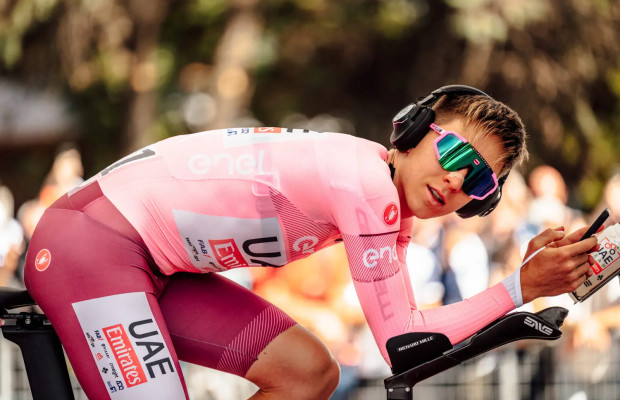
Tadej Pogačar could have been the first rider in the Tour de France to be seen using a lactate gel. During the descent of the Tourmalet, a television broadcast showed the Slovenian pulling a gel from his back pocket with a packaging almost identical to that of ExoLactate, the Spanish technology set to revolutionize nutrition in endurance cycling.
Pogacar could have debuted the biggest nutritional revolution in cycling during the Tour: a lactate gel
So far, there is no official confirmation from ExoLactate, UAE Team Emirates-XRG, or Pogačar himself that it was indeed one of these innovative lactate gels or that they are working together. However, the aesthetic coincidence and the brand's announcement that they would be present at the Tour have sparked speculation.
UPDATE: Enervit, the nutrition brand that sponsors UAE, has released a statement explaining that the gels Pogacar is using during the race are a prototype from their brand. So we’ll have to keep waiting to find out who is using the innovative lactate gels and whether they really make a difference in competition.

When ExoLactate was officially presented at the "89 Grams" event organized by Fissac in Barcelona, its representatives hinted that the product would be used during the Tour de France. However, they avoided revealing which teams or riders would be the first to try it in competition.
RECOMENDADO

Lactate gels: the next revolution in cycling is brewing in Spain
The measurement of lactate during a race will be a radical change for cycling
When to skip training and rest without feeling guilty
Free aero gains for your bike: small changes that make you faster
More power, less fatigue: how nitrates could help you on the bike
An indoor trainer can do more for your training than you think: here are 7 reasons to own one
Now, just a few weeks later, the television images have opened the possibility that the first cyclist to use this technology in the world's biggest race could be none other than the reigning world champion and one of the top favorites for the yellow jersey.
Although it remains a hypothesis for now, if confirmed, it would represent a huge boost for a technology that until very recently was still considered practically experimental.
What is special about lactate gels?
For decades, lactate was considered little more than a byproduct associated with muscle fatigue. Today, science offers a completely different perspective.
Numerous studies have shown that lactate acts as an important fuel for various tissues in the body and plays a key role in metabolism during exercise. In fact, Spanish physiologist Aitor Viribay, one of the promoters of ExoLactate and one of the leading international specialists in nutrition applied to endurance sports, has been arguing for years that many current strategies based on large amounts of glucose and fructose aim precisely to increase the internal production of lactate so that it can later be used as an energy source.

The question was obvious: if the body produces lactate to use it as fuel, why not supply it directly?
The problem was that no one had managed to develop a practical format that allowed for the ingestion of truly useful amounts during a competition.
A technological barrier that had remained unresolved for decades
That has been precisely the goal of ExoLactate. The project, developed by Aitor Viribay along with Dani Lasa, former head of gastronomic experimentation at Mugaritz, and researcher Juan Carlos Arboleya from the Basque Culinary Center, claims to have found a solution through a proprietary encapsulation technology that allows lactate to be administered in a format similar to that of a conventional energy gel.
As they explained during their presentation, each consumption strategy would allow for relevant amounts of lactate to be provided during exertion using a metabolic pathway different from that of carbohydrates.
It does not seek to replace carbohydrates
The big difference compared to traditional gels is that lactate uses different intestinal transporters than glucose and fructose.
Currently, one of the main limits of performance is not so much the amount of energy a cyclist can transport, but the intestine's ability to absorb it. Carbohydrates depend on transporters that become saturated when the amounts are very high.
Lactate, however, employs what are called MCT transporters, which opens the door to using a complementary energy pathway without directly competing with the absorption of glucose and fructose.
The idea is not to replace current carbohydrate gels, but to add a new nutritional tool capable of increasing energy availability during longer and more intense efforts.
A product that had already left the laboratory
Even before reaching the Tour, ExoLactate had already been tested by high-level athletes in both training and endurance competitions.
However, there are still no published scientific studies that allow for precise quantification of its impact on performance, so more evidence will be needed before its true potential is known.
Precisely for this reason, it is particularly striking that Pogačar could already be using it in full competition.
If it is ultimately confirmed that the gel seen during the descent of the Tourmalet was indeed an ExoLactate, the Tour de France could have become the stage for the debut of one of the most promising nutritional innovations in recent years. For now, it remains a possibility, but the images have been enough to place lactate gels at the center of the technological debate in the professional peloton.
También puede interesarte
Nutrition
Lactate gels: the next revolution in cycling is brewing in Spain
Training
The measurement of lactate during a race will be a radical change for cycling
Training
When to skip training and rest without feeling guilty
Road
Free aero gains for your bike: small changes that make you faster
Nutrition
More power, less fatigue: how nitrates could help you on the bike
Training
