Pogacar debuts a prototype of the Colnago TT2 in Romandy
The first major real test of the new generation of Colnago time trial bikes will arrive sooner than expected. Tadej Pogačar will compete today in the prologue of the Tour de Romandie with a prototype of the future Colnago TT2.
Pogacar debuts the new Colnago TT2 at the Tour de Romandie with 550 grams less
Colnago has just introduced a direct evolution of the TT1, a platform that was already considered among the most aerodynamically efficient in the WorldTour peloton. The goal of this new iteration has not been to redefine the concept, but to adjust two critical variables that are shaping the current trend in time trials: weight and control in real race situations.
The key figure is a reduction of 550 grams in the frame, fork, and seatpost. In terms of performance, this reduction has direct implications on courses that are no longer completely flat. Modern time trials increasingly incorporate more climbs, changes in pace, and technical sections where pure inertia is no longer sufficient. A lighter system allows for easier acceleration after turns or inclines, reducing the energy cost in repeated efforts.

RECOMENDADO
What do the colours of the rainbow jersey mean, and who was the first World Champion?
How much prize money does La Vuelta 2026 offer? Here’s what Enric Mas has earned and how it compares with the Tour and Giro
Sign up first, train later: why entering a race can change the way you train
Cycling improves how we think, remember and process information: a new study confirms it
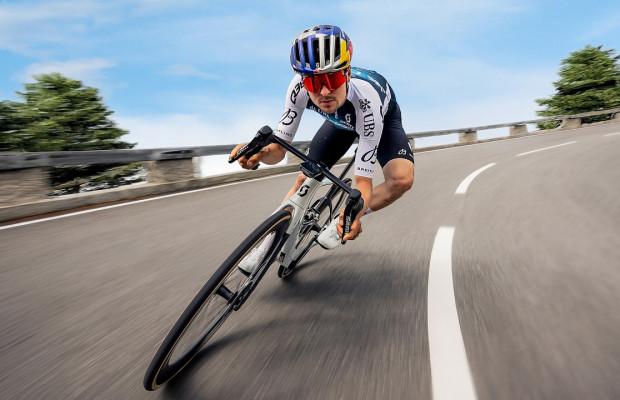
From struggling to enjoying it: tips to build confidence on descents
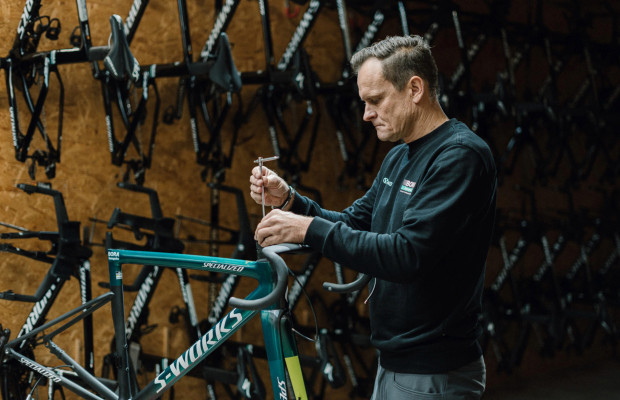
Are you properly positioned on your bike? These are the measurements you should check
In parallel, the brand claims to have maintained the aerodynamic level of the TT1 and even improved it slightly. The specific reference is approximately 2 watts of savings at 50 km/h, calculated as a weighted average at different wind angles. It is a small gain in absolute terms, but relevant in a competitive context, where differences of that order can translate into several seconds in sustained high-speed efforts.
Another area of focus has been stability. In crosswind conditions, the forces acting on the bike force the rider to make constant corrections that penalize efficiency. The TT2 aims to reduce that effect, which in practice translates to a more stable position on the aero bars and fewer micro-adjustments. This factor not only improves average speed but also reduces neuromuscular fatigue in prolonged efforts. No quantitative data on the reduction of lateral forces or yaw moments have been published here either.

In terms of geometry, the development has focused on expanding the adjustment range without resorting to extreme solutions. A new XS size is introduced, and the M and L sizes are modified with a higher front end, allowing for position adaptation without the need for large spacer towers or high extensions. The S size, which Pogačar will use, remains unchanged, suggesting that his current position was already optimized within the previous system.

Beyond pure performance, there is a clear focus on simplifying the overall system. The system has been redesigned to facilitate adjustments and use, keeping in mind a non-professional user. This is a coherent move with the launch schedule, as the model will hit the market months after its competition debut, aiming for a direct transfer of technology from the WorldTour to the end customer.

Although there are still a few months before this bike reaches the market, the debut in the prologue of the Tour de Romandie will serve as the first testing ground in real conditions. In a context where differences are measured in seconds and every detail counts, the combination of lower weight, slight aerodynamic improvement, and greater stability marks a clear direction in the development of time trial bikes. It remains to be seen if these adjustments translate into a tangible advantage over other platforms, but the mere fact that a rider like Pogacar is betting on the prototype in competition already indicates the level of confidence in its performance.
También puede interesarte
Road
What do the colours of the rainbow jersey mean, and who was the first World Champion?
Road
How much prize money does La Vuelta 2026 offer? Here’s what Enric Mas has earned and how it compares with the Tour and Giro
Training
Sign up first, train later: why entering a race can change the way you train
Training
Cycling improves how we think, remember and process information: a new study confirms it
Road
From struggling to enjoying it: tips to build confidence on descents
Road
