Pidcock insists on competing in the Red Bull Rampage and explains why he doesn't like Grand Tours
Tom Pidcock demonstrated in the last Vuelta a España that he can compete for the general classification of a Grand Tour. The Brit finished third and achieved the best result of his career in a three-week race, but even that success does not seem to have completely changed his relationship with this type of racing. Now, during the Tour de France, he has openly acknowledged that Grand Tours are not exactly the format of competition he enjoys the most.
Why doesn't Pidcock like Grand Tours?
"I really don't enjoy Grand Tours", Pidcock admitted during an interview with Sporza. A statement that may come as a surprise after seeing him on the podium of the Vuelta in 2025, but which the Pinarello-Q36.5 rider himself explains by the particular physical and, above all, mental demands of competing for three weeks.
The problem for Pidcock is not only having to face 21 stages. What he struggles with the most is accepting that, when competing for a general classification, for many days you are not racing to win, but simply to survive, maintain your position, and lose as little time as possible.
"Every day you fight and suffer, but you can't fight for victory every day. Sometimes you just have to suffer to limit losses. Mentally, that's quite hard for me", he explained.
RECOMENDADO
Volkswagen's first eBikes arrive with an integrated rear camera and radar to detect cars
Is Pogacar using lactate gels in the Tour de France?
Which workouts do you enjoy most, and what do they reveal about you as a cyclist?
Short on time to train? Here’s how to keep improving on the bike
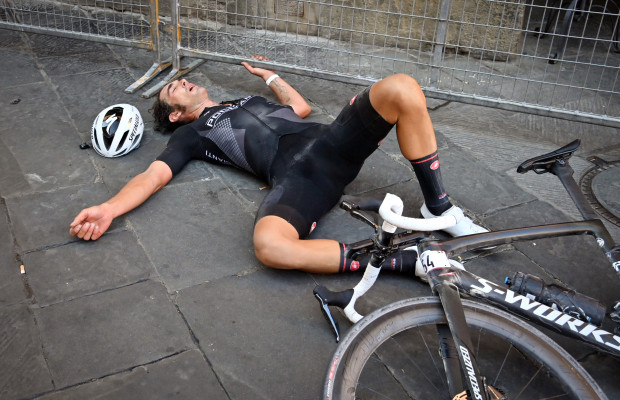
When to skip training and rest without feeling guilty
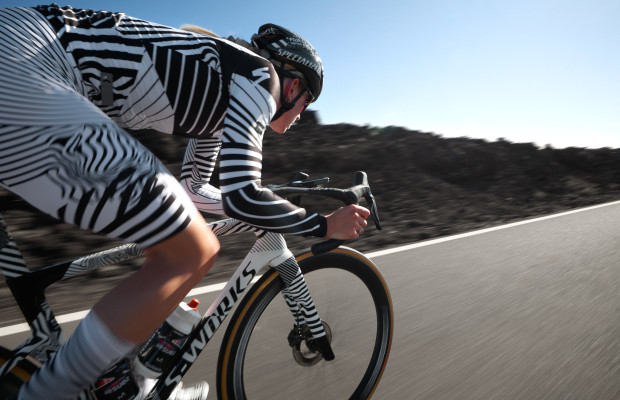
Free aero gains for your bike: small changes that make you faster
His way of understanding cycling helps to comprehend this difficulty. Pidcock has built much of his career around disciplines and races where changes of pace, technique, and the ability to improvise play a fundamental role. He has been a world and Olympic champion in XCO, a world cyclocross champion, and has won some of the most prestigious races on the road calendar.
Grand Tours, especially when the goal is to fight for the overall, require a different way of competing. There are stages where attacking is impossible or unnecessary, days where the only goal is to stay with the rivals, and long climbs where any excess can be paid for several days later.
Precisely the big climbs are another aspect of these races that least fits Pidcock's preferences.
"I like variety and races with short climbs. A long climb gives me too much time to think", the Brit stated.
Despite everything, his experience in the Vuelta a España in 2025 showed that he can adapt to those demands. Pidcock acknowledged that he enjoyed that race more as the stages progressed and considers his third-place finish as one of the greatest achievements of his career.
"Last year's Vuelta was more enjoyable as it went on. I think that was a huge achievement for me", he explained.
The paradox is evident. Pidcock has shown he has the ability to reach the podium of a Grand Tour, but the type of cycling required to achieve that is not necessarily the one he enjoys practicing the most.
The rider himself had already explained before the Tour de France 2026 that he wanted to approach the race without overly rigid goals. In Jan Frodeno's Going Mental podcast, he stated that his intention was to compete with greater freedom and reduce the pressure around his results.
"This year I'm not going with any expectations. I want to compete, I want to have fun, and the rest will come," he said then.
He also acknowledged the particular toughness of the Tour, a race capable of offering the greatest satisfactions, but also of becoming a particularly difficult place when things do not go as planned.
"When it goes well, there's no better place to perform. But when it doesn't go well, it can be miserable."
His performance in the ninth stage of the Tour, finishing in Ussel, showed precisely the version of Pidcock that seems to enjoy cycling the most. The Brit got into the breakaway, raced aggressively, and was in the fight for victory until finishing third behind Mathieu van der Poel and Tobias Halland Johannessen.
A mechanical problem ultimately affected his options in the decisive stretch. Later, Pidcock himself explained that a small stone had gotten into the button of the right lever and prevented him from using the shift properly.
Beyond the result, that day reflected well the difference between the Pidcock who has to manage efforts and minimize losses over three weeks and the aggressive and unpredictable rider who seeks opportunities to attack and win races.
His major sporting goals also seem to point in that direction. After successfully defending his Olympic XCO title in Paris, Pidcock wants to take a new step on the road by winning a Monument, while the rainbow jersey continues to be, in his own words, the ultimate goal.
Outside of professional cycling, his plans are even more varied. During the interview with Sporza, he revealed that on his personal wish list are challenges such as climbing Everest, competing in motorsport and participating in the Monte Carlo Rally, taking part in the Red Bull Rampage, achieving a Guinness record, or jumping from the railway bridge at Whistler Mountain Bike Park.
A collection of goals that, to some extent, also helps to understand his sporting personality. Pidcock seeks variety, new stimuli, and different challenges. And although he has already shown that he can be among the best for three weeks, Grand Tours force him to do something that seems particularly difficult for him: to hold back, manage, and accept that not every day can be raced to win.
También puede interesarte
eBike
Volkswagen's first eBikes arrive with an integrated rear camera and radar to detect cars
Nutrition
Is Pogacar using lactate gels in the Tour de France?
Training
Which workouts do you enjoy most, and what do they reveal about you as a cyclist?
Training
Short on time to train? Here’s how to keep improving on the bike
Training
When to skip training and rest without feeling guilty
Road
