Gravel on the Angliru? La Vuelta is considering a gravel section on one of its most feared stages
The Angliru could change its route in future editions of La Vuelta with the incorporation of a gravel section before its most extreme ramps. The proposal has already reached Javier Guillén, the race director, who has committed to studying its feasibility. The idea comes after the success of the gravel section at El Bartolo in 2026, the scene of one of the most surprising duels between Enric Mas and Tadej Pogačar.
Two dirt alternatives to reach the Angliru before its toughest ramps
The Angliru is one of those climbs that hardly needs an introduction and that, apparently, also doesn't need more difficulty. However, there is a proposal to modify its usual access and incorporate dirt roads into an ascent that is already among the most demanding in professional cycling.
According to the newspaper AS, the initiative comes from José Antonio Muñiz, former mayor of Riosa and current president of the Friends of Angliru Association, who personally conveyed the idea to Javier Guillén during an event held last Saturday in Asturias.
The proposal includes two possible dirt sections of about three kilometers in length that would connect with the Angliru road at the height of Llagos. This way, the peloton would face a sector of gravel before returning to the asphalt to contest the decisive part of the ascent.
RECOMENDADO
Pogačar reveals what caused his crash at La Vuelta and outlines his three major goals for 2027
The Tour, Giro and Vuelta reject plans to cut the Grand Tours to 16 days

Still got it: Dumoulin flies in New York to set a new personal best
“I don’t want to end up hating it”: Joey Pidcock retires from professional cycling at just 24
Haibike changes hands and survives: what happens now to warranties and technical support?
Tips to stay motivated to ride when cold weather, rain, and darkness set in
From that point, there would be less than five kilometers to the summit, precisely those that concentrate some of the most famous slopes of the climb. Los Picones and Cobayos reach gradients of 21.5%, while La Cueña les Cabres reaches 23.5%.
The modification would not eliminate, therefore, the ramps that have given international fame to the Angliru. What would change is the approach to them, adding terrain where traction, line choice, and positioning within the peloton could become even more important.
Javier Guillén agrees to study the proposal but warns about the difficulty
The organization's response has been favorable to analyze the idea, although that does not mean that its incorporation is approved.
Javier Guillén himself recalled that the Angliru is already "at the limit of extreme difficulty", so any modification should provide sporting interest without unnecessarily increasing the challenges.
"We listen to all ideas," explained the director of La Vuelta, who committed to inspecting the alternatives alongside the organization's technicians.
For now, there is no decision on which of the two tracks could be used, if any meet the necessary conditions, or in which edition this possible alternative route would debut.
The precedent of El Bartolo in 2026, when Enric Mas surprised Pogačar
The possibility of introducing gravel in the Angliru comes after La Vuelta 2026 demonstrated that unpaved roads can offer a decisive scenario in a mountain stage.
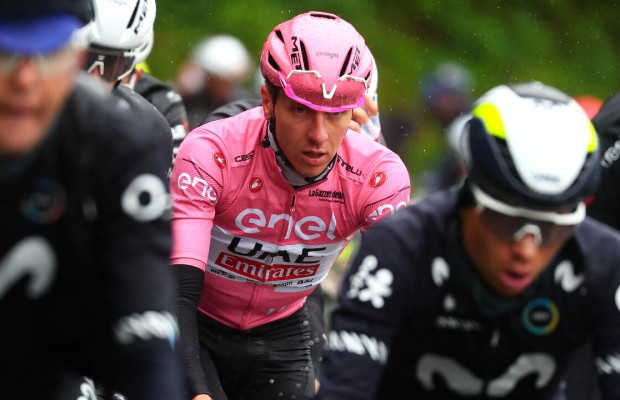
The best example was the sixth stage, with the ascent to Puerto El Bartolo and its gravel sector. There occurred one of the most striking moments of that edition, when Enric Mas managed to catch up to Tadej Pogačar after the Slovenian had attacked and distanced himself from the other favorites.
Pogačar had opened a gap before entering the dirt and seemed headed for another solo victory. However, Mas reduced the difference during the climb, managed to catch up with him just before the summit, and even passed him to reach the top first.
Although the Slovenian ended up winning that stage in a sprint in Castellón, Mas's performance left one of the most memorable images of the race.
That experiment also changed Javier Guillén's opinion on this type of route. In a subsequent interview with AS, the head of La Vuelta acknowledged that he was initially opposed to introducing gravel, but that the result had convinced him.
"Gravel has come so that La Vuelta can include it again, but not every year", he assured then, also acknowledging the efforts of technical director Kiko García to carry out that stage.
Now, just a few months later, the organization has on the table a proposal that would bring that concept to one of the most emblematic scenarios of the race.
También puede interesarte
Road
Pogačar reveals what caused his crash at La Vuelta and outlines his three major goals for 2027
Road
The Tour, Giro and Vuelta reject plans to cut the Grand Tours to 16 days
Road
Still got it: Dumoulin flies in New York to set a new personal best
Road
“I don’t want to end up hating it”: Joey Pidcock retires from professional cycling at just 24
Road
Haibike changes hands and survives: what happens now to warranties and technical support?
Training
