Doping in cycling continues its trend, but the gray areas and lower categories are concerning
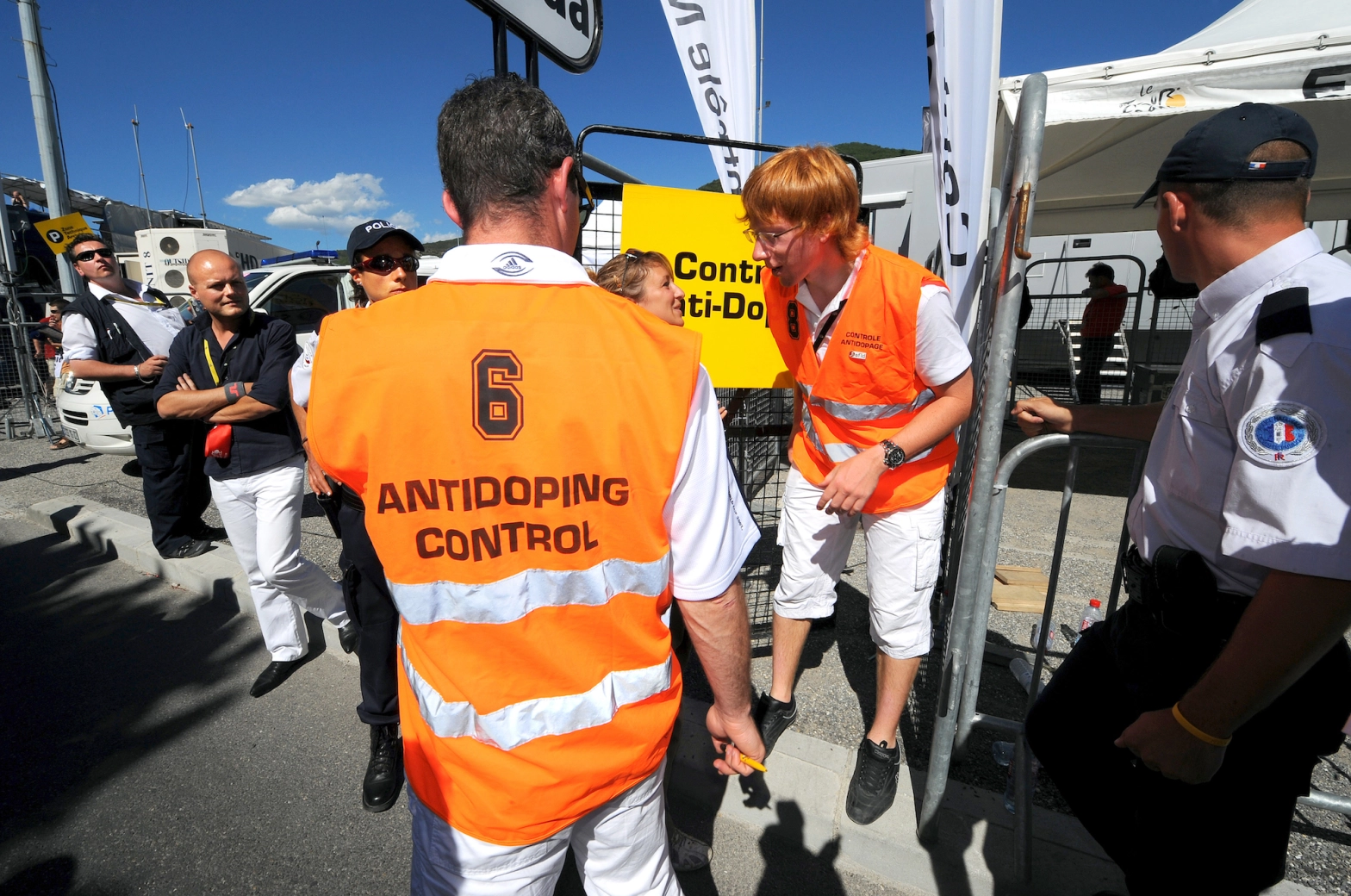
The anti-doping balance of 2025 presents an ambivalent picture for professional cycling. The Mouvement Pour un Cyclisme Crédible (MPCC) has recorded 20 doping cases among professional cyclists throughout the year, a figure that confirms the downward trend that began in 2022, when 29 cases were made public. However, the organization itself insists that the sport cannot relax and must monitor both new medical practices in the elite and the "traditional" doping that persists in lower categories.
Doping in cycling decreases in 2025, but the MPCC calls for maximum vigilance
According to the so-called "Credibility Figures," which provide a global view of the anti-doping fight in international sports, cycling ranked tenth in 2025 in terms of the number of doping and sports fraud cases. Far behind athletics (163 cases), weightlifting (63), or tennis (46, including 27 for sports fraud).
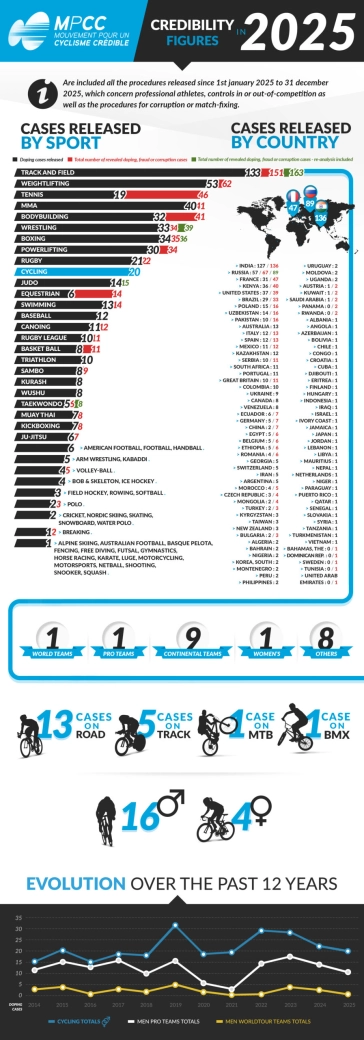
For the MPCC, this data places cycling in a much stronger position than in the past, when it was considered one of the major focal points of the problem. The reduction of positives in the professional peloton reinforces the perception that current tools (controls, biological monitoring, and increased medical supervision) are working.
RECOMENDADO
It makes them gain weight, but professional cyclists do not give up this supplement
The most reliable method for determining how many calories you burn while cycling
How to know what is making noise on your bike and how to fix it
The highest-paid cyclists in the world in 2026: Pogacar continues to lead the ranking.
SCOTT Spark RC 2026 Range: updated models, prices, and weights

When do helmets have to be changed? Do they have an expiration date?
Nevertheless, the organization emphasizes that the numerical decline does not equate to a completely clean sport.
For the first time in two years, a rider from the UCI WorldTour was suspended after anomalies were detected in his biological passport, one of the pillars of the modern anti-doping system. This concerns the Spaniard Oier Lazkano, a cyclist who did not belong to the MPCC nor raced for a team affiliated with the movement, but the case serves as a reminder that vigilance must be maintained at the highest level.
The biological passport remains a key tool for detecting abnormal variations in blood parameters over time, even when there is no direct positive for a specific substance.
The "gray areas": the most uncomfortable debate
Beyond confirmed positives, the MPCC insists on the need to question the growth of certain medical practices that, while not initially prohibited, raise ethical and health concerns.
Just over a decade ago, Tramadol was considered a "gray area" in the peloton due to its use as a painkiller to mitigate pain during races. After pressure was exerted, the World Anti-Doping Agency (WADA) eventually included it in the list of prohibited substances.
In the same vein, the organization has been critical of the widespread use of certain substances such as ketones or medical practices that increase the medicalization of professional cycling. More recently, the Union Cycliste Internationale banned in February 2025 the repeated inhalation of carbon monoxide, a measure that WADA extended to all sports starting in 2026.
For the MPCC, the concept of "credible cycling" is not limited to the absence of positives but involves reviewing any practice that may compromise the physical or mental health of the riders.
Focus on the Continental level and amateur cycling
Of the 20 cases recorded in professional cycling in 2025, nine corresponded to Continental category teams, the third tier of world cycling. This data particularly concerns the MPCC, which calls for strengthening anti-doping policies in these structures, where resources and controls may be more limited.
The problem is even more evident in the amateur realm. By the end of 2025, the Colombian anti-doping agency had 25 riders sanctioned or provisionally suspended, more than half belonging to amateur or semi-professional structures.
In this regard, the MPCC's message focuses on ensuring that a clean cycling elite necessarily involves protecting its base. The increasingly early recruitment of young talents, better prepared in technique and nutrition, requires heightened vigilance in the formative categories.
The figures for 2025 are, on paper, encouraging. Cycling no longer tops the doping statistics and maintains a downward trend in recent years. However, the recent history of the sport invites caution.
The challenge is not only to reduce positives but to prevent "gray areas" and structural weaknesses in lower categories from eroding the credibility that has been regained with such effort.
También puede interesarte
Road
It makes them gain weight, but professional cyclists do not give up this supplement
Nutrition
The most reliable method for determining how many calories you burn while cycling
Mechanics
How to know what is making noise on your bike and how to fix it
Road
The highest-paid cyclists in the world in 2026: Pogacar continues to lead the ranking.
Mountain bike
SCOTT Spark RC 2026 Range: updated models, prices, and weights
Bike Equipment