Canyon-SRAM turns to AI to discover what helps its riders perform at their best
Artificial intelligence continues to gain ground in professional cycling. Canyon-SRAM has announced a collaboration with the American company FasCat Coaching to analyze the training and performance history of its cyclists using AI. The goal is to discover patterns that help explain their best results and use that information to optimize preparation for 2027.
Canyon-SRAM will use artificial intelligence to discover which training methods work best
The German team of the Women's WorldTour has incorporated FasCat Coaching as a research and development partner in artificial intelligence for the remainder of 2026. The collaboration will focus on conducting individual season analyses on selected riders chosen by the performance department.
To do this, they will use CoachCat, a platform capable of processing large amounts of data accumulated during a cyclist's career, including histories of five seasons or more.
The main novelty is not in collecting information, something common in professional teams, but in analyzing it together to find relationships that could go unnoticed.
RECOMENDADO

The INEOS team is changing its name, kit, and colors: a new phase focused on artificial intelligence begins
“Give Mathieu those five seconds and you won't see him again for the rest of the race”: Thibau Nys has won the European title, but he can't stop thinking about Van der Poel
Kirian Mirabet’s spectacular Megamo Silk “Africa Twin”
32-inch wheels could take over in record time, and the industry has good reason to speed things up
Carlos Coloma clears up doubts over BH Coloma Team’s future and announces changes for 2027
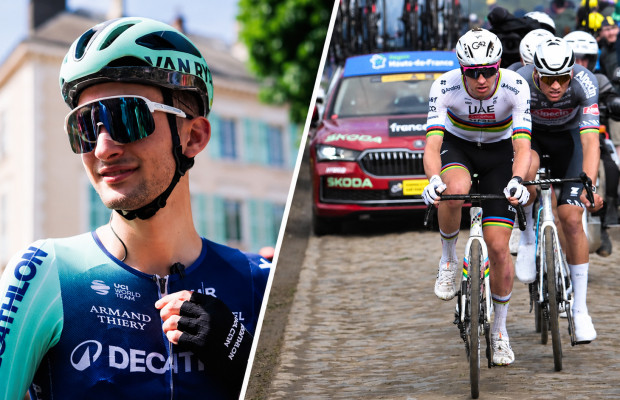
“I love the cobbles”: Seixas wants to follow the path Pogačar has blazed in record time
The system studies which training blocks have produced the greatest improvements, when performance has plateaued, or what type of preparation preceded the best results. It also cross-references training load data with factors such as heat exposure, altitude, sleep, or heart rate variability (HRV).
Based on that information, CoachCat tries to identify which strategies have worked best for each rider and suggests adjustments for their future planning.
FasCat summarizes the operation of its technology in three steps: analyze, predict, and prescribe.

The technology was already tested before the Tour de France Femmes
Although the agreement has been announced now, both parties had already worked together before the Tour de France Femmes of 2026.
During that collaboration, FasCat analyzed the history of the Canyon-SRAM riders to make power predictions in decisive stages, including the climbs to Mont Ventoux and Col d'Èze.
According to the company, the data obtained during the competition allowed them to validate those predictions and refine the model, which will now be used to detect improvement opportunities for the upcoming season.
Frank Overton, founder and CEO of FasCat Coaching, believes that teams are still not leveraging the full potential of the information they collect:
"WorldTour teams have a huge amount of untapped data that could tell them exactly why a cyclist won or lost, and what they should change. CoachCat finds those answers in minutes, not months."
For his part, Dan Fleeman, performance director of Canyon-SRAM, explains the team's interest in this technology:
"We are always looking for new ways to understand performance, and the analysis through artificial intelligence of a cyclist's entire history is a natural next step."
"FasCat's AI analyses provide our performance staff with a new and objective perspective on what has driven the best results of each rider and where we can improve for 2027," adds Fleeman.
Artificial intelligence is beginning to occupy an important place in the professional peloton
Canyon-SRAM's commitment comes at a time when more and more professional structures are looking to integrate artificial intelligence into their performance departments.
One of the most notable examples is INEOS and its alliance with Netcompany to incorporate the PULSE platform, a technology designed to centralize training, competition, and recovery information, and facilitate decision-making.
Although both initiatives share the goal of better leveraging data, their approaches are different. While PULSE has a broader scope of application, including team management and decisions during competition, CoachCat focuses specifically on historical performance analysis and individual training planning.
In any case, the approach is similar: to use technology to find small competitive advantages in a sport where the margins between winning and losing are increasingly narrow.
Canyon-SRAM has not communicated how many riders will participate in this program or whether the collaboration with FasCat will continue into 2027. For now, the confirmed agreement is limited to the last months of 2026, with the goal of preparing for the upcoming season.
También puede interesarte
Road
The INEOS team is changing its name, kit, and colors: a new phase focused on artificial intelligence begins
Cyclocross
“Give Mathieu those five seconds and you won't see him again for the rest of the race”: Thibau Nys has won the European title, but he can't stop thinking about Van der Poel
Gravel
Kirian Mirabet’s spectacular Megamo Silk “Africa Twin”
Mountain bike
32-inch wheels could take over in record time, and the industry has good reason to speed things up
Mountain bike
Carlos Coloma clears up doubts over BH Coloma Team’s future and announces changes for 2027
Road
