A custom-made AI has allowed her to improve in a short time: the Olympic champion is tired of training blindly
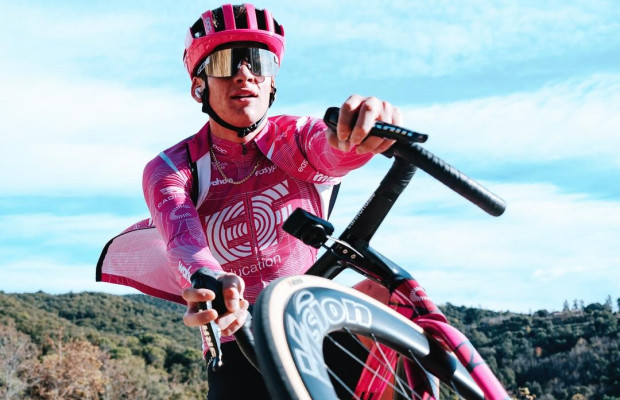
Kristen Faulkner has opened an unusual window into the invisible work behind her performance. The Olympic road champion has shared that she has been dedicated for two months to developing her own artificial intelligence tool with the goal of better understanding how her body responds and turning all that information into useful decisions for training and competition. Faulkner claims she has just set her best power record in 20 minutes.
Kristen Faulkner turns her data into performance and claims she has achieved her best power in 20 minutes thanks to an AI she created herself
The most striking aspect of the EF Education-Oatly runner is not just the use of AI, but the reason that drove her to build it. The American explains that the research she needed about her own body "did not exist," especially in a field where she believes there are still very few studies focused on women and, even more so, on elite athletes. That’s why she decided to start working on her own. "I took the matter into my own hands and started writing that research myself," she suggests in her LinkedIn post where she explains everything.
Faulkner, double Olympic gold medalist in Paris 2024 (road and team pursuit), states that for almost a decade she has been accumulating biometric data without finding a truly useful way to integrate it. Heart rate, heart rate variability, sleep, weight, power, temperature, training load, menstrual cycle phases, blood tests, and DEXA scans were part of a huge file that, until now, was scattered. According to her explanation, the problem was not the lack of data, but that each platform only offered a part of the complete picture.

RECOMENDADO
How to train on the bike when life gets in the way of a fixed training plan
Which workouts do you enjoy most, and what do they reveal about you as a cyclist?
Short on time to train? Here’s how to keep improving on the bike
When to skip training and rest without feeling guilty
Free aero gains for your bike: small changes that make you faster
More power, less fatigue: how nitrates could help you on the bike
From there, she decided to build her own system capable of gathering the sources she uses as an athlete and cross-referencing them with 4,400 hours of training history. Her idea was not to have a prettier dashboard or another statistical summary, but to develop personalized models of her physiology. In her words, "each model is trained with my body," "each finding is specific to my history," and "each result is actionable, not just interesting."
This approach, according to the American runner, has already had a direct competitive application in the preparation for the Pan American Championships, where this year she won three gold medals. Faulkner also asserts that this same tool is what has helped her now achieve her best power data in 20 minutes, a particularly relevant figure as it is one of the most commonly used references to measure a cyclist's fitness level.
The publication also helps to better understand why this project fits her profile. Faulkner recalls that she studied computer science at Harvard, worked in venture capital, and actively invests in companies related to artificial intelligence. All that background has now led her to professional cycling, where she competes in the WorldTour while preparing for her major mid-term goal, defending the Olympic gold in Los Angeles 2028.

Her message also leaves an underlying idea that goes beyond her particular case. Faulkner is convinced that artificial intelligence can change the research on female performance "from the ground up" and wants to be part of that process. She does not present it as a technological trend, but as a way to fill a historical gap in knowledge applied to high-level women's sports.
It also fits with the way she herself explains her sports career. Faulkner recalls that she came to cycling late and never had the advantage of a long prior training in competition. Her response, as she recounts, was to compensate for it with analysis, study, and preparation. Before her first European race, she even made notes on rivals, studied every curve of the routes, and obsessively reviewed her data. Now, that same logic has taken her a step further with a tool designed by herself.
These types of initiatives align with the step we have also recently taken at Brujulabike, where we have just launched our own artificial intelligence applied to cycling. Through Brujulabike Coach, any cyclist can access guided planning based on their data, with tailored recommendations and a practical approach that seeks to bring these types of tools, previously reserved for more advanced profiles, to real use in day-to-day life.
También puede interesarte
Training
How to train on the bike when life gets in the way of a fixed training plan
Training
Which workouts do you enjoy most, and what do they reveal about you as a cyclist?
Training
Short on time to train? Here’s how to keep improving on the bike
Training
When to skip training and rest without feeling guilty
Road
Free aero gains for your bike: small changes that make you faster
Nutrition
