Pogacar and the limits of the tire: Roubaix will determine how far one can go
The trend of using wider tires is also evident in the Paris-Roubaix 2026 race that will take place next Sunday, April 12. A test in which mounting larger tires makes even more sense than on the road in order to achieve maximum absorption and stability on such a peculiar terrain as the cobblestones.

Wide tires will be protagonists of the Paris-Roubaix
Not so many years ago, 700x28 tires were a rarity that professional cyclists only used one day a year, when they had to compete on the cobblestones of the Paris-Roubaix. However, over time, that size has become the standard for everyday use. So what are cyclists using today to face the Paris-Roubaix?
It is important to note that, despite the great work done by engineers in building bikes, managing to combine tremendous lateral stiffness with an unimaginable absorption capacity a few years ago, and resulting in the current norm of using aerodynamic bikes and high-profile wheels in a race that, due to its flat layout, is run at spectacular speeds. Especially if, as predicted for next Sunday, cyclists will be able to enjoy predominant winds from the south in the Paris-Roubaix, meaning a tailwind along the route.
RECOMENDADO
Are you properly positioned on your bike? These are the measurements you should check
Free aerodynamics for your bike: small changes that make you faster
Is your bike slow, nervous or hard to handle? The wheels might be causing it
3 one-hour workouts to improve speed, strength and endurance
Some workouts for cyclists who don't like series

2026 Tour de France: The Meaning of Each Jersey and How to Win It
In recent seasons, 700x30 and 700x32 tires have become common, sizes that allow for much lower pressure, providing greater grip on the cobblestones and, above all, a tremendous level of absorption. In addition, according to all studies, increasing the tire section reduces rolling resistance. In fact, the most limiting factor when choosing wider tires is usually the increase in weight, something that in the Paris-Roubaix and its flat layout is completely secondary.
However, the question is where is the limit? If we look at cyclocross, the maximum tire width is limited to 32 mm and, in fact, it is a parameter that referees check on each rider's bike using a template before races. But in road cycling, there is no such limitation. The only limitation found in the UCI technical regulations is the maximum diameter of the mounted wheel, which cannot exceed 700 mm.

If we do the math, we see that this figure is exceeded with tires starting from 700x40, therefore, within the commercial sizes available from different manufacturers, cyclists could not use more than 700x38. In any case, the diameter of the mounted tire is affected by various factors such as the width of the rim or the tire casing geometry.
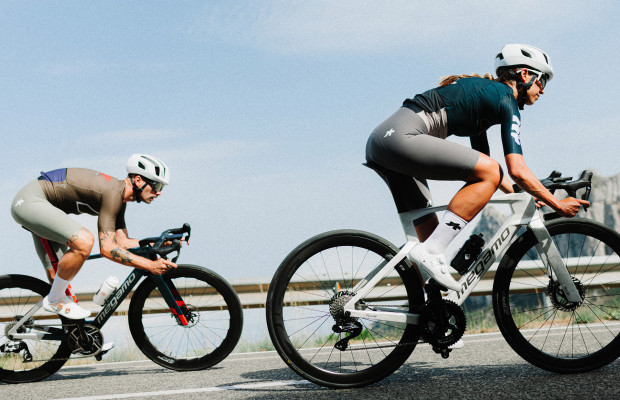
On the other hand, there is the aspect of aerodynamic bikes that are used as a general rule, machines that usually do not accept more than 700x32c. There are some models that can accommodate 35 tires since the specifications at the wheel clearance limit are always generous and leave some margin of error to ensure that the frame is not rubbed, so it is possible that some cyclists will choose this size, but no more.

For example, one of the bikes under the most scrutiny will be Tadej Pogacar’s, and we’ve already seen that the Slovenian seems determined to race this year on his Aero model. We also saw him testing equipment with what appeared to be 35mm tires, something that pushed both the bike’s limits and the mechanics to the edge, since another limitation of mounting such a wide tire is that the front derailleur can end up rubbing against it. We also saw Pogacar race with a single chainring at Milan-San Remo, but it seems that was more of a weight issue than a tire width limitation.

However, the advancements in bikes that manufacturers present year after year now take into account this factor and increasingly opt to allow the mounting of wider tires, so no one can say for sure where we will see the limit.
También puede interesarte
Road
Are you properly positioned on your bike? These are the measurements you should check
Road
Free aerodynamics for your bike: small changes that make you faster
Bike Equipment
Is your bike slow, nervous or hard to handle? The wheels might be causing it
Training
3 one-hour workouts to improve speed, strength and endurance
Training
Some workouts for cyclists who don't like series
Road
