This is how Pidcock has adjusted his riding position to improve performance in 2026
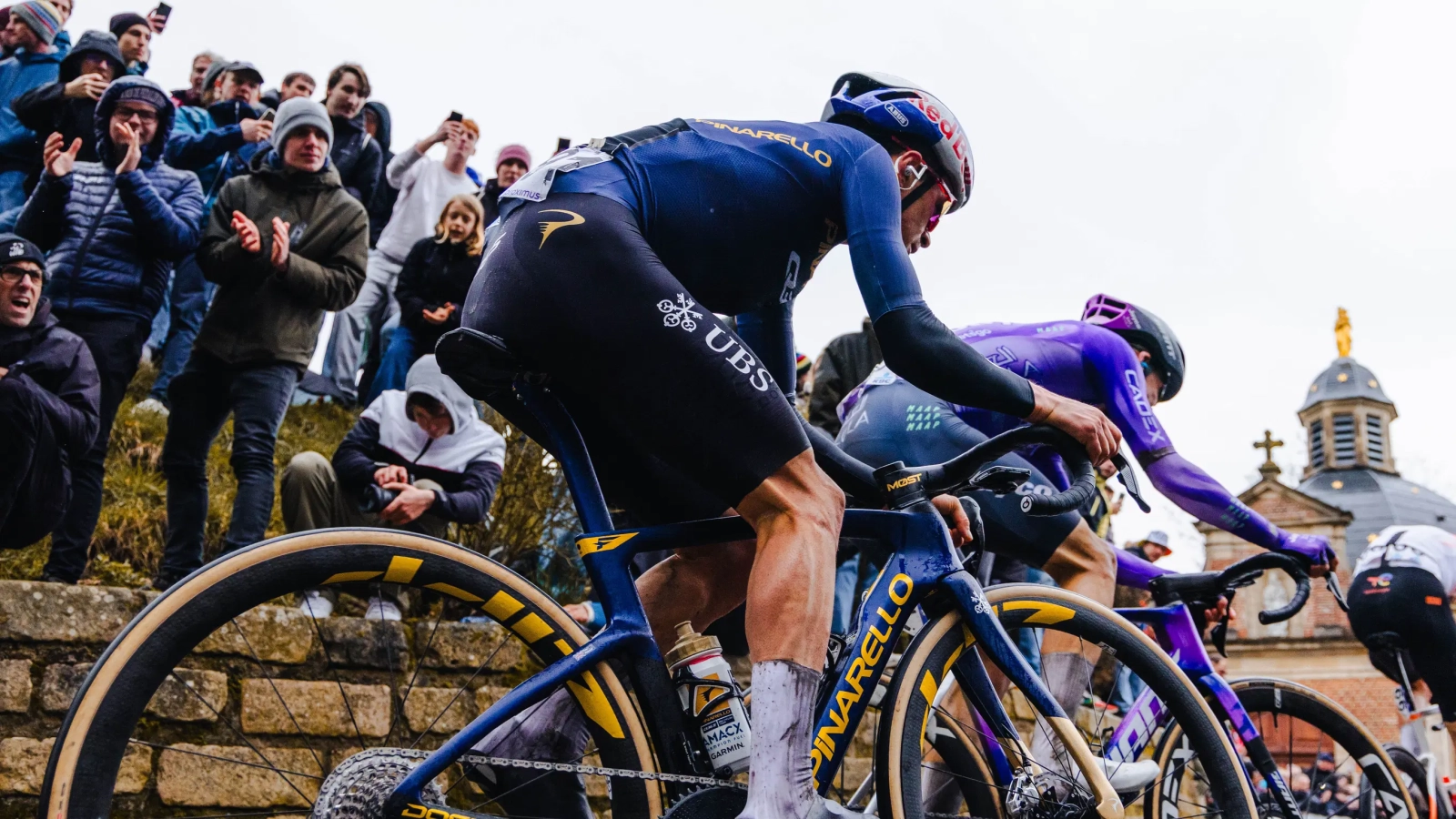
Although the Dogma F was not a completely new bike for him, Pidcock and his team switched from SCOTT to Pinarello in 2026. And a new bike required a prior setup. But, far from being a simple comfort adjustment, the work focused on optimizing his overall position on the bike, seeking that critical balance between power, stability, and endurance in prolonged efforts.
Pidcock's new bike fit relies on a longer cockpit and a compact saddle
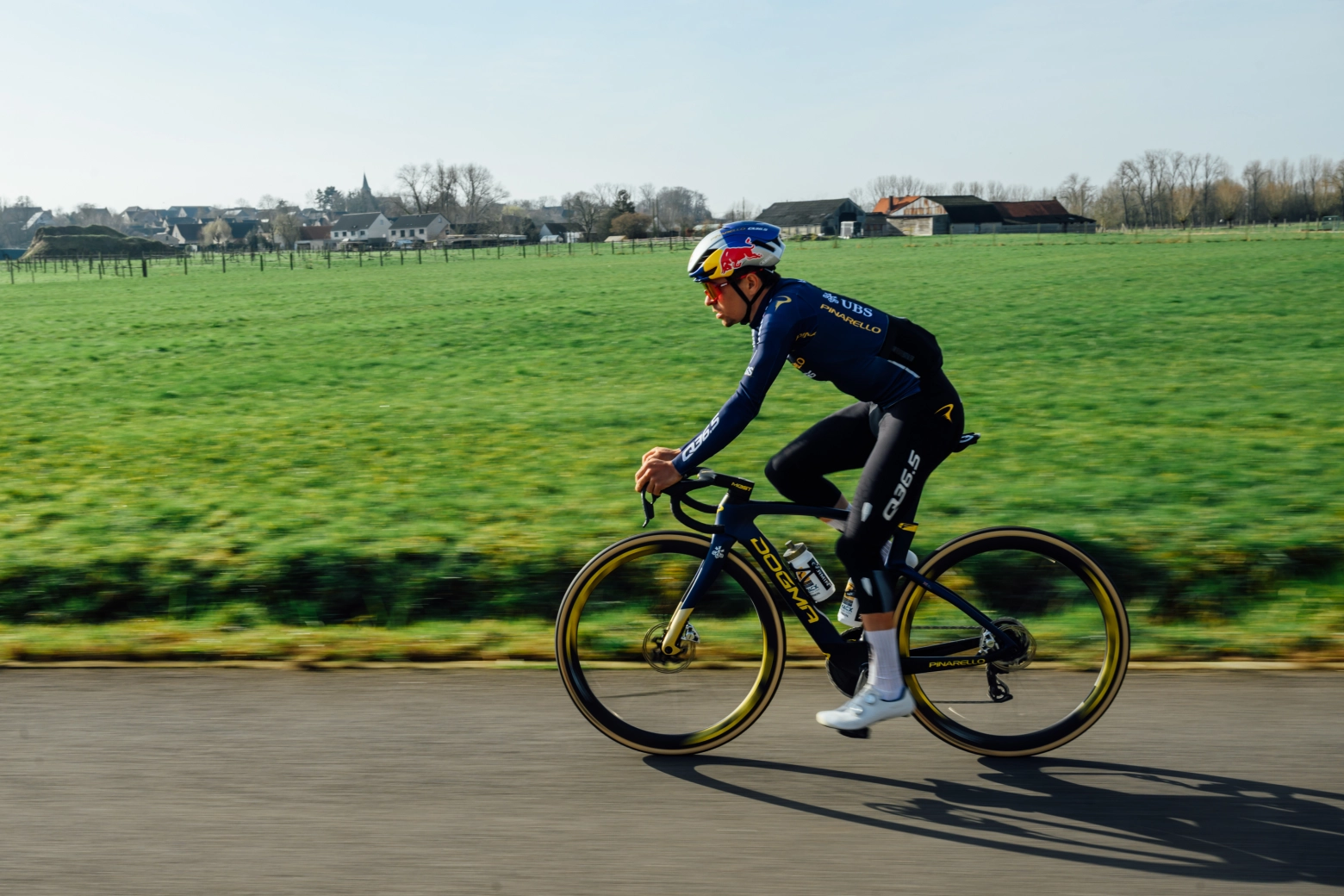
For 2026, Pidcock is generally riding a Pinarello Dogma F in size 465, equivalent to a 50, with an integrated MOST Talon Ultra Fast handlebar in a configuration of 110 mm in length and 40 cm in width. These measurements and components were chosen after the bike fit session with Ken Ballhouse, the biomechanical chief on the team, which we see in the video shared by the Swiss structure. In it, we can see that the entire configuration process revolves around how his body relates to that geometry.
The Prologo Nago R4 saddle of 137 mm as a starting point
The central element of the adjustment has been the saddle, in his case a Prologo Nago R4 with a width of 137 mm. Variations of nearly a centimeter have been made on this component compared to the previous season, alternating more rearward positions with slightly forward ones.
RECOMENDADO
The new Specialized Turbo Levo R now has an affordable version
More rigid, lighter, and faster: OQUO launches its most advanced range with carbon spokes for road and gravel
The true passion for cycling often arises far from the races, and this documentary reminds us of that
The Protone Icon returns with MAAP in a limited edition that focuses on design and performance
Zéfal Adventure, the mini pump that aims to replace a floor pump on the go
New rival for Van der Poel, Del Toro appears unexpectedly at the E3
The goal was not to find a fixed number, but to ensure that the saddle remains "under" the cyclist when he rotates his pelvis in an aerodynamic position. In this context, the compact design of the Nago R4 and its width directly influence the type of support Pidcock can achieve.
The work on the saddle is not seen as a simple adjustment but as a way to ensure stability and symmetry in pedaling when the load increases.
A 110 mm and 40 cm cockpit that defines the reach
The increase in reach of around 10 mm is integrated into a cockpit already configured with a 110 mm stem. This indicates that the length has not been radically modified, but the relationship of the cyclist with the set has been adjusted, especially through the saddle.
In the video, it can be seen that Pidcock seems very reluctant to change handlebars, but he acknowledges that at the end of the 2025 season he had some discomfort in his forearms, which could have been due to the position of the levers trying to close his position on the handlebars, so after advice and tests with Ballhouse, the Brit agreed to change his handlebars.
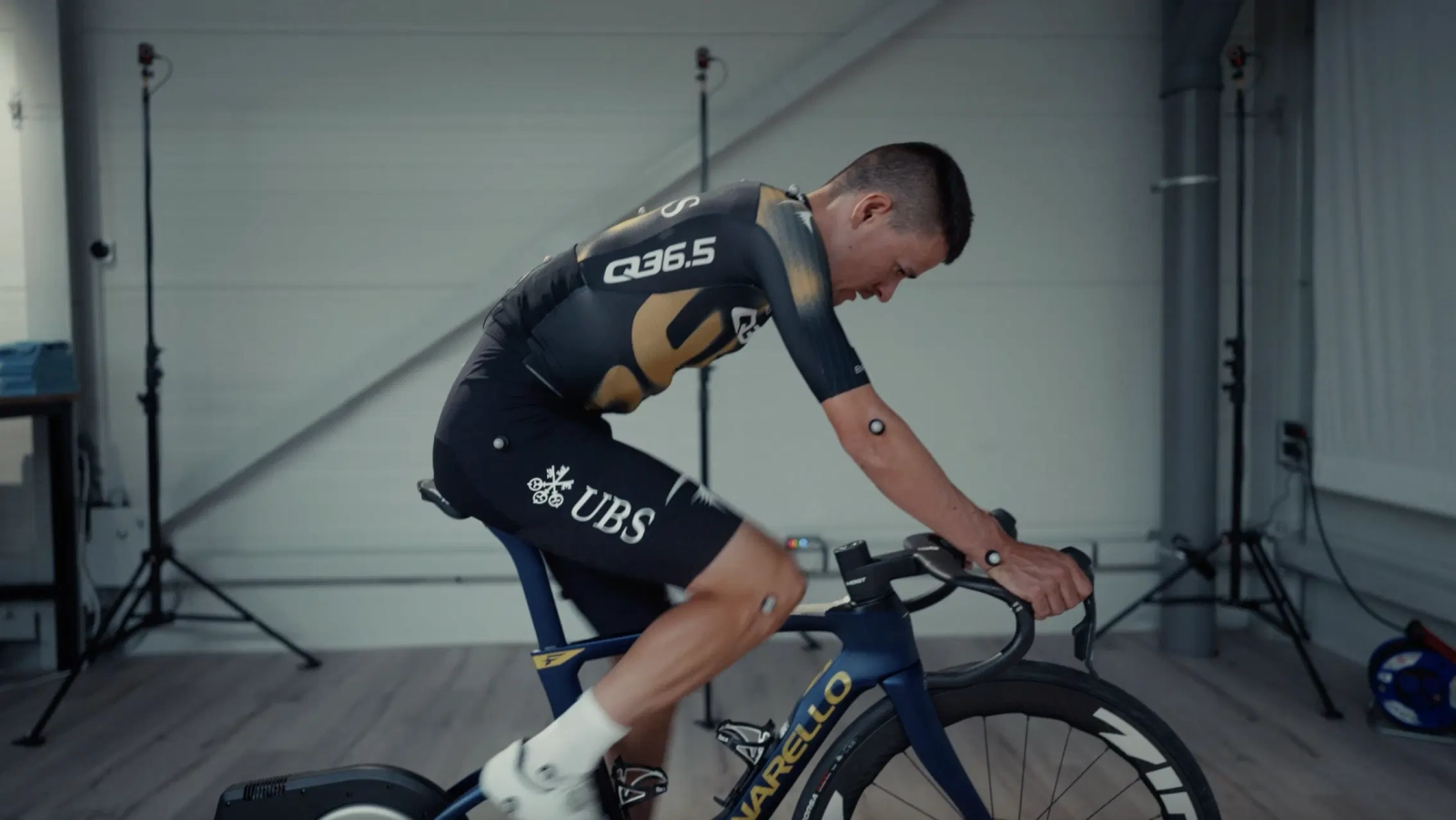
The width of 40 cm of the handlebars, along with the possibility of working up to 2 cm narrower during tests, points to a position clearly oriented towards aerodynamics. However, the process itself makes it clear that reducing width does not always improve sensations, so the final adjustment depends on the balance between efficiency and control.
165 mm cranks and pedal stroke adjustment
Another key element in the setup is the 165 mm SRAM Red cranks. This shorter length fits with a more compact position and helps maintain more favorable joint angles when riding in an aerodynamic posture.
In parallel, the bike fit included adjustments in the alignment of the cleats, especially on the left foot, where Pidcock perceives the need to slightly close the position. This type of correction is directly related to the biomechanics of pedaling and the management of muscle load.
During the process, the importance of avoiding excessive work in the pronator muscles is mentioned, something that can occur when the foot position is not correct.
3D scanning to transfer the position to the equipment
The 3D scanning allows for precise recording of how Pidcock positions himself on the bike, both on the road and in time trials. This model is used to analyze his posture and also to develop adapted equipment, especially for full suits.
This demonstrates that the bike fit is no longer limited to the bike but is part of a complete system in which each element influences performance.
An adjustment built from the ground up
The set of changes leaves a clear idea. The increase in reach is not understood as a simple modification of the cockpit, but as a consequence of better support on the saddle.
The combination of a specific saddle like the Prologo Nago R4 of 137 mm, a cockpit of 110 mm by 40 cm, and 165 mm cranks defines a system in which the position is built from the base of the body forward.
También puede interesarte
Mountain bike
The new Specialized Turbo Levo R now has an affordable version
Road
More rigid, lighter, and faster: OQUO launches its most advanced range with carbon spokes for road and gravel
Mountain bike
The true passion for cycling often arises far from the races, and this documentary reminds us of that
Bike Equipment
The Protone Icon returns with MAAP in a limited edition that focuses on design and performance
Bike Equipment
Zéfal Adventure, the mini pump that aims to replace a floor pump on the go
Road