Test of the Trek Air Rush after several weeks in the pocket of the jersey: quality, precision, and a very competitive price
Years ago, cycling sought the perfect solution for the most hated moment of any ride: the flat tire. We have moved from hand pumps (reliable but exhausting) to CO2 cartridges (quick but single-use) and now to electric pumps, which are currently positioning themselves as the most widespread option. Among these latest options, Trek has introduced its new Trek Air Rush, a compact, reliable, and very complete mini-compressor that we have just tested to see if it is really worth its price.
Manual pump, CO2, or electric? The Trek Air Rush brings order to the debate
Until recently, portable electric pumps were, to be honest, "junk." They were large, heavy (they looked like an old power bank) and barely had the power to reach the pressures required by a road bike. However, the miniaturization of batteries and motors has advanced significantly.
Trek (under its accessory umbrella that was previously branded Bontrager) has launched the Air Rush, a device that fits in the palm of your hand and seems like a real alternative, in terms of weight, autonomy, and performance, to manual pumps or CO2 cartridges. Is it the ultimate gadget or an unnecessary luxury? We carried it in the pocket of our jersey for two weeks of road and gravel riding to find out.
First contact: Build quality and actual weight
RECOMENDADO
The most important information about your bike that almost no one checks
Cobblestones, mud, and legend. Why cycling never abandoned the cobblestones
Boost your watts, boost your level: that's how you improve your FTP
What are the five monuments of cycling?
It makes them gain weight, but professional cyclists do not give up this supplement
The most reliable method for determining how many calories you burn while cycling
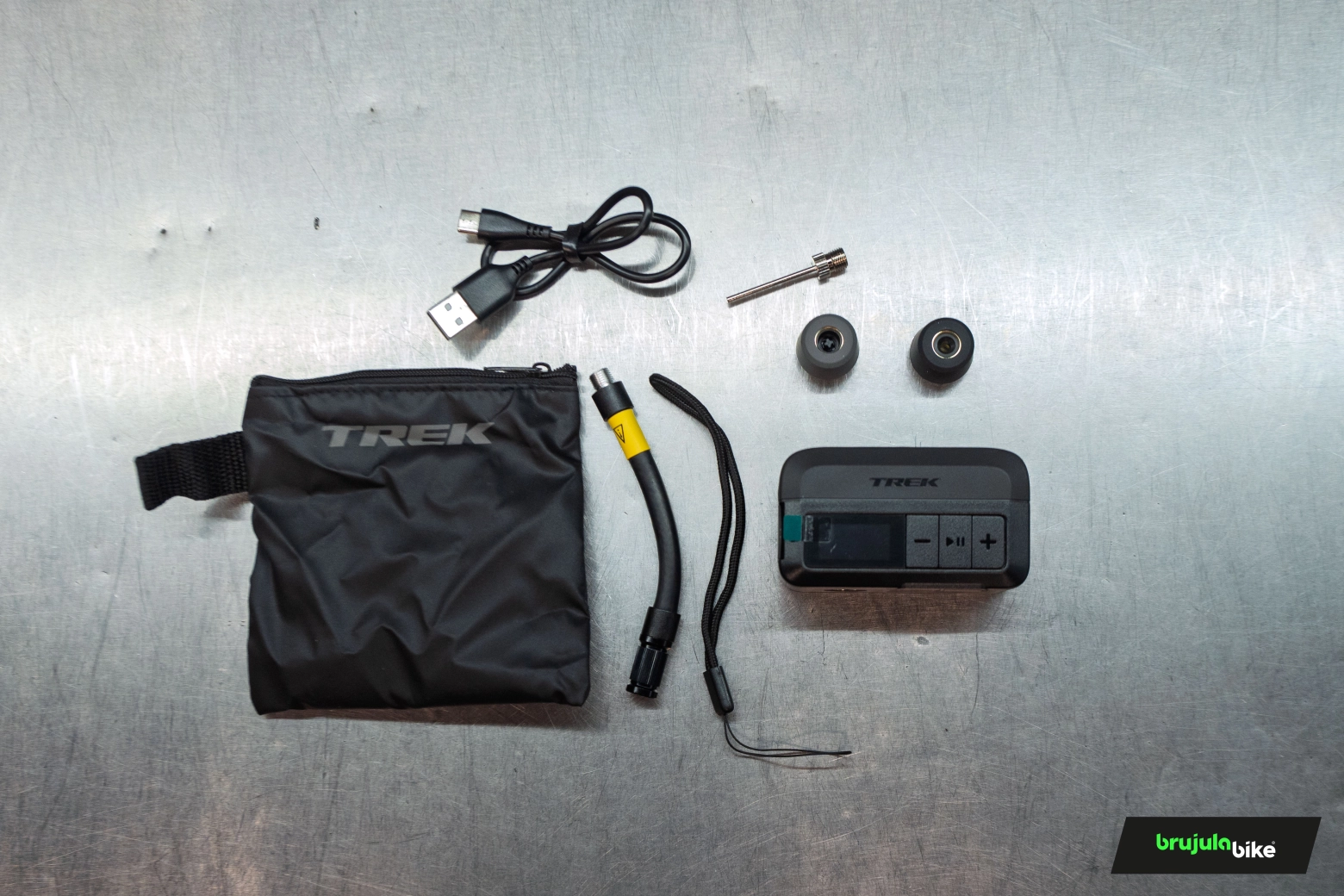
The first thing that catches your attention when taking the Trek Air Rush out of the box is its size. It is small, very small. With dimensions of 80 x 45 x 32 mm, it is barely larger than the block formed by two 25g CO2 cartridges together.
The finish is matte black, sober, and has that rough and solid feel characteristic of Trek's high-end accessories. It does not feel like a cheap hollow plastic device; it feels like a tool.
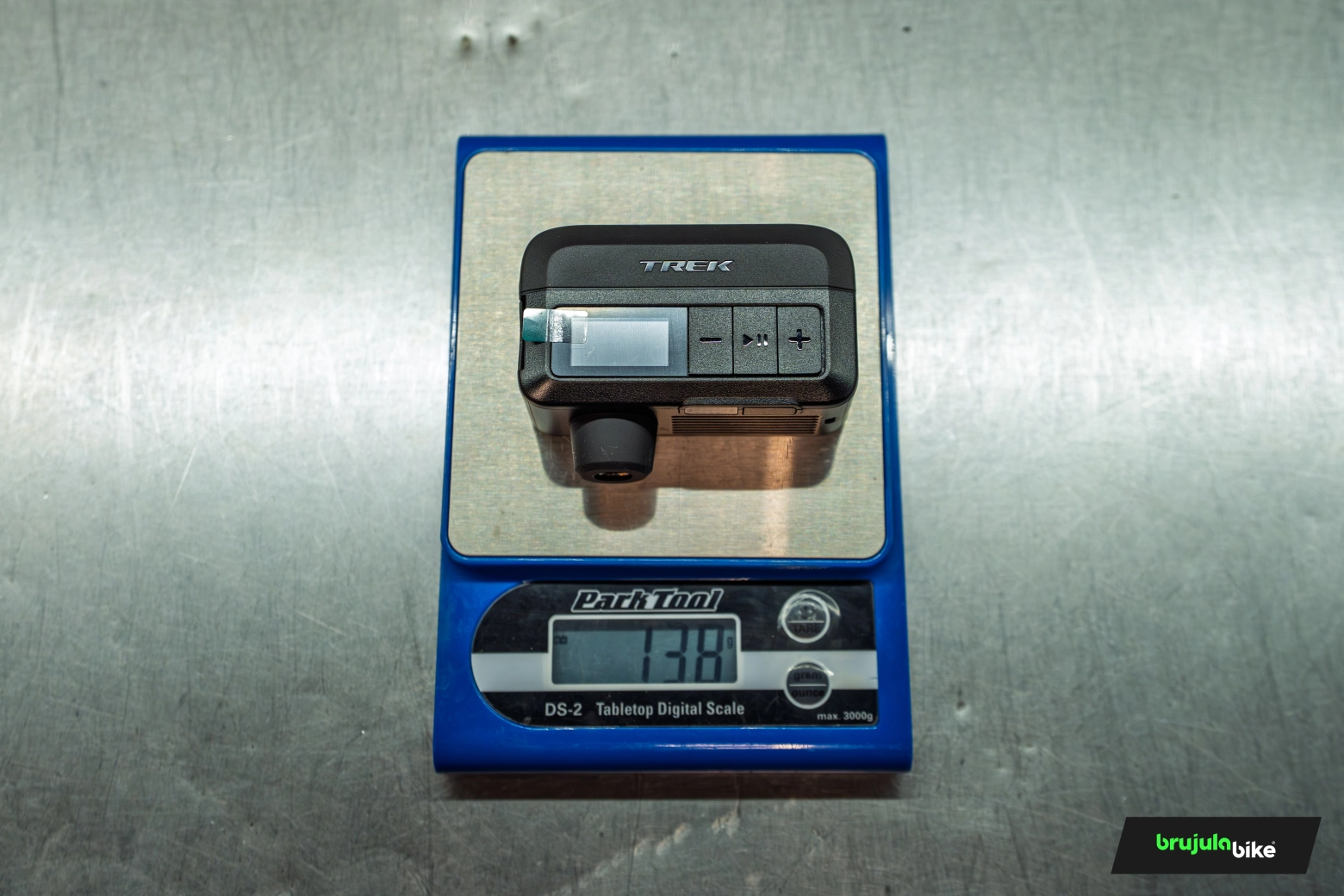
On our scale, it weighed 138 grams. This is where the weight-obsessed cyclist will raise an eyebrow. "138 grams? A carbon pump weighs 60g". That is true. But if we add a decent and effective manual pump (about 100g) or a CO2 head plus two spare cartridges (about 120-140g), the technical tie is evident. The difference is that here we will be much more precise and clean without any effort, plus it is infinitely rechargeable.
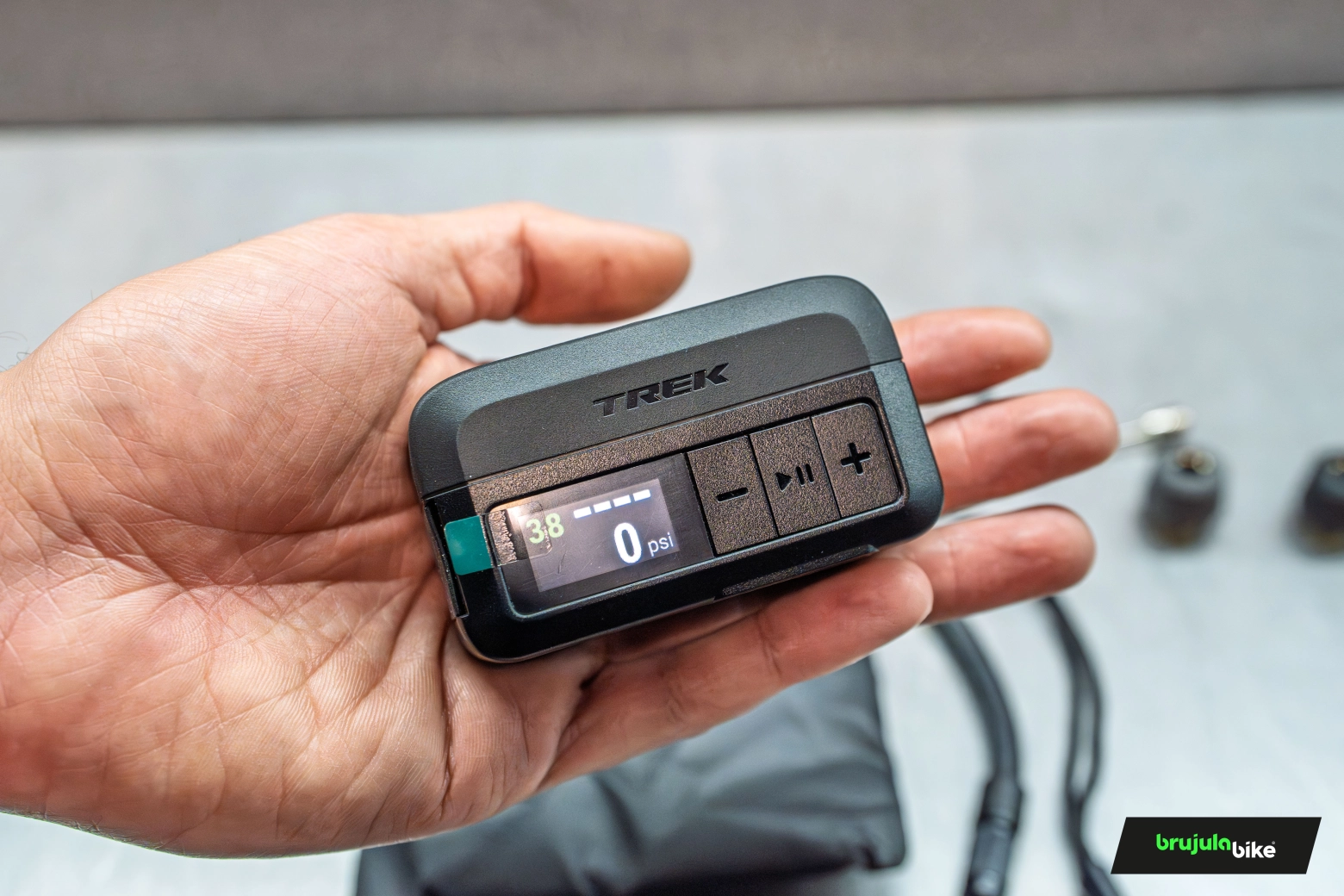
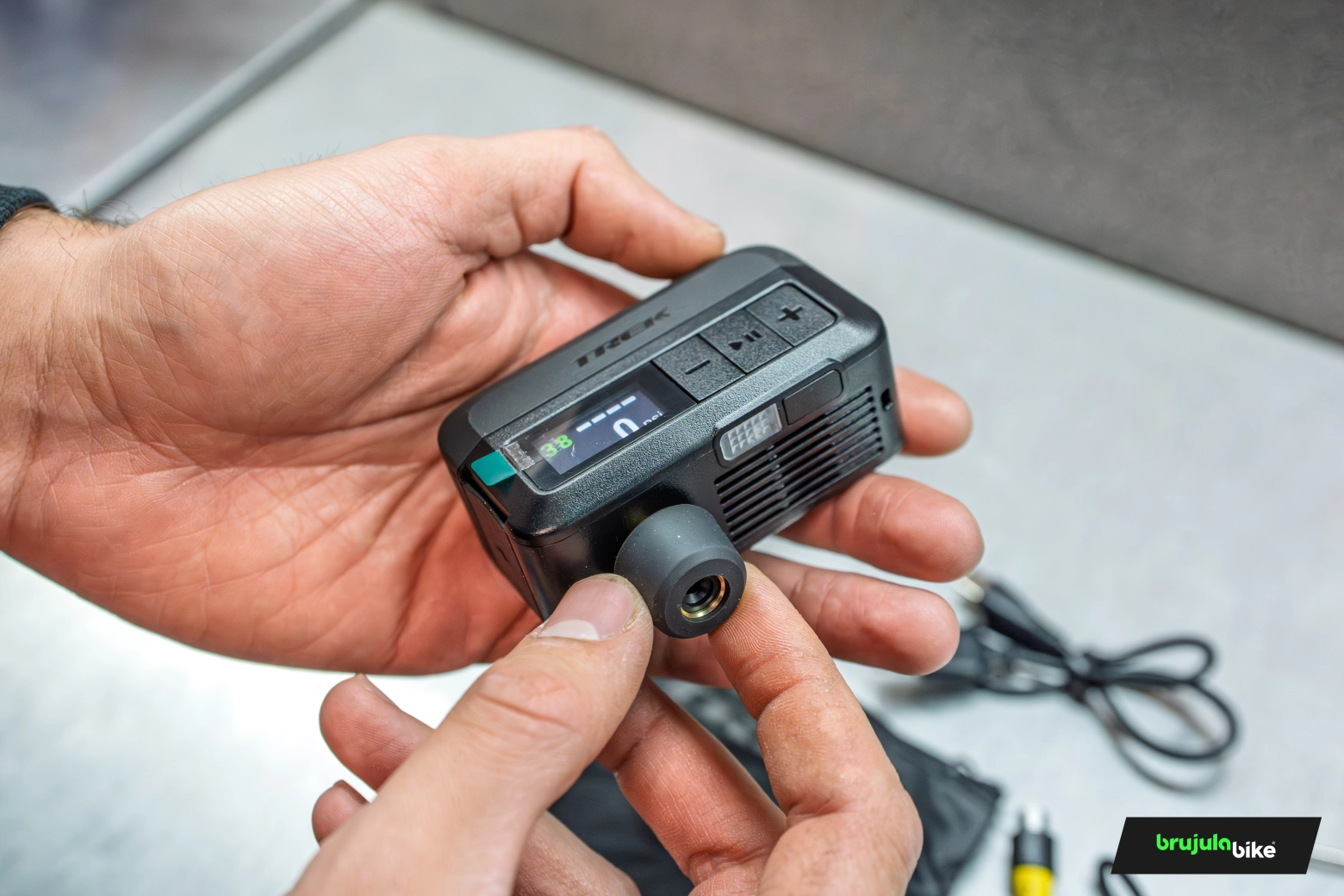
The design is clean, with an OLED digital display on the front, three well-sealed rubber buttons (power/adjustment), a USB-C charging port (thank you!), and the hole for the hose.
A key point that we value very positively before starting to use it is that in addition to a direct inflating connection, it also comes with a flexible extension hose. This accessory may be overlooked by many, but, through the direct connection, if you do not hold the pump properly while inflating, it can transmit the motor's vibration to the valve stem, potentially bending the valve and turning a simple flat into a fatal breakdown.
This short hose from the Trek Air Rush absorbs those vibrations and protects the valve. Additionally, the hose has its own housing in the body of the pump so that it does not hang. The head is reversible (Presta and Schrader) using the classic system of unscrewing and flipping the inner rubber. Simple and effective.
In action: The ultimate test (and air)
We tested the Air Rush in two very different scenarios to see its versatility.
Scenario 1: Road and high pressure
This is the Achilles' heel of most electric pumps. They promise 100 PSI, but after 60 PSI, the motor "dies" or overheats so much that it shuts off. We simulated a flat tire on a 700x28c tubeless tire. We turned it on, selected 80 PSI on the display, and pressed the central button.
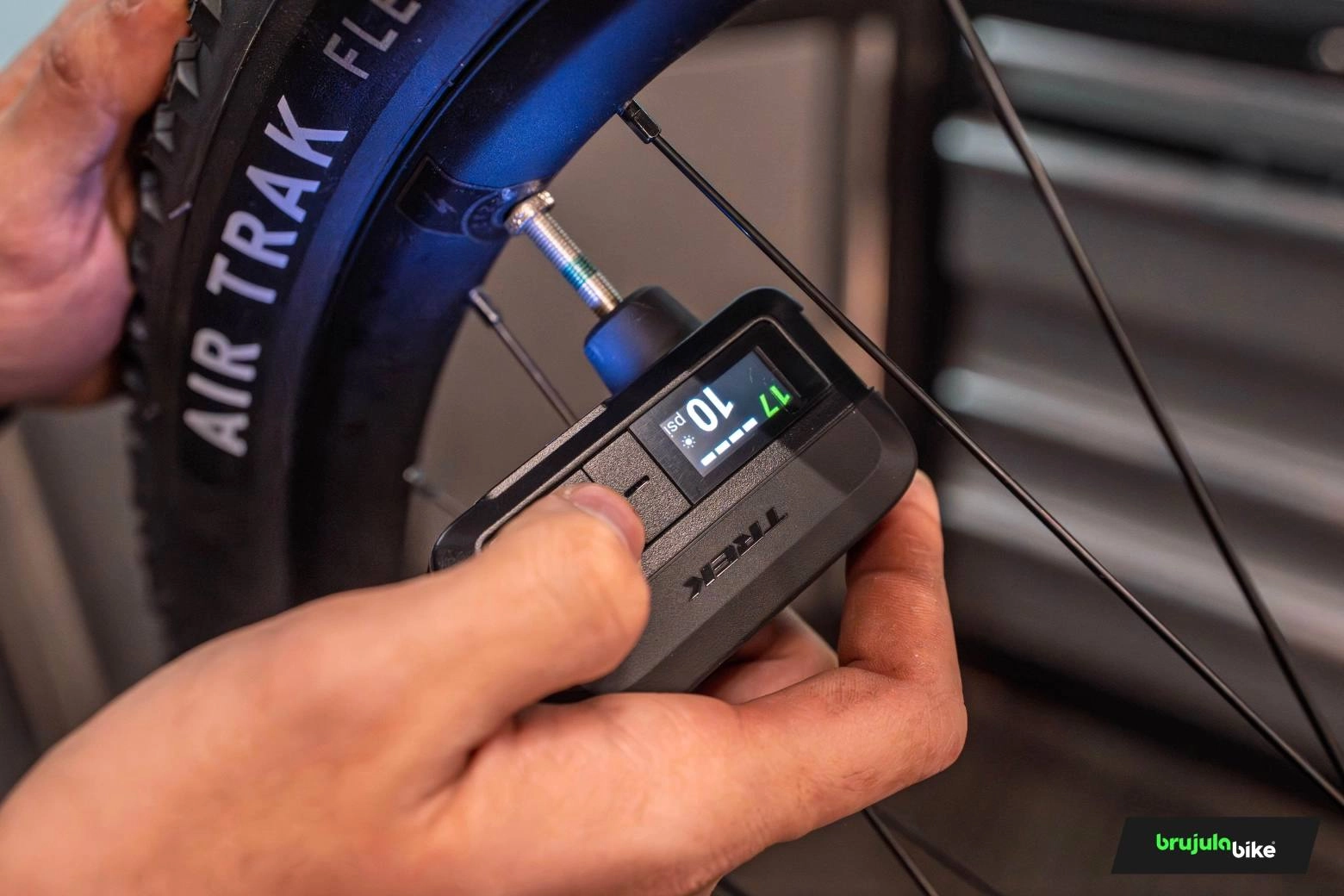
- The noise: Let's not kid ourselves, it makes noise. It has a high-pitched hum, similar to a powerful razor or a small compressor. In the middle of the field, it is not bothersome, but if you use it in your garage at 6 in the morning...
- The speed: It is not the instant "shot" of CO2 that inflates suddenly. It is a progressive filling. It took about 50 seconds to reach 80 PSI.
- The result: The best part is the Auto-Stop function. The pump stopped exactly when it reached the set pressure. This is a luxury: you can take that minute to store the old tube, eat a bar, or check the tire without having to keep touching the wheel with your finger to see if it is hard.
An important detail is that the body of the pump gets warm. It is pure physics (gas compression). However, Trek has designed the casing to dissipate that heat well. It feels warm to the touch after intense use, but it does not burn like a frozen CO2 cartridge or with other lower-quality pumps.
Scenario 2: Gravel and volume
Here, what we are looking for is to move a lot of air quickly. On a 40mm tire, the Air Rush feels very comfortable. Does it work for seating? It depends. We tried to seat a new tire. If the rim/tire combination is "friendly," the continuous airflow from the Air Rush can seat it. But if the tire is stubborn and needs that violent "burst" of air that a compressor or CO2 cartridge provides, the electric pump may fall short in instantaneous flow.
For everything else (refilling, inflating after repairing with a plug, or changing a tube), it is infinitely superior to straining your bicep with a manual mini-pump.
Real autonomy
Trek promises several tires with one charge. In our real test, with a single full charge (which takes about 40-50 minutes via USB-C), we managed:
- To inflate 2 road tires from zero to 80 PSI.
- To inflate one gravel tire of 40mm to 35 PSI.
- There was still a battery line left for an emergency refill.
This is more than enough autonomy to save you and your riding buddy on a long outing.
Our verdict on the Trek Air Rush
After testing it, it is clear to us that this product is for most cyclists, at least for all those who value comfort.
The Trek Air Rush is one of those accessories that, once you try it, is hard to leave at home. The initial retail price is higher than that of a conventional manual pump, but if we compare it with other electric models, we can say that it is within range and for quality and performance, it could be one of the best options on the market.
The peace of mind of knowing that if you get a flat, the solution is just a matter of pressing a button and waiting a minute without physical effort is priceless. It is a well-executed, rounded product with the quality expected from a brand like Trek. Possibly the star gift for cyclists this season.
What we liked
- Ultracompact size: Disappears in the pocket of the jersey or saddle bag.
- Precision: The digital manometer and Auto-Stop work perfectly.
- Flexible hose: Essential to avoid damaging valves.
- Goodbye to waste: Ecologically superior to throwing away CO2 cartridges.
- Build quality
To improve
- Noise: Inevitable, but noticeable.
- Flow for seating: It lacks that final "punch" for the most difficult tubeless tires to seat. But that is a drawback that all pumps of this type have.
Technical specifications and take a look at the price
- Product: Trek Air Rush Mini Pump
- Weight: 133 g (verified)
- Maximum pressure: 120 PSI
- Battery: Rechargeable USB-C (cable included)
- Valves: Presta and Schrader
- Price: The retail price is €89.99, which is very reasonable within the premium sector of this type of device, but just browsing the internet can find offers that lower that price to the point where it is practically indistinguishable from a mid-range mini-pump.
The Trek Air Rush is not just an alternative to the manual pump or CO2, but a practical solution that provides precision and comfort at the most uncomfortable moment of any ride. Its size, ease of use, and reliability make it hard to leave home without it once it fits in the pocket of your jersey.
También puede interesarte
Road
The most important information about your bike that almost no one checks
Road
Cobblestones, mud, and legend. Why cycling never abandoned the cobblestones
Training
Boost your watts, boost your level: that's how you improve your FTP
Road
What are the five monuments of cycling?
Road
It makes them gain weight, but professional cyclists do not give up this supplement
Nutrition