A 2021 Canyon with a dropper post—what’s the story behind Shimano’s blue bikes?
There are moments in cycling races when the race becomes a matter of pure survival. It doesn’t matter what level the rider is at or what the team’s budget is. A flat tire at the wrong moment can change everything. That’s exactly what happened to Tadej Pogačar in the last Roubaix when, more than 120 kilometers from the finish line, he was left stranded in the middle of the cobblestones with no team car in sight. For a few seconds, the Slovenian went from being a contender for the win to a completely isolated rider in the chaos of the race. Until one of Shimano’s blue cars appeared.
The blue bike that saved Pogačar in Roubaix: how the peloton’s least-known system works
In Pogacar’s case, the change was immediate. A mechanic took a bike down from the rack, handed it to him, and helped him back onto the road. Pogacar rode about 5 kilometers on that completely unremarkable blue bike with no visible markings. It’s a scene that rarely happens, but one that always leaves the same question hanging in the air: what kind of bike is that really, and to what extent can it influence a race?

For decades, neutral support in professional cycling was synonymous with Mavic’s yellow cars. They were a fixture of the peloton and featured in some of the most iconic scenes in modern cycling. However, in 2021, Shimano took on that role at the Tour de France, gradually expanding its presence to the rest of the calendar until it became the standard provider for top-tier UCI events.
RECOMENDADO
Is your bike slow, nervous or hard to handle? The wheels might be causing it
2026 Tour de France: The Meaning of Each Jersey and How to Win It
Why have short gloves disappeared from mountain biking?
What's the story behind the Tour de France stuffed lion?
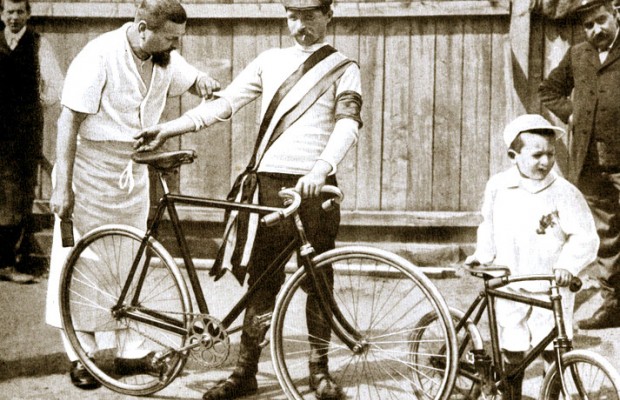
Brand, specifications, and weight of the first bike to win the Tour de France: it was a gravel bike, with no brakes or gears
The most reliable method for determining how many calories you burn while cycling
Shimano’s arrival marked an evolution in how this service is understood, adapting it to a peloton that is becoming increasingly complex from a technical standpoint.
Speaking to the Belgian outlet Sporza, Servais Knaven, head of neutral service in Benelux and France, explains that nothing about this moment is improvised. Before each race, the mechanics compile comprehensive lists with detailed information on the riders. Not only which groupset they use, but also the type of pedals, brakes, or specific configurations for each bike. The goal is that, when the time comes, they can quickly identify which option is the most suitable from the available equipment.
Ver esta publicación en Instagram
What model is the blue Shimano bike?
Shimano does not manufacture frames and deliberately keeps the origin of the bicycles it uses in its neutral service a secret. For years, it was possible to identify models from the French brand Origine beneath the blue paint thanks to the UCI homologation codes. However, what we saw in Roubaix suggests a change in that strategy.
From what can be gleaned from the images, and as several media outlets agree, the frame’s shape matches that of a Canyon Ultimate from previous generations, roughly from 2020 or 2021. This information has not been officially confirmed by Shimano, but it is a consistent conclusion.
Why these bikes aren't trendy (and don't want to be)
At first glance, Shimano’s blue bike appears more basic. Visible wiring, less integrated components, and a design that strays from current trends. But this isn’t a limitation—it’s a deliberate technical choice.
Knaven himself explained one of the key points on Sporza: the use of dropper posts. This system allows the rider to adjust the saddle height on the fly without tools, which is essential when riding a bike that isn’t custom-fitted. However, this solution requires the use of round seatposts, which greatly limits the types of frames that can be used, since most modern bikes employ proprietary, integrated designs.
This constraint completely defines the concept behind these bikes. They aren’t designed to be the fastest or the lightest, but rather the most adaptable. In an emergency situation, the priority isn’t absolute performance, but the ability to provide an immediate and functional solution.
How the service is actually managed during the race
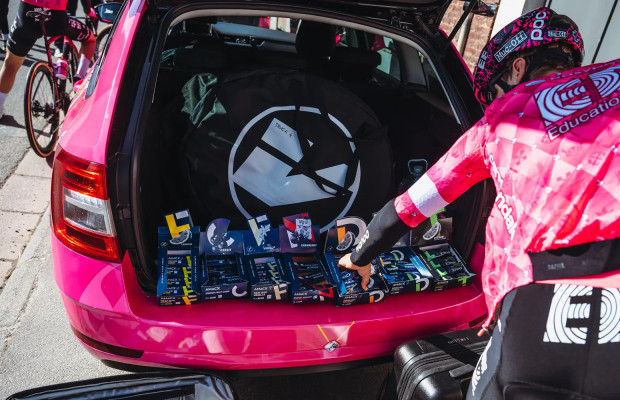
Behind every blue car lies much more than just a few bicycles. Each vehicle carries several bikes in different sizes and configurations, along with multiple types of pedals to ensure compatibility with most of the peloton. The right choice comes down to split-second decisions and the mechanic’s ability to identify the rider and their needs.

That work begins days before the race. Shimano teams contact the teams to gather detailed information and anticipate possible scenarios. They even prepare for specific situations, such as riders using non-standard equipment or prototypes.
Furthermore, the logistics are much more extensive than they appear from the outside. It’s not just about one car, but an entire support structure that includes several race vehicles, motorcycles carrying spare wheels, and intermediate service points. In a race like Roubaix, where cobblestone sections constantly break up the race, this network is essential to ensure that a solution is always nearby.
A bike to stay in the race
What happened to Pogačar in Roubaix perfectly sums up the purpose of these bikes. They aren’t designed to win races, nor to deliver the same performance as a team bike. They’re designed to prevent a mechanical issue from taking you out of the race in a matter of seconds.
During those kilometers on the blue bike, Pogačar wasn’t on equal footing, but he was still in the race. And in a race like Paris-Roubaix, where everything can change in any sector, that’s exactly what makes the difference.
También puede interesarte
Bike Equipment
Is your bike slow, nervous or hard to handle? The wheels might be causing it
Road
2026 Tour de France: The Meaning of Each Jersey and How to Win It
Mountain bike
Why have short gloves disappeared from mountain biking?
Road
What's the story behind the Tour de France stuffed lion?
Road
Brand, specifications, and weight of the first bike to win the Tour de France: it was a gravel bike, with no brakes or gears
Nutrition
