Schedules and keys for stage 8 of the Tour: a new opportunity for sprinters in Bergerac
Just 24 hours after competing in Bordeaux, the sprinters of the 2026 Tour de France will have a new opportunity in the 179 kilometers between Périgueux and Bergerac. The profile clearly points towards a mass finish again, but the outcome will be very different from the previous day.
Tour de France 2026: stage 8 | Bergerac offers an immediate rematch to the sprinters
Stage 7 ended on a very long straight where the fastest men could unleash all their speed. In Bergerac, however, positioning will be even more important. Two turns within the last 1,100 meters will force the lead-out trains to anticipate moves and could leave any favorite who starts the last kilometer too far back out of contention for victory.
With Tim Merlier and Olav Kooij already having debuted in this Tour, the pressure now shifts to Jasper Philipsen and the rest of the top sprinters still seeking their first victory.

Schedule and key points of stage 8 of the 2026 Tour de France
- Start: 13:25 h (CEST)
- Expected finish: between 17:20 and 17:43 h (CEST)
- Route: Périgueux - Bergerac
- Distance: 179.1 km
- Total ascent: 1,090 meters
- Type of stage: flat
RECOMENDADO
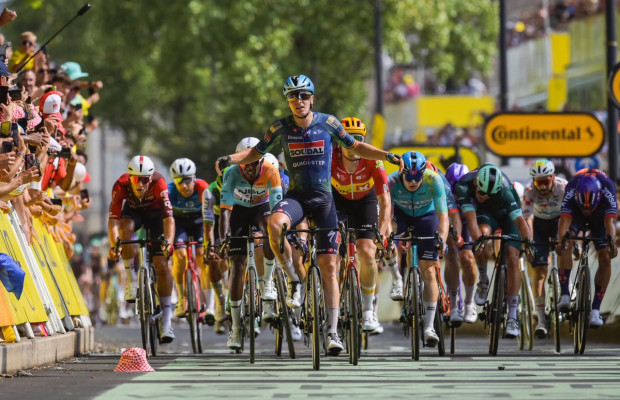
Tim Merlier wins in Bordeaux and gives Belgium its first victory in the 2026 Tour de France
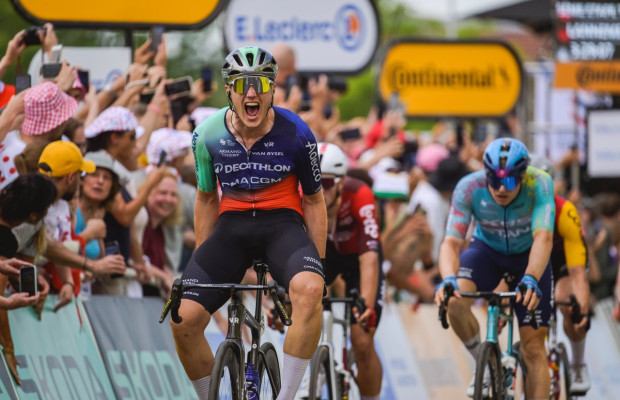
Olav Kooij wins the first battle among sprinters in the Tour de France and fulfills Decathlon's bet
When to skip training and rest without feeling guilty
Free aero gains for your bike: small changes that make you faster
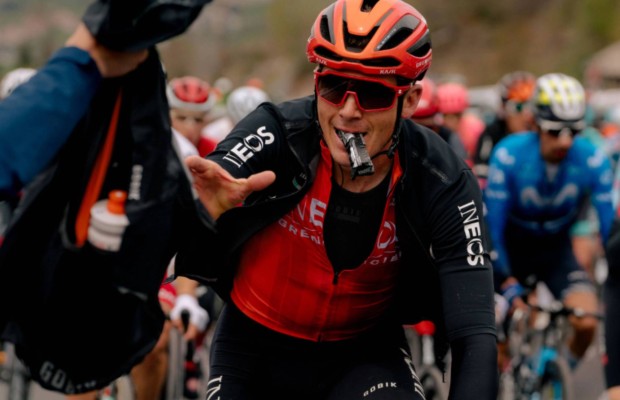
More power, less fatigue: how nitrates could help you on the bike
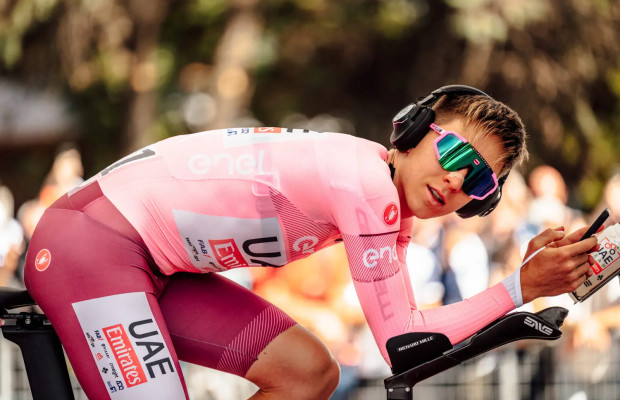
An indoor trainer can do more for your training than you think: here are 7 reasons to own one
The profile of the eighth stage leaves little room to imagine an outcome different from a mass finish. The 1,090 meters of total ascent are spread over a route without major difficulties, and the sprinters' teams will have enough kilometers to keep any breakaway under control.

That doesn't mean the day will go by without attacks. For teams that do not have real options in the sprint, getting into the breakaway will be practically the only chance to gain prominence. The problem will be finding enough adventure companions to build a group capable of challenging a peloton where several teams share exactly the same goal.
The only two categorized climbs also do not seem demanding enough to change the race. The Côte de Domme presents 3.6 kilometers at 3.3% and peaks 77.5 kilometers from the finish, while the Côte du Buisson-de-Cadouin, with 2.1 kilometers at 5.5%, ends 40 kilometers from Bergerac.
Between the two, the intermediate sprint will take place, located 58 kilometers from the finish and again important for the battle for the points classification.
The stage may be decided in the last two turns
The absence of major difficulties does not mean the finish will be easy. The last kilometers will force teams to manage a very different approach than in Bordeaux. The first important reference will come just before entering the last kilometer, with a turn that should initiate the final battle for the top positions.
Those who arrive late to that point will still have room to advance, but will have to expend energy just before the sprint.
The second turn will be much more decisive. It is located approximately 500 meters from the finish and its proximity to the arrival will greatly reduce the chances of moving up positions. The main sprinters will need to enter ahead, but also avoid starting their effort too early.
The battle between the lead-out trains may cause the speed to be at its maximum well before the banner of the last kilometer. Having several teammates available will be important, although the individual ability to find a wheel and defend the position will again be decisive.
Thus, Bergerac presents a very different problem than Bordeaux. It will not be enough to have the fastest rider. It will be necessary to ensure he arrives at the right place at the exact moment.
Merlier arrives as a reference and Philipsen needs to react
Tim Merlier approaches the stage as the man to beat after his victory in Bordeaux. The withdrawal of Bert Van Lerberghe has weakened his train, but the Belgian showed that he can find his own way in a mass finish and resolve the sprint without needing perfect preparation. Olav Kooij will look to respond after a seventh stage where poor positioning prevented him from contesting for victory, while Biniam Girmay continues to show speed and consistency, although he still needs to find the necessary space to complete a clean sprint.
Jasper Philipsen faces a new opportunity after not yet showing the superiority of previous editions. Alpecin-Premier Tech managed to place him in a good position in Bordeaux, but the Belgian could not convert that work into a victory. The finish in Bergerac, with two decisive turns, may favor his experience and aggressiveness in the battle for position. Søren Wærenskjold also arrives strengthened after finishing second in stage 7, while Max Kanter once again has an XDS Astana that is executing some of the best lead-outs of this Tour.
Pavel Bittner, Phil Bauhaus, and Fernando Gaviria will try to take advantage of this new opportunity after different problems in previous finishes. Huub Artz has become one of the surprises among the fast men, while Milan Fretin, Mads Pedersen, and Pascal Ackermann complete a large group of candidates to enter the top positions. Pedersen and Girmay, in addition, will again have added interest in every point available for the green jersey classification.
The eighth stage seems doomed to repeat the mass finish of Bordeaux, but it is unlikely we will see the same type of sprint.
También puede interesarte
Road
Tim Merlier wins in Bordeaux and gives Belgium its first victory in the 2026 Tour de France
Road
Olav Kooij wins the first battle among sprinters in the Tour de France and fulfills Decathlon's bet
Training
When to skip training and rest without feeling guilty
Road
Free aero gains for your bike: small changes that make you faster
Nutrition
More power, less fatigue: how nitrates could help you on the bike
Training
