Do you really need an electronic shift? The new DEORE for €80 might change your mind
In the midst of the expansion of electronic and wireless drivetrains, Shimano has made a particularly interesting move in the opposite direction. The Japanese brand has completely revamped its mechanical DEORE and has transferred some of the solutions developed for its latest electronic transmissions to a cable-operated shift. The result costs just 80 euros, requires no batteries, and presents itself as a very serious alternative for those who prioritize simplicity, robustness, and price without sacrificing weight.
Shimano continues to bet on mechanical shifting, and this new DEORE perfectly explains why
Specifically, Ibon Zugasti has just published a video recorded from the Shimano Iberia headquarters in Alcobendas, where he reviews the entire new DEORE family with company representatives. The visit allows for a direct comparison between mechanical and electronic alternatives and explains how for many users, upgrading their bike with the new mechanical DEORE may make more sense than switching to wireless.
What does DEORE mean? The story of Shimano's deer
The video reveals a curiosity that many users probably do not know. Shimano explains that DEORE comes from the term Japanese deer (deer in English) and with the idea of harmony between the cyclist and nature, taking as a reference an agile and fast animal perfectly adapted to the forest.
The first DEORE appeared in 1983 and was developed with the use of the bicycle in the countryside in mind. More than four decades later, the name continues to be one of the pillars of Shimano's MTB catalog and currently represents the entry into its performance groups.
RECOMENDADO
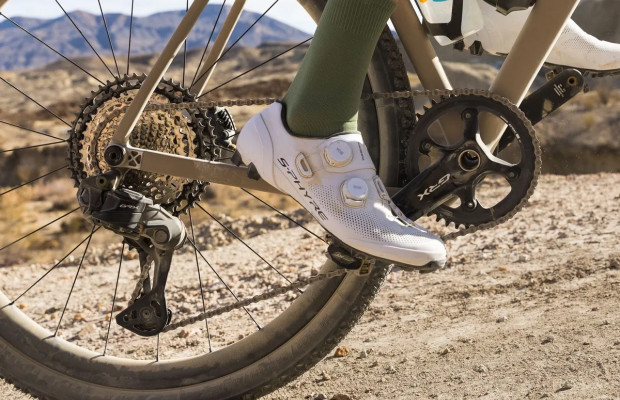
Another leak of the 13-speed Shimano points to a new standard
Shimano warns of a possible price increase due to the war in the Middle East

When to skip training and rest without feeling guilty
Free aero gains for your bike: small changes that make you faster

More power, less fatigue: how nitrates could help you on the bike
An indoor trainer can do more for your training than you think: here are 7 reasons to own one
Above it are XT and XTR, but the differences between them are not limited to technology. As David González Vaquero from Shimano Iberia explains in Zugasti's video, much of the architecture and operation of the latest transmissions is shared, and it is the materials that establish significant differences in weight and price.

This is perfectly evident in electronic shifts. XTR uses carbon in certain parts, XT uses aluminum, and DEORE opts more for steel. On the scale in the video, the XTR weighs about 391 grams and the DEORE Di2 around 496 g. That's just over 100 grams of difference while the price of the shift goes from approximately 600 to 350 euros.
Moreover, when Zugasti asks if he would be able to distinguish them solely by their operation, Shimano acknowledges that it would be complicated in a blind performance test. They share a battery and much of the technologies that determine the precision and speed of the shift, while the use of steel makes DEORE a less lightweight option, but also particularly robust.
Shimano continues to firmly bet on mechanical shifting
A year ago, we reported how the Shimano DEORE Di2 brought the brand's new wireless technology to a much lower price than XTR. But in June 2026, Shimano presented the new generation DEORE M7200 and M6200 and demonstrated that the arrival of electronics does not mean abandoning the cable.
“Our commitment to cable is very strong,” explains González Vaquero during the video. And the new RD-M7200 shows that it is not simply about maintaining an old mechanical transmission as an economic alternative.
The new shift adopts a much more protected construction than its predecessor, uses the SHADOW ES architecture, and incorporates a stabilization system with a double spring that replaces the traditional clutch of previous Shimano shifts. This aims to increase chain tension, reduce its movements over rough terrain, and improve resistance to impacts.
In short, Shimano has used part of what it learned while developing its new electronic groups to manufacture a better mechanical shift.

80 euros versus 350: the great argument of the new Shimano DEORE
The most striking comparison comes with the price. The new Shimano DEORE RD-M7200 mechanical costs 79.99 euros, while the electronic DEORE Di2 shift is around 350 euros.
If we add the mechanical shifter, which costs 37.99 euros, the shift and shifter total approximately 118 euros, before adding cable and housing. In the electronic version, during the video, around 350 euros is mentioned for the shift and 129 euros for the shifter, totaling around 479 euros for both.
The difference is enormous, and moreover, we are not comparing a modern transmission with one from a previous generation. The new mechanical DEORE also incorporates Shimano's latest architecture, but replaces the motor, battery, and electronics with a traditional cable system.
It even turns out to be lighter than its electronic equivalent. On the scale used during the video, the new mechanical shift weighs about 429 grams compared to approximately 496 g of the DEORE Di2, although the weight of the cable and part of the housing would need to be added to the former. Compared to the previous mechanical DEORE, it is indeed heavier, a difference that Shimano justifies by its more protected and robust construction.
An update of just over 100 euros that can make a lot of sense
Here probably lies the main conclusion of Zugasti's video. A user with a compatible 12-speed Shimano mechanical transmission can access the new shift for about 80 euros or install the shift and shifter for around 118 euros without needing to automatically replace the entire transmission.
In contrast, the electronic version offers speed, precision, absence of cable between shifter and shift, and a particularly interesting installation in frames with complex internal routing. But the mechanical version responds with a much lower price, ease of repair, and total independence from batteries and chargers.
As González Vaquero explains, this simplicity can be particularly interesting for users who make intensive use of their bike, travelers, or cyclists who simply want an easy-to-maintain transmission. Even when Zugasti asks which option they would choose to ride around the world, Shimano bets on mechanical DEORE precisely for its robustness and ease of repair.
And perhaps there lies the key to this new group. Shimano is not suggesting that cable is better than electronics, but rather offering two solutions for different needs. For about 80 euros compared to 350 for the electronic version, the new DEORE demonstrates that a mechanical transmission can still evolve and, for a huge number of cyclists, remain the most logical option.
También puede interesarte
Bike components
Another leak of the 13-speed Shimano points to a new standard
Bike Equipment
Shimano warns of a possible price increase due to the war in the Middle East
Training
When to skip training and rest without feeling guilty
Road
Free aero gains for your bike: small changes that make you faster
Nutrition
More power, less fatigue: how nitrates could help you on the bike
Training
