Van Aert beats Pogacar in the sprint and wins the Paris-Roubaix 2026
The Paris-Roubaix 2026 has left one of those editions that will be remembered for years. The race gradually became tougher, turning into a brutal battle of attrition, with all the favorites forced to improvise amid punctures, bike changes, falls, and chained attacks in the key sectors.
Pogacar and Van Aert ignite the Paris-Roubaix 2026 after a race marred by punctures and chases
Wout van Aert already has his cobblestone. The Belgian won the Paris-Roubaix 2026 after one of the most tense, accident-prone, and spectacular editions in recent years, a race in which he had to survive the chaos, recover after a puncture, and finish off Tadej Pogacar in the sprint at the velodrome. The Slovenian rose to the challenge and turned the race into a relentless battle again, but this time he found no response in the final meters. Mathieu van der Poel, winner of the last three editions, was out of the fight for victory after a double mechanical failure in the Arenberg Forest.
The 123rd edition of the Hell of the North started with tension. The pace was extremely high from the start, and the peloton spent much of the first half of the race rolling with hardly any margin to establish a stable breakaway. Attempts came one after another, but the big teams did not allow the race to settle. The average speed was enormous from very early on, and the wind also began to play its part, causing splits and forcing the favorites to stay at the front at all times.
UAE toughened the race from very far out
As the first major cobbled section approached, UAE Team Emirates-XRG clearly took on the responsibility of tightening the race. Pogacar did not want a Roubaix of waiting, but a test of continuous attrition. His men began to raise the pace, and the group started to shrink sector by sector. In those first cobbles, the first serious problems appeared.
RECOMENDADO
Nino Schurter debuts the SCOTT SRAM kit for 2026
The weather is on Pogacar's side in the Paris-Roubaix
Can a road bike keep up with a downhill bike? Pidcock gives it a try against Bruni
From MotoGP to cycling, Van Rysel presents its integrated airbag for cyclists
This exclusive Pinarello comes with a matching Tissot watch included
Van der Poel confirms his 90 minutes at 446 watts and reveals his strategy for Roubaix
Mads Pedersen had to chase after a puncture. Wout van Aert also suffered a mechanical failure and was forced to change bikes at a very delicate moment, just as the leading group continued to advance at full speed. Pogacar, who had been well positioned until then, soon experienced one of the key episodes of the day.
Pogacar complicates his life before Arenberg
The world champion punctured before the Arenberg Forest, 120 km from the finish, and the incident was significant. First, he had to continue with a neutral Shimano bike, and for several kilometers, he was caught in an uncomfortable and grueling chase while the race continued to select itself ahead. It was a critical moment because losing contact before the forest usually means saying goodbye to victory.
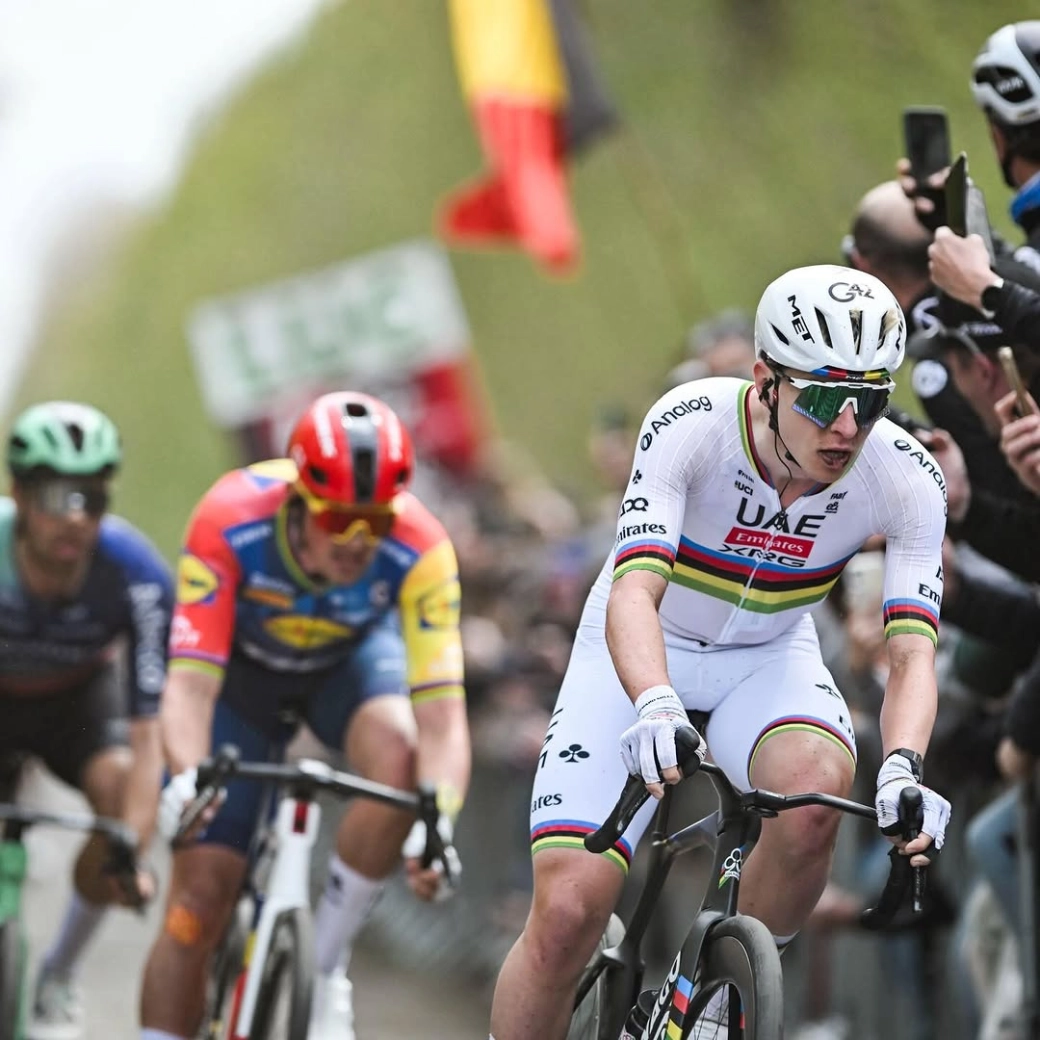
However, Pogacar did not sink. With the help of his teammates, he cut down the time until he returned just before the most feared sector of the course. That effort left him with a huge burden in his legs, but it also confirmed that he had arrived in Roubaix ready to sustain any script.
Arenberg blew the race apart and left Van der Poel shaken
The Arenberg Forest was the major breaking point. Van Aert entered very well positioned, Pogacar managed to arrive on time after his chase, and Van der Poel also appeared in the front zone intending to start selecting. But inside the forest, everything changed.
The Dutchman suffered a puncture, tried to resolve it with the help of the team, and shortly after punctured again. The sequence was chaotic, to the point of seeing him lose a lot of time and becoming completely detached from the leading group. The race of the big favorite broke there. Later, he staged a huge comeback, but that double mechanical failure left him with no real margin to fight for a fourth consecutive victory.
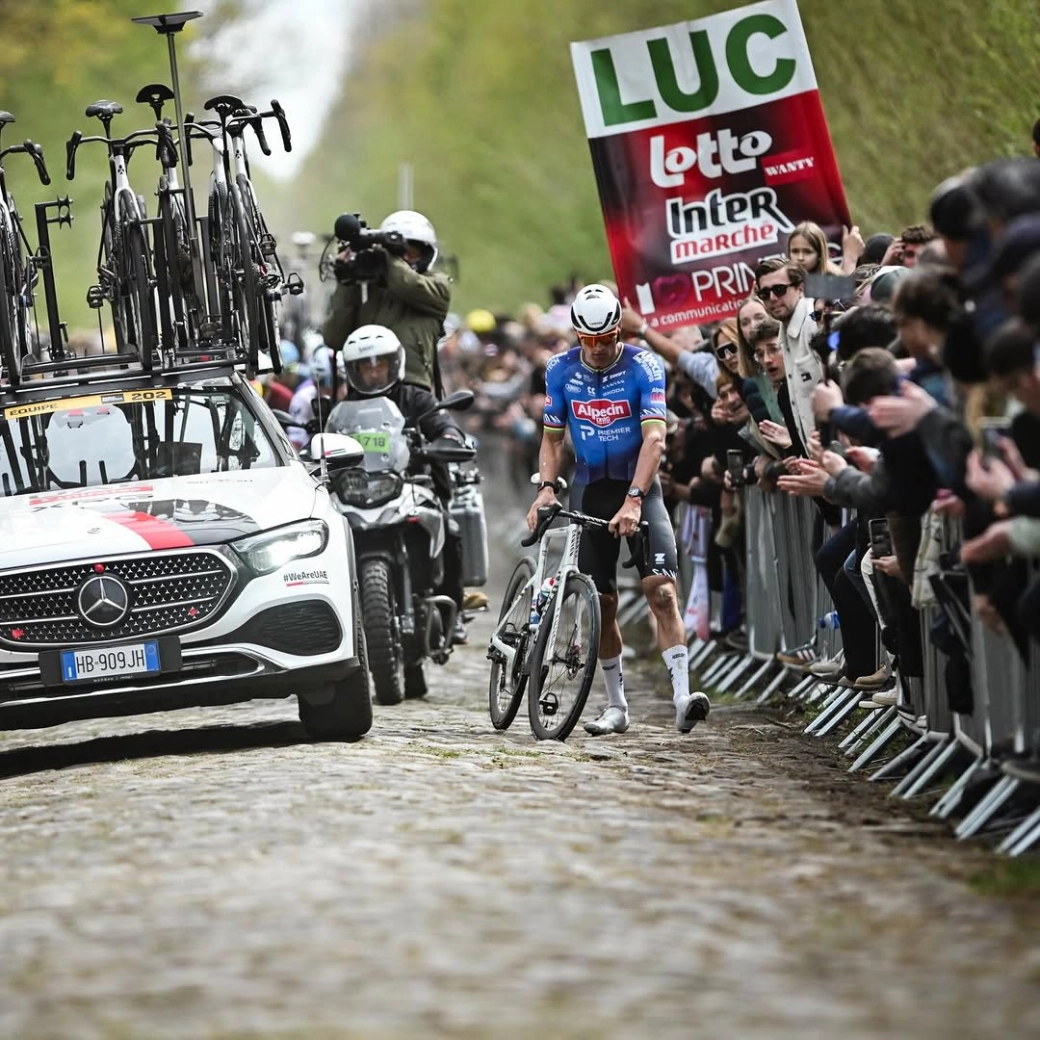
Up front, the selection was very clear. From Arenberg, riders like Pogacar, Van Aert, Pedersen, Laporte, Bissegger, Pithie, and Stuyven emerged at the front, with Ganna and Meeus trying to catch up later. It was already a race of big names and resilient legs.
Punctures, chases, and an increasingly smaller race
The phase after Arenberg maintained the same wild tone. Ganna managed to return but was cut off again by another puncture. Pithie also lost contact due to mechanical issues. Each sector seemed to punish someone, and the leading group was constantly changing shape.
Pogacar was not spared either. He suffered a second puncture when he was already fully back in the race. Van Aert, for his part, also had to manage his second puncture of the day. The two main protagonists reached the finish after having punctured twice, a fact that very well explains the level of chaos that this Roubaix had.
Meanwhile, Van der Poel did not stop chasing. First, he managed to reconnect with intermediate groups and then gradually approached the most dangerous chasing block. He seemed doomed after Arenberg, but he never stopped rolling as if there was still a race.
Van Aert's attack changed the Paris-Roubaix
About 54 kilometers from the finish came the move that definitively altered the race. Van Aert attacked just before the Auchy-lez-Orchies à Bersée sector. It was a very important move because it came at the moment when Van der Poel was starting to dangerously close in behind. The Belgian understood that he could not continue to wait.
Only Pogacar and, for a brief stretch, Mads Pedersen were able to respond. The Dane ended up giving way, and the race turned into a face-off between the two men who had best resisted all day. From that moment on, the fight for victory became a pure duel between an increasingly solid Van Aert and a Pogacar determined to decide the race by force.
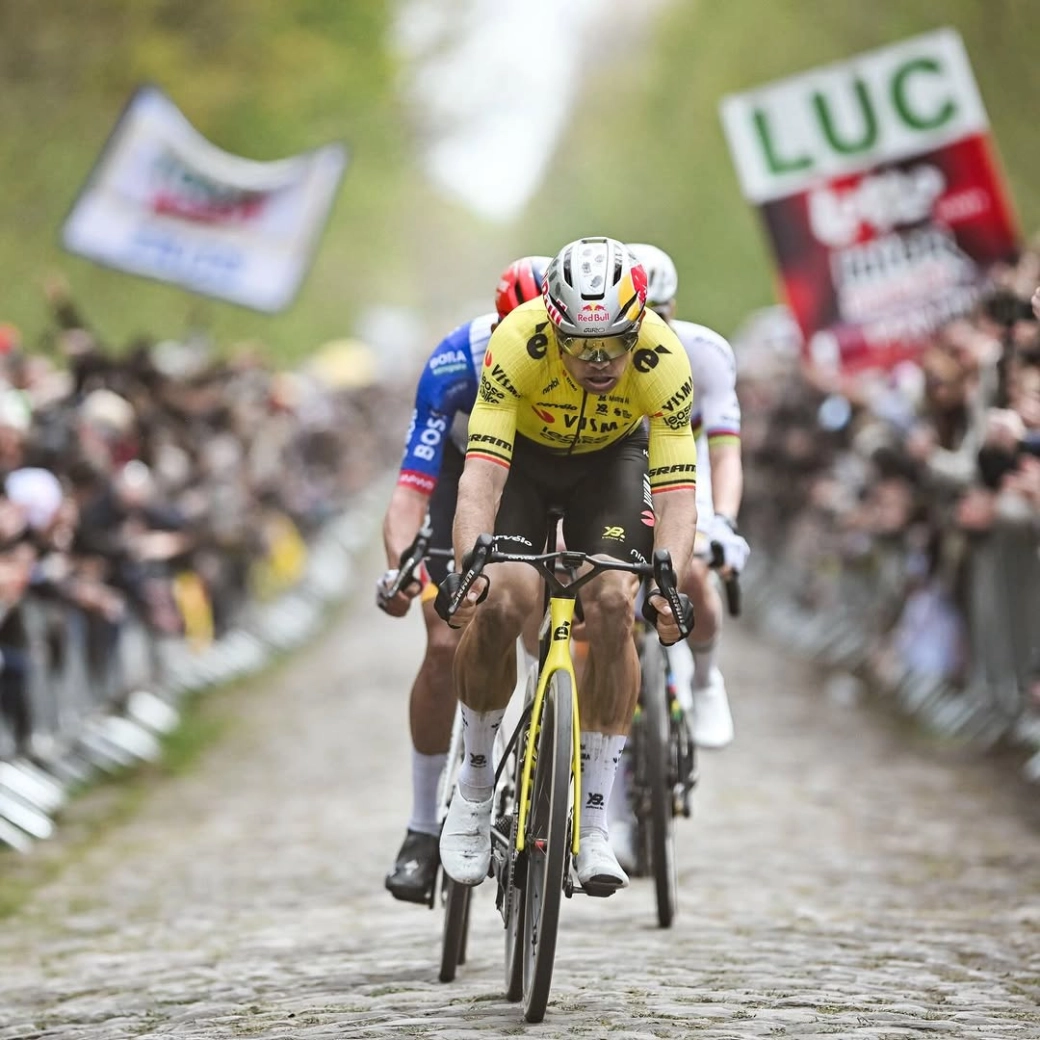
Pogacar tried several times against Van Aert in Mons-en-Pévèle, one of the great judges of the course. He attacked within the sector and tried to open a gap also on the subsequent asphalt, but the Belgian always responded. There were moments when Van Aert seemed to be at his limit, although he never broke, and others when he was the one who managed to put Pogacar in difficulties, even forcing him to seek the margin of grass to maintain his line and rhythm.
This exchange left a very clear conclusion. Pogacar was the most aggressive, the one who insisted the most on breaking the race, but Van Aert was completing his best Roubaix, with a mix of endurance, coolness, and power that he had not managed to gather in his previous attempts.
Camphin and Carrefour de l’Arbre took the duel to the extreme
With about 40 seconds of advantage over the chasing group, Pogacar and Van Aert entered the decisive sequence towards Camphin-en-Pévèle and Carrefour de l’Arbre. It was the terrain where the Slovenian had to try something definitive before the velodrome. And he tried.
As soon as he started Carrefour de l’Arbre, Pogacar launched a very hard acceleration. He entered first, decisively, and for a few seconds, it seemed that he could open the gap he had been looking for all afternoon. But Van Aert held on. He held on even when Pogacar was close to a scare at the beginning of the sector, and he followed his wheel when the race demanded extreme technique and lucidity.
Behind, Van der Poel led a chasing group that included Stuyven, Laporte, Pedersen, Mick van Dijke, and Bissegger. The difference dropped to 20 seconds at times, but up front, Pogacar and Van Aert managed to maintain enough control to fight for victory between them.
From the last cobble to the velodrome
Once Carrefour was passed, the feeling changed. There were no longer sectors capable of breaking by sheer brutality, and the race entered a phase of control, calculation, and tension. Pogacar continued to enter first at many points, but it seemed that he no longer had that acceleration capable of shaking off the Belgian. Van Aert, on the other hand, increasingly conveyed more composure.
In Gruson and then in Willems à Hem, it became clear that he still had the strength to contest the position and to maintain the pace in the final kilometers. The advantage over the chasing group grew back to half a minute, and everything began to lead to a sprint between the two.
Pogacar was the first to enter the velodrome, but Van Aert arrived right on his wheel. There was no hesitation. When he launched the sprint, the Belgian was clearly superior. Pogacar found no response, and Van Aert crossed the finish line as the winner of the Paris-Roubaix 2026, finally putting an end to his long frustration in the cobbled Monuments.
View this post on Instagram
The victory carries enormous weight for Van Aert. Not only because he finally wins Roubaix, but because he does so in a gigantic edition, surpassing Pogacar in a direct confrontation and enduring a day when almost everything went wrong for almost everyone. He won after two punctures, after chasing, after responding to all the decisive attacks, and after finishing in the most symbolic possible setting.
Pogacar signed a tremendous Roubaix in his attempt to complete the five Monuments, but this time he fell just short of glory by a sprint. Van der Poel, burdened by his disaster in Arenberg, still had the strength to climb to fourth place. Jasper Stuyven completed the podium with a third position of great merit.
Results Paris-Roubaix 2026
- Wout van Aert (Team Visma | Lease a Bike) — 5:16:52
- Tadej Pogacar (UAE Team Emirates-XRG) — +00
- Jasper Stuyven (Soudal Quick-Step) — at 13 s
- Mathieu van der Poel (Alpecin-Premier Tech) — at 15 s
- Christophe Laporte (Team Visma | Lease a Bike) — at 15 s
- Tim van Dijke (Red Bull-BORA-hansgrohe) — at 15 s
- Mads Pedersen (Lidl-Trek) — at 15 s
- Stefan Bissegger (Decathlon CMA CGM Team) — at 20 s
- Nils Politt (UAE Team Emirates-XRG) — at 2:36
- Mike Teunissen (XDS Astana Team) — at 2:36
También puede interesarte
Gravel
Nino Schurter debuts the SCOTT SRAM kit for 2026
Road
The weather is on Pogacar's side in the Paris-Roubaix
Road
Can a road bike keep up with a downhill bike? Pidcock gives it a try against Bruni
Road
From MotoGP to cycling, Van Rysel presents its integrated airbag for cyclists
Road
This exclusive Pinarello comes with a matching Tissot watch included
Road