A “bigger” bra to go faster? The controversy coming to the Tour de France Femmes
Just a few weeks after the UCI tightened controls on equipment during the men's Tour de France, a new controversy threatens to shift to the Tour de France Femmes. Several women's WorldTour teams have asked the commissioners of the Union Cycliste Internationale to monitor a supposed aerodynamic aid used by some riders in time trials: the use of padding under the jersey to artificially increase breast volume and improve air penetration.
A new possible aerodynamic trick in the Tour de France Femmes: teams denounce the use of padding in bras
The complaint has been published by the Dutch media WielerFlits, which reports statements from several formations in the women's peloton concerned about a practice they consider contrary to UCI regulations and which, however, is barely being monitored.
A "chest fairing" hidden under the jersey
According to the published information, during some time trials in recent seasons, it has been observed that certain cyclists present a volume in the chest area significantly greater than in road races. The suspicion is that some riders use padding inside their sports bras or under their competition clothing to modify the airflow around their bodies.
The goal would be to create what is known in aerodynamics as a "chest fairing," a surface that smooths the airflow over the torso and reduces the drag created by the upper legs while pedaling.
RECOMENDADO

Why did the UCI ban ice socks in the Tour?

The toughest Tour de France Femmes 2026 is coming: route, favorites, and decisive stages
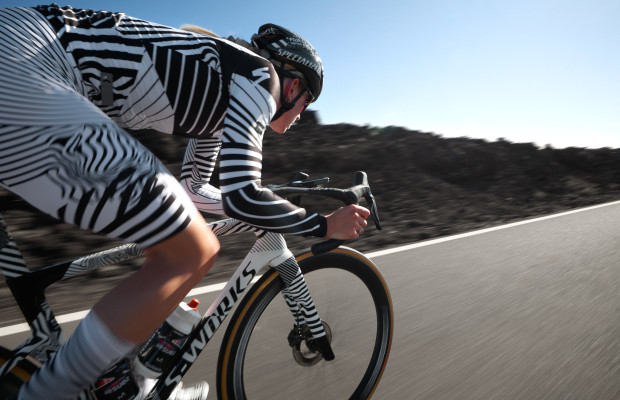
Free aero gains for your bike: small changes that make you faster

More power, less fatigue: how nitrates could help you on the bike

An indoor trainer can do more for your training than you think: here are 7 reasons to own one

Goodbye to watts per kilogram as the sole benchmark—fatigue decides who’s the best
Images from several time trials, including the one from the Paris 2024 Olympic Games and recent events like the Giro d'Italia Women, were analyzed by Bert Blocken, a professor specializing in aerodynamics at Heriot-Watt University (Scotland) and LUT University (Finland), who believes that some of these cases "are not correct" and that in one of them the system was "very well executed."
Science supports that the benefit exists
The controversy does not arise solely from visual suspicions. In 2024, Bert Blocken published, along with other researchers, a scientific study on chest fairings in cyclists and triathletes.

Simulations showed that an appropriate aerodynamic shape over the chest can reduce drag by up to 3.6%, which translates to approximately 0.78 seconds per kilometer in a time trial. Over a distance of 20 to 30 kilometers, the gain can turn into several seconds, a difference sufficient to decide a victory or a podium.

The same research group had previously demonstrated that even placing a water bottle under the jersey in triathlon events could offer significant aerodynamic advantages by modifying the airflow towards the pelvis and legs.
The UCI regulations already prohibit it
Although the debate has erupted now, UCI regulations have contemplated this type of modification for some time.
Article 1.3.033 states that clothing can only serve its function as apparel and cannot artificially modify the morphology of the cyclist. It also prohibits the use of foams, plastics, adhesive tapes, or other elements intended to improve aerodynamics, allowing only textures integrated into the fabric itself with very limited dimensions.
If an infraction is detected, the regulations provide for immediate disqualification, removal from the classification, and financial penalties that can range from 200 to 1,000 Swiss francs, or even higher depending on the severity of the case and the level of competition.
Teams request specific controls
According to WielerFlits, several teams believe that the solution would be simple: to conduct an inspection immediately after the time trial, in a private area, by a UCI commissioner who could verify that the riders are not hiding any elements under their bras or competition clothing.
The request comes just before the 21-kilometer individual time trial between Gevrey-Chambertin and Dijon, a stage where any aerodynamic improvement can make significant differences.
The UCI has already tightened controls during the men's Tour 
This would not be the first time the UCI acts against elements intended to improve aerodynamics outside of the permitted material. During the recent Tour de France 2026, the international body prohibited the use of so-called ice socks, the socks or ice bags that some riders placed under their jerseys to combat the heat.
Although their main function was cooling, the UCI argued that by modifying the cyclist's body profile, they could also generate an aerodynamic benefit contrary to the regulations. The decision sparked intense debate at the very start of the Tour, especially due to the high temperatures recorded in the early stages held in Barcelona.
Now, the focus returns to equipment, but this time in the women's peloton. The big question will be whether the UCI decides to reinforce controls during the time trial of the Tour de France Femmes or if the controversy remains merely a complaint raised by several rival teams.
También puede interesarte
Road
Why did the UCI ban ice socks in the Tour?
Road
The toughest Tour de France Femmes 2026 is coming: route, favorites, and decisive stages
Road
Free aero gains for your bike: small changes that make you faster
Nutrition
More power, less fatigue: how nitrates could help you on the bike
Training
An indoor trainer can do more for your training than you think: here are 7 reasons to own one
Road
