We tested Pogačar’s new photochromic sunglasses: meet the Scicon Aeroshade 2.0 Titanium
The Scicon Aeroshade have become one of the most recognizable glasses in professional cycling, largely thanks to Tadej Pogačar. The Slovenian has been competing with them for years, and this season he debuted the new Aeroshade 2.0 Titanium, with which he won the Strade Bianche 2026.
We already talked about these new Scicon when they were presented, but now we have had the opportunity to test them for more than ten days in their version with a matte black frame and photochromic lens.
The main novelty is in the titanium temples, although during our test there were other aspects that we found even more interesting, especially the adjustment possibilities and their ventilation.

Scicon Aeroshade 2.0 Titanium: an evolution that goes beyond titanium
RECOMENDADO
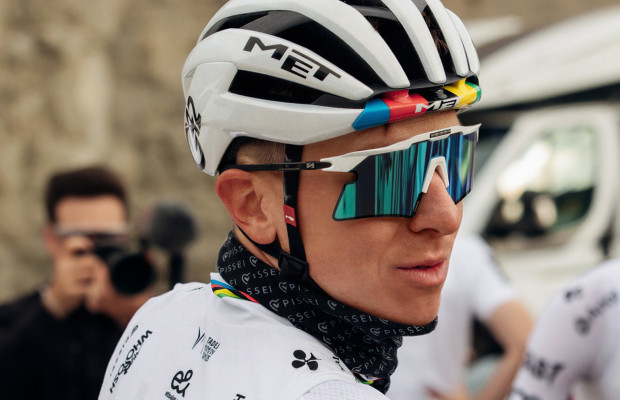
Scicon presents the new Pogacar glasses: the Aeroshade 2.0 Titanium

From retirement rumors to a contract extension: Egan Bernal will stay with Netcompany INEOS

“I’ve fallen in love with gravel; it’s my new road”: Nino Schurter looks back on his first season after leaving the World Cup
Ford designs a bike rack that can charge an e-bike while you travel
XDS will remain with Astana in 2027: team reportedly overcomes crisis that threatened its main sponsorship

20 minutes, one dumbbell and more watts: the workout every cyclist should be doing
Aesthetically, the new Aeroshade maintain the identity of the original model, with a large panoramic lens of angular shapes that offers very wide coverage. But just looking at them from the side reveals their main novelty.
The traditional plastic temples give way to ones made from medical-grade titanium that are practically visible throughout their length. Scicon manufactures them from solid titanium rods that require more than twenty machining processes to achieve their final shape.

The result is a frame with a look quite different from most sports glasses. Titanium provides strength and flexibility, while the tips of the temples allow for slight shaping to adapt them to the support area behind the ears.

The front is still made of Grilamid TR90, and overall, the build quality and finishes seemed very good to us.
Regarding weight, Scicon declares a weight of 40 grams, four more than the original Aeroshade, and when holding them, they also felt slightly heavier than the Oakley Sutro that we usually use.
An adjustment system that we particularly liked
One of the aspects that convinced us the most about the Aeroshade 2.0 Titanium is their adaptability. Interestingly, the element we liked the most is not the new temples, but the nose bridge.
Scicon uses its FlexiFit 2.0 system, consisting of two rubber supports that we can manually open or close to adapt them to the width of our nose. It’s a very simple adjustment, but it allows for quite a bit of customization in how the glasses rest.
Additionally, they incorporate the Horizon Adapt system, which allows us to modify the height of the lens relative to the eyes. This enables us to adjust its position according to our preferences and the posture we adopt on the bike.

This is especially interesting in a more aggressive road position, when we tilt our heads and raise our gaze to continue seeing what is in front of us.
The combination of these adjustments with the moldable tips of the temples offers plenty of possibilities to find a suitable position.
Another highlighted point is ventilation. Despite being glasses with a large lens, Scicon has incorporated several openings both in the lens and in the upper part of the frame.

This system, called VortexFlow, aims to facilitate air circulation inside and reduce fogging. In our test, it worked particularly well, and during the more than ten days we used them, we had no fogging issues.
The photochromic lens expands its usage possibilities
Although the Aeroshade 2.0 Titanium are available with different lenses, we tested the photochromic version with category 1 to 3.
This is a lens that automatically modifies its level of darkness depending on the light, with a transmission that varies between 68% in its clearest state and 13% when it reaches its maximum darkness.

This range allows the same glasses to be used in quite different conditions, from cloudy days to completely clear ones. This is precisely one of the advantages of photochromic lenses over fixed tint ones.
For those of us who practice different cycling modalities, it is also an interesting option, especially in MTB, where we can constantly alternate between sun-exposed areas and trails under trees.
However, there are two considerations to keep in mind. The first is that, even in its clearest state, the lens maintains a certain level of darkness. The second is that the transition is not instantaneous, and its speed can vary with temperature, especially when it’s cold.

The lens uses a cylindrical geometry, is 143 mm wide and 58 mm high, and features hydrophobic and oleophobic treatments to facilitate cleaning and prevent water and dirt from adhering so easily. Additionally, Scicon offers the option to install an interior adapter for prescription lenses.
The Aeroshade 2.0 Titanium allow for lens swapping, and Scicon has a catalog of replacement lenses with different finishes and filters. However, during the test, we found that the replacement process is not as quick as we would like.
To remove the lens, it must be separated from the frame, and during this operation, the nose bridge becomes completely loose. This requires repositioning it correctly before mounting the new lens.
It’s not a significant problem if we are going to regularly use a single lens, especially in the photochromic version, but it is a detail that could be improved for those who are used to swapping lenses according to conditions.
Our opinion on the Scicon Aeroshade 2.0 Titanium
The new Aeroshade 2.0 Titanium are high-end glasses and also come with a price that matches that position. The photochromic version we tested has a retail price of €250, about €30 more than the configuration with fixed tint lens.
After using them, we believe that the design and their premium materials are strong arguments for acquiring them, but this model goes beyond that

The large coverage of the lens, the good functioning of the ventilation, and above all, the adjustment possibilities are the aspects we liked the most. Especially the nose bridge, an element that is not always given much attention, but can make a significant difference in the comfort of glasses.
We also find it positive that Scicon sells spare parts for different components, including the temples and the nose bridge. This is complemented by a program for replacing scratched lenses that covers up to two incidents every twelve months, although the user must bear the management and shipping costs.

In short, we are looking at glasses with very careful construction and interesting solutions for sports use. The titanium temples are their most striking element, but it is the combination of adjustment and ventilation that convinced us the most during the test.
Features of Scicon Aeroshade 2.0 Titanium
- Tested model: matte black with photochromic lens (EY440101)
- Frame: Grilamid TR90 with titanium temples
- Declared weight: 40 g
- Dimensions: front of 144 mm and lens of 143 × 58 mm
- Lens: cylindrical, photochromic, and interchangeable
- Category: 1-3
- Light transmission: 13-68 %
- Adjustments: FlexiFit 2.0, Horizon Adapt, and moldable tips
- Ventilation: VortexFlow
- Included accessories: multi-purpose case and microfiber bag
- Recommended price: €250
También puede interesarte
Road
Scicon presents the new Pogacar glasses: the Aeroshade 2.0 Titanium
Road
From retirement rumors to a contract extension: Egan Bernal will stay with Netcompany INEOS
Mountain bike
“I’ve fallen in love with gravel; it’s my new road”: Nino Schurter looks back on his first season after leaving the World Cup
eBike
Ford designs a bike rack that can charge an e-bike while you travel
Road
XDS will remain with Astana in 2027: team reportedly overcomes crisis that threatened its main sponsorship
Training
