Tips for drafting and getting the most out of it
We are all aware of the energy savings that come from drafting, and yet, it is incredible how many people have been cycling for years and still do not know how to do it correctly, constantly wasting energy that they would surely appreciate having at other moments during their rides. We explain how to stay in the most protected position and take turns correctly to avoid using even one extra watt.
The Secret of Minimum Effort
Surely many of you have heard of one of the oldest tactics in cycling, the CBR tactic, which has nothing to do with any motorcycle from a Japanese brand. It is the acronym for Eat, Drink, and Draft, three words that express one of the main mantras of cycling, which is to make the best possible management of the energy we have.
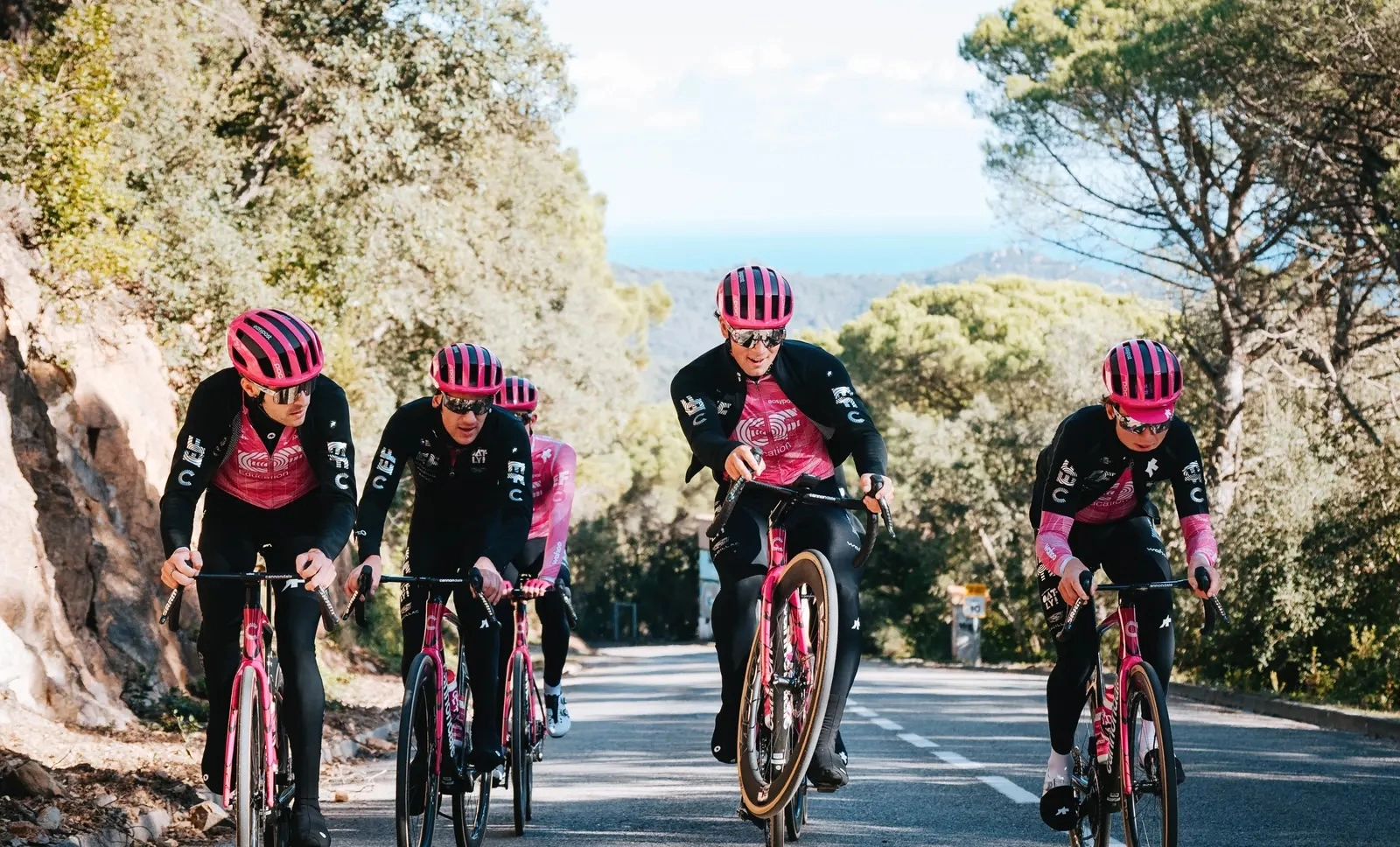
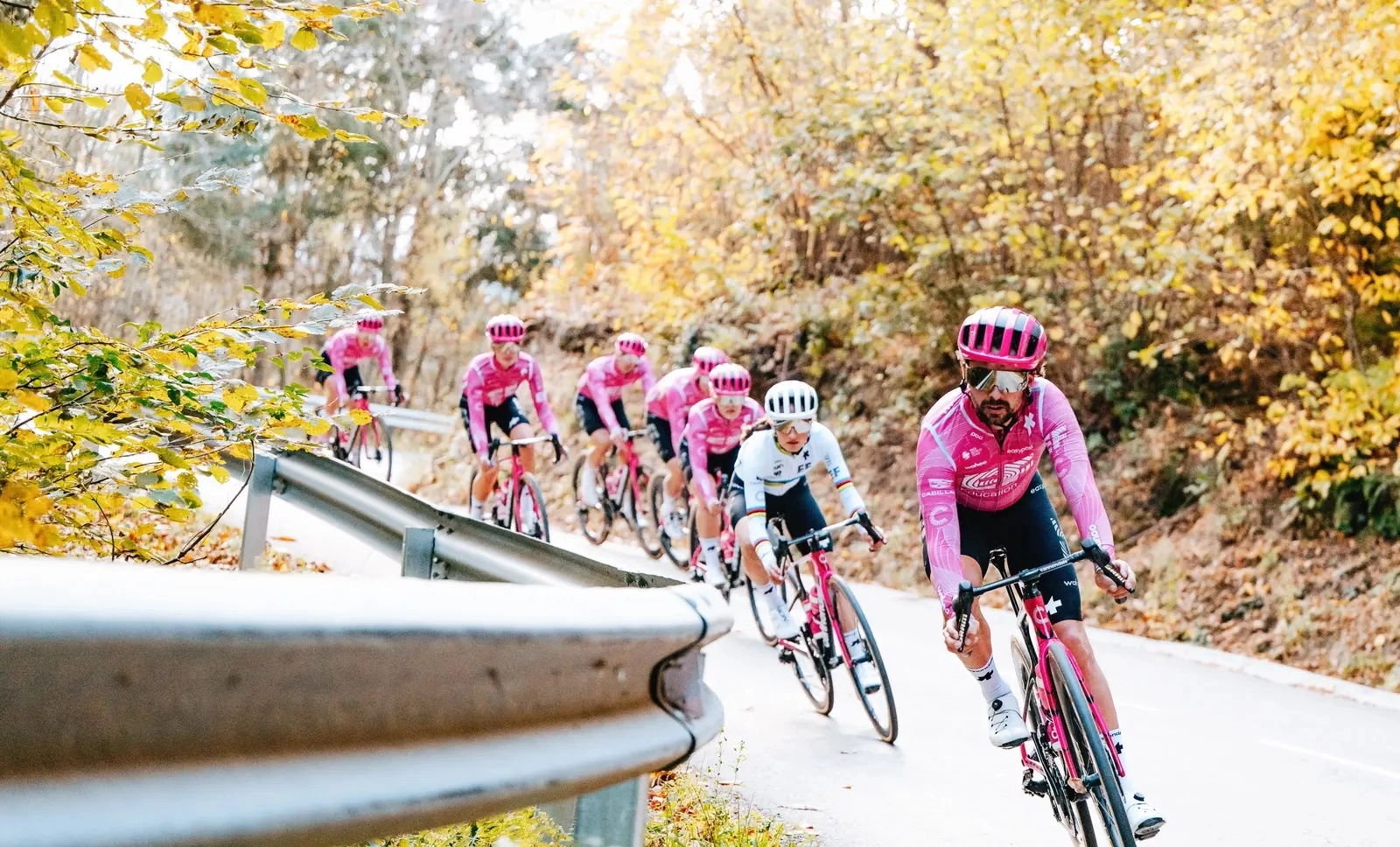
This time we are going to focus on the last parameter since, when speed increases, aerodynamics becomes an essential factor among all the forces opposing our progress. Drafting behind other cyclists can result in a significant savings of up to 30%, which is simply outrageous. Translated into more understandable numbers, we have measured differences, on days with headwinds, of almost 100 W between pedaling at the front of the group and letting oneself fall back to the 4th or 5th position in the pack—almost nothing!
RECOMENDADO
Why does Pogacar always wear lace-up shoes?
Bad odors and chafing? You’re washing your cycling clothes the wrong way
Goodbye to watts per kilogram as the sole benchmark—fatigue decides who’s the best
The 2026 MTB World Cup kicks off in a month: dates, venues, and key highlights of the schedule
Fake stickers and illegal bikes: How the UCI monitors equipment during competitions
From steel tubes to carbon without limits: the revolution that forced the UCI to intervene
The problem is that most cyclists we see on the road do not know the correct way to draft, so while they manage to benefit to some extent from the wheel of the cyclist in front of them, they do not save all the energy they could.
A Matter of Aerodynamics
Before getting into the details, it is necessary to explain why we observe energy savings when we position ourselves behind another cyclist. When we move through a fluid like air, we first have to overcome the resistance generated by impacting it, a resistance that will depend to a greater or lesser extent on the frontal area we present to the wind.

Next, the airflow will circulate around our body and bike, behaving in different ways. The most common is that when interacting with the wheels or with the moving legs, when passing over our clothing or through the helmet, turbulence is generated that makes the airflow become chaotic and creates forces that oppose our forward motion. This is where aerodynamics comes into play, which aims to ensure that the air flows along all these elements in the most orderly manner possible, being directed in the smartest way so that the forces generated are as minimal as possible.
Finally, when the air escapes from our body, it continues to maintain the direction and speed it had, so just behind the cyclist, there is a space, let’s say, empty, which is also a source of resistance. But if something occupies that void, let’s say another cyclist, that resistance decreases, so if we are drafting someone, it also helps to save energy compared to if we were riding alone.
The Right Spot
As you may have guessed, when we draft someone, we avoid the frontal impact of the airflow, which generates the most resistance, but we also save energy for the cyclist in front by preventing the void that forms behind them. Up to that point, everything is fine, except for one detail: in the real world, it is not as simple as just positioning ourselves behind the cyclist in front of us.
In real-world aerodynamics, another parameter is used called yaw, a term from navigation that, in the case of aerodynamics, defines the effective angle of wind incidence and is used when optimizing the designs of wheels, helmets, bikes, etc.
The wind rarely hits exactly head-on on the road but rather at a certain angle. However, here we are interested in the effective angle, which is the combination of where the wind is coming from and our forward speed. Depending on the angle of the wind, the wake left behind the cyclist in front of us will also vary, so to protect ourselves, we must adjust our position to one side or the other.

Sometimes on the road, if the wind is not very strong or due to the turbulence produced, it can be difficult to determine where the wind is coming from and find the ideal position. To help us, we can always look at the direction in which the grass leans at the edge of the road or the flags we might see on our route.
Another way to detect when we are protected from the wind is by how we hear the wind. When it hits directly, it usually produces a continuous sound, while when we enter the wake of the cyclist in front, it becomes intermittent.
Of course, when we lean to protect ourselves from the wind, we must keep in mind that we are not alone on the road. We cannot just fan out like we see in races on television. We will take advantage of the shoulder as much as possible, but if traffic does not allow it, we will have no choice but to stay right behind the cyclist in front of us and exposed to the air.

The distance we maintain from the cyclist in front is also essential to achieve maximum protection. Ideally, the closer we are, the greater the savings, which is precisely where most people fail due to fear or lack of bike control. Additionally, being too close can cause us to expend too much energy on the typical accelerations and braking that always occur.
It is clear that to stay close to the cyclist in front, we must trust them completely, so we can only achieve the best position with people we know. Furthermore, the cyclist in front must be aware of their responsibility towards us and warn us of any obstacles that may arise: potholes, dirt, other cyclists we are overtaking...
Of course, to master the technique, it is necessary to practice, so if we always ride alone, we will never be able to feel comfortable riding in a group. By the way, the position we ride in within the group also matters when it comes to achieving the greatest advantage. With what we have explained earlier, you may have realized that the best spot is not at the back of the group but in the middle, where we gain both from the air we avoid at the front and from those who fill the void left behind us. In general, according to various studies, the least resistance is achieved starting from the 4th position and having two others behind.

The last aspect that is often overlooked when riding in a group is taking turns. Generally, in groups, it is customary to take turns on the left side, which leaves more space free, when the correct approach, to save the maximum possible energy, would be to do it on the protected side of the wind. That is, if the wind comes from the right, we will indeed take turns on the left, but we will do it on the right if the wind is coming from the opposite side.
This is also an aspect we can consider when riding parallel, trying to leave the protected side of the wind for the cyclists who have less energy. After all, cycling is both an individual and a team sport, and one of its most interesting facets is how collaboration among cyclists helps them all pedal faster and with less effort.
También puede interesarte
Road
Why does Pogacar always wear lace-up shoes?
Bike Equipment
Bad odors and chafing? You’re washing your cycling clothes the wrong way
Road
Goodbye to watts per kilogram as the sole benchmark—fatigue decides who’s the best
Mountain bike
The 2026 MTB World Cup kicks off in a month: dates, venues, and key highlights of the schedule
Road
Fake stickers and illegal bikes: How the UCI monitors equipment during competitions
Road