More than 600W under fatigue, this is how Pogacar blew up the Tour of Flanders with constant attacks
Tadej Pogacar's third victory in the Tour of Flanders was not an exhibition based on a single devastating attack, but on something much more difficult to execute and even more complicated to counter. The ability to sustain efforts close to maximum when the race was already completely broken. Now, with the data provided by Velon and its shared activity on Strava, we can piece together how he did it.
Pogacar turned Flanders into a power test with continuous attacks above 600W
The key was not in the final moment, but in how he got there. When the race had already surpassed four hours of competition, that was when Pogacar began to mark his territory.
Far from waiting for the definitive move on the key walls, he opted for a much more aggressive strategy. UAE turned the race into a continuous selection process, hardening the pace before each climb and forcing everyone to always run at the limit. This approach did not seek an immediate difference, but to erode the rivals until the race was reduced to a minimal group.
When the second passage of the Kwaremont arrived, the context was already completely different from that of a usual classic. The riders still at the front were doing so after several chained changes of pace, with hardly any margin to recover. At that point, Pogacar launched one of his most demanding moves, rolling for almost three minutes at values close to 530 watts on average and shooting the power in the hardest sections above 600.
RECOMENDADO
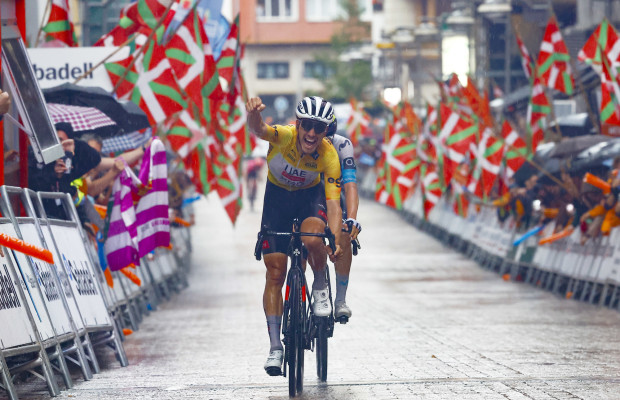
The 2026 Vuelta al País Vasco kicks off with Del Toro, Ayuso, Roglic, and Seixas in an open battle for the txapela
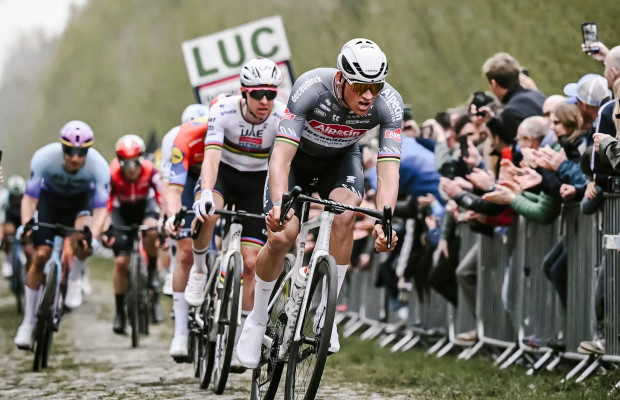
When is the Paris-Roubaix 2026?
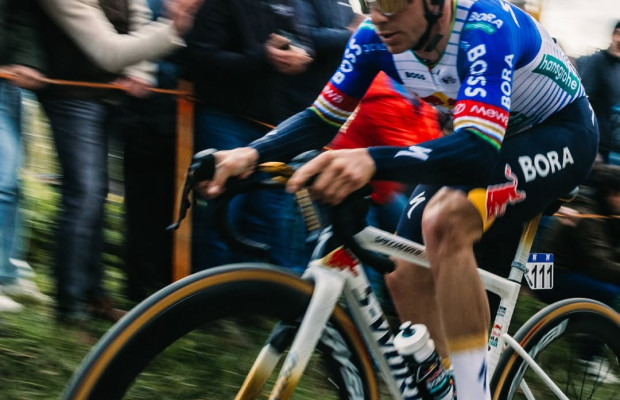
Evenepoel does not close the door on Roubaix
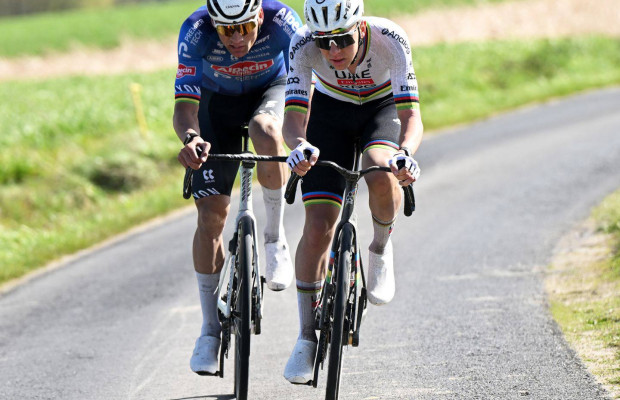
"I was going at 650 watts and I couldn't keep up with him": Van der Poel explains how Pogacar dropped him in Flanders
SCOTT Cala Bandida conquers the Vuelta a Ibiza MTB 2026 with Morcillo and Barroso
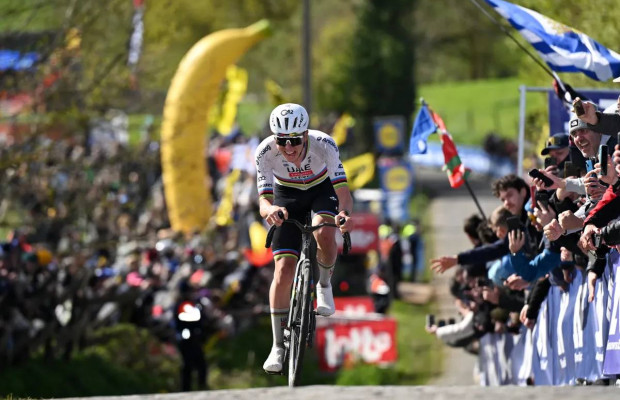
Pogacar dominates the 2026 Tour of Flanders after breaking the race, with Van der Poel and Evenepoel completing the podium
It was not a definitive attack, but it was the one that finished organizing the race. Only Mathieu van der Poel and Remco Evenepoel managed to sustain that level, while Wout van Aert found himself in an intermediate zone that, in this type of effort, is usually the precursor to collapse.
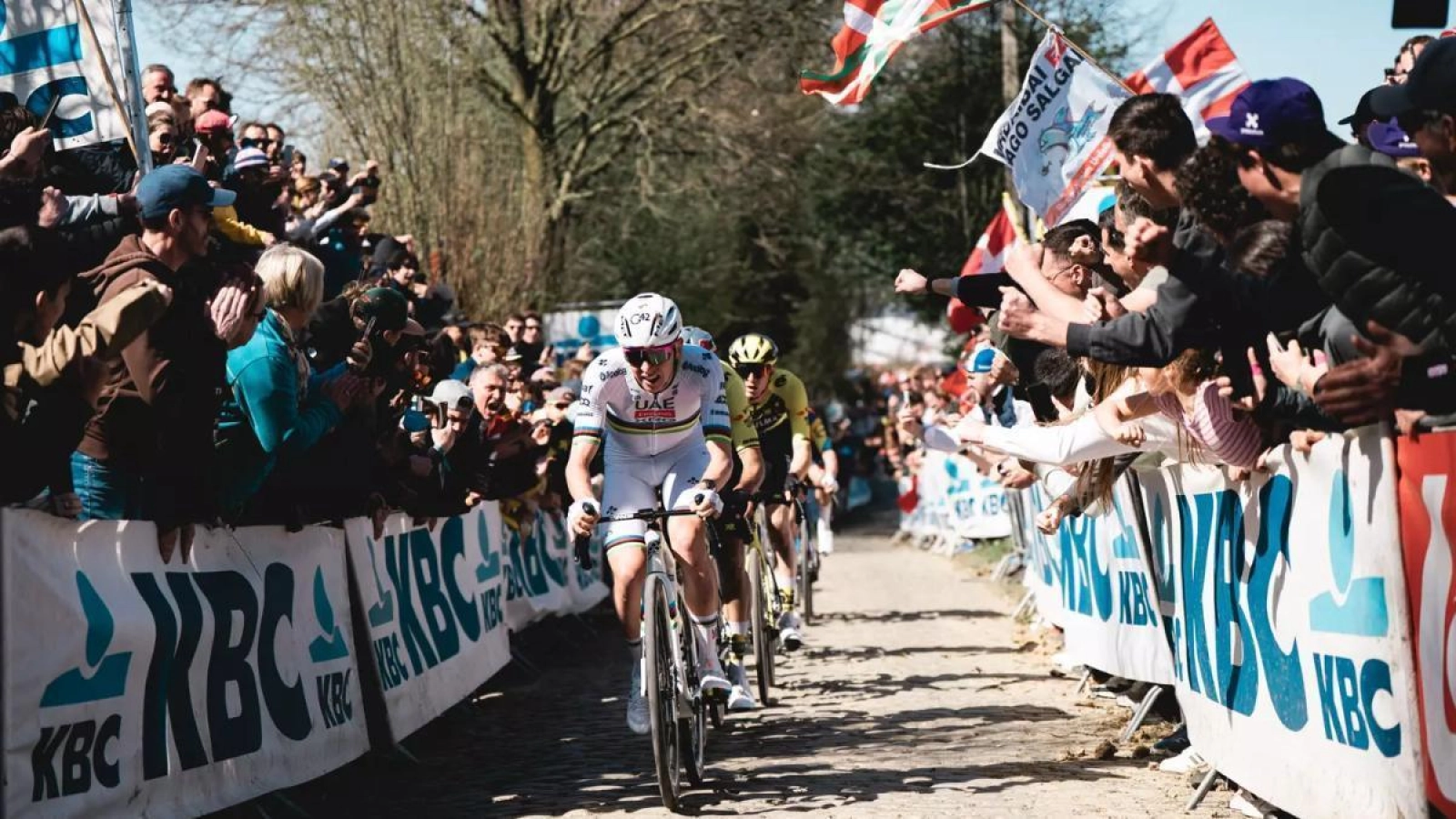
The next critical point came at the Paterberg. A short, explosive effort, where the power shoots above 600 watts and where any excess is paid for immediately. Evenepoel, in an attempt to stay in the race, overcommitted and ended up emptying himself. That decision, more than a lack of strength, marked his race. He lost a few seconds at the top that, with the dynamics of the race, turned into a definitive difference.
There, a decisive tactical change occurred. The collaboration between Pogacar and Van der Poel stabilized the advantage on the flat, neutralizing any chance of a comeback from the Belgian. The race went from being an open chase to a direct duel.
However, even in that scenario, the feeling was not one of real equality. Van der Poel could respond to the changes of pace, but he was doing so increasingly at the limit. Pogacar, on the other hand, continued to accumulate efforts without showing a sharp drop in his performance.
The outcome came at the last passage of the Kwaremont, but not as a sudden explosion, but as the logical consequence of everything that had come before. Pogacar accelerated again, this time with slightly lower figures in absolute terms, but in a context of extreme fatigue. That is where the real difference is understood.
Because it was not about who could make the best minute or the best two minutes, but about who could repeat that level after almost six hours of racing, several maximum attacks, and a long two-man relay. In that terrain, the Slovenian has no rival. At the end of the race, Van der Poel himself explained that there he was at 650 watts and could not follow him.
The advantage opened up without the need for a violent change. First a few meters, then seconds, and finally a difference that left no room for response. Van der Poel progressively ceded, without an exact breaking point, which better reflects the accumulated wear and tear than any data.
The final result confirmed what had already been seen in the race, but the analysis goes beyond the classification. Pogacar did not win by being the most explosive or by choosing the perfect moment. He won because he was able to sustain an intensity unattainable for the rest when the race was already at its most critical point.
También puede interesarte
Road
The 2026 Vuelta al País Vasco kicks off with Del Toro, Ayuso, Roglic, and Seixas in an open battle for the txapela
Road
When is the Paris-Roubaix 2026?
Road
Evenepoel does not close the door on Roubaix
Road
"I was going at 650 watts and I couldn't keep up with him": Van der Poel explains how Pogacar dropped him in Flanders
Mountain bike
SCOTT Cala Bandida conquers the Vuelta a Ibiza MTB 2026 with Morcillo and Barroso
Road